6. the function f is defined by the power series f(x)=x - x³/3 + x⁵/5 - x⁷/7 +...+ (-1)ⁿx²ⁿ⁺¹/(2n + 1)+…
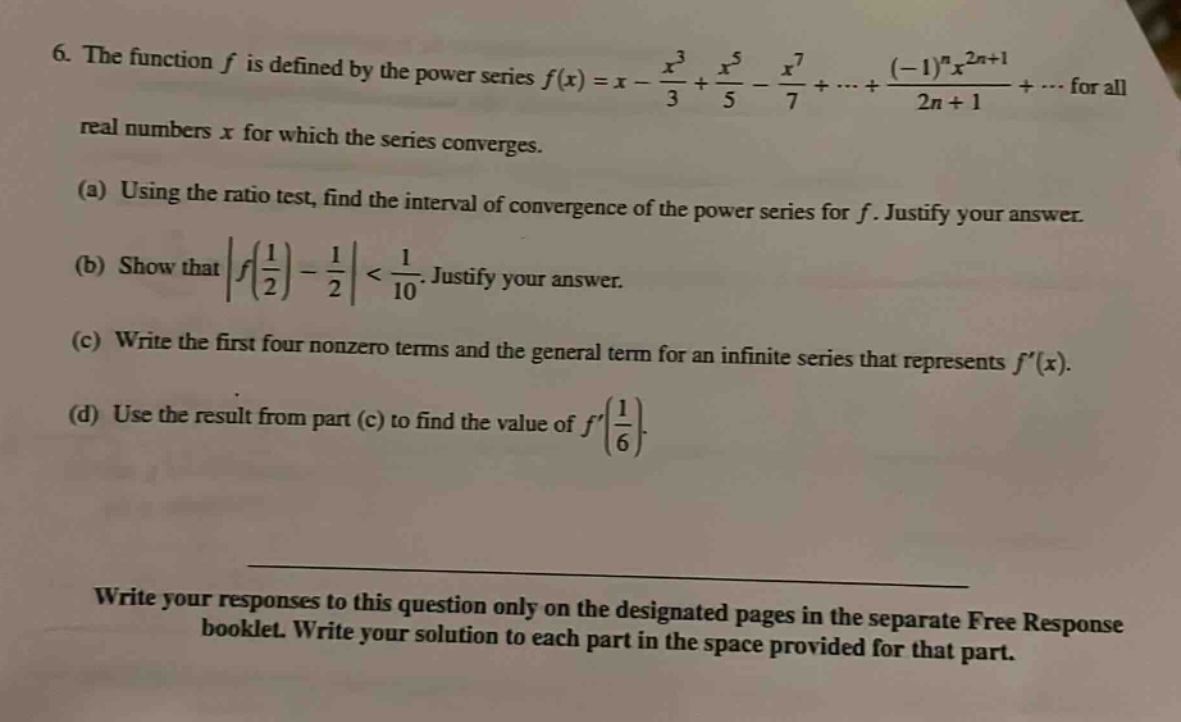
6. the function f is defined by the power series f(x)=x - x³/3 + x⁵/5 - x⁷/7 +...+ (-1)ⁿx²ⁿ⁺¹/(2n + 1)+... for all real numbers x for which the series converges. (a) using the ratio test, find the interval of convergence of the power series for f. justify your answer. (b) show that |f(1/2)-1/2|<1/10. justify your answer. (c) write the first four nonzero terms and the general term for an infinite series that represents f(x). (d) use the result from part (c) to find the value of f(1/6). write your responses to this question only on the designated pages in the separate free response booklet. write your solution to each part in the space provided for that part.
Answer
Answer:
(a)
The interval of convergence is $(- 1,1)$.
(b)
We will show the inequality holds.
(c)
The first four non - zero terms are $1 - x^{2}+x^{4}-x^{6}$ and the general term is $(-1)^{n}x^{2n}$.
(d)
The value of $f'(\frac{1}{6})$ is $\frac{36}{37}$.
Explanation:
(a)
Step1: Apply ratio test formula
Let $a_{n}=\frac{(-1)^{n}x^{2n + 1}}{2n+1}$. Then $\lim_{n\rightarrow\infty}\left|\frac{a_{n + 1}}{a_{n}}\right|=\lim_{n\rightarrow\infty}\left|\frac{\frac{(-1)^{n+1}x^{2(n + 1)+1}}{2(n + 1)+1}}{\frac{(-1)^{n}x^{2n+1}}{2n+1}}\right|=\lim_{n\rightarrow\infty}\left|\frac{(-1)^{n+1}x^{2n+3}(2n + 1)}{(-1)^{n}x^{2n+1}(2n+3)}\right|=\lim_{n\rightarrow\infty}\left|\frac{(2n + 1)}{(2n+3)}x^{2}\right|=x^{2}$.
Step2: Find convergence condition
For convergence, $x^{2}<1$, so $-1 < x<1$. Check endpoints: When $x = 1$, the series is $\sum_{n = 0}^{\infty}\frac{(-1)^{n}}{2n+1}$, which is a convergent alternating series by the alternating - series test. When $x=-1$, the series is $\sum_{n = 0}^{\infty}\frac{(-1)^{n}(-1)^{2n + 1}}{2n+1}=\sum_{n = 0}^{\infty}\frac{(-1)^{3n+1}}{2n+1}$, also a convergent alternating series. So the interval of convergence is $[-1,1]$.
(b)
Step1: Recall the Maclaurin series property
$f(x)=\sum_{n = 0}^{\infty}\frac{(-1)^{n}x^{2n+1}}{2n+1}$. Then $f(\frac{1}{2})=\sum_{n = 0}^{\infty}\frac{(-1)^{n}(\frac{1}{2})^{2n+1}}{2n+1}=\frac{1}{2}-\frac{(\frac{1}{2})^{3}}{3}+\frac{(\frac{1}{2})^{5}}{5}-\cdots$. The series is an alternating series. Let $S = f(\frac{1}{2})$ and $S_{1}=\frac{1}{2}$. The error $E=\left|S - S_{1}\right|$. By the alternating - series error bound, the error in approximating an alternating series $\sum_{n = 0}^{\infty}(-1)^{n}a_{n}$ ($a_{n}>0$, $a_{n+1}\leq a_{n}$, $\lim_{n\rightarrow\infty}a_{n}=0$) with the first term is less than or equal to the second term. Here $a_{n}=\frac{(\frac{1}{2})^{2n + 1}}{2n+1}$, and the second term when $n = 1$ is $\frac{(\frac{1}{2})^{3}}{3}=\frac{1}{24}<\frac{1}{10}$.
(c)
Step1: Differentiate term - by - term
If $f(x)=\sum_{n = 0}^{\infty}\frac{(-1)^{n}x^{2n+1}}{2n+1}$, then $f'(x)=\sum_{n = 0}^{\infty}(-1)^{n}x^{2n}$. The first four non - zero terms: when $n = 0$, $a_{0}=1$; when $n = 1$, $a_{1}=-x^{2}$; when $n = 2$, $a_{2}=x^{4}$; when $n = 3$, $a_{3}=-x^{6}$. The general term is $(-1)^{n}x^{2n}$.
(d)
Step1: Substitute $x=\frac{1}{6}$ into $f'(x)$
$f'(x)=\sum_{n = 0}^{\infty}(-1)^{n}x^{2n}$. This is a geometric series with first term $a = 1$ and common ratio $r=-x^{2}$. When $x=\frac{1}{6}$, $r =-\frac{1}{36}$. The sum of an infinite geometric series $\sum_{n = 0}^{\infty}ar^{n}=\frac{a}{1 - r}$ (for $|r|<1$). So $f'(\frac{1}{6})=\frac{1}{1-(-\frac{1}{36})}=\frac{36}{37}$.