6. the function f has derivatives of all orders for all real numbers. it is known that f(0) = 2, f(0) = 3…
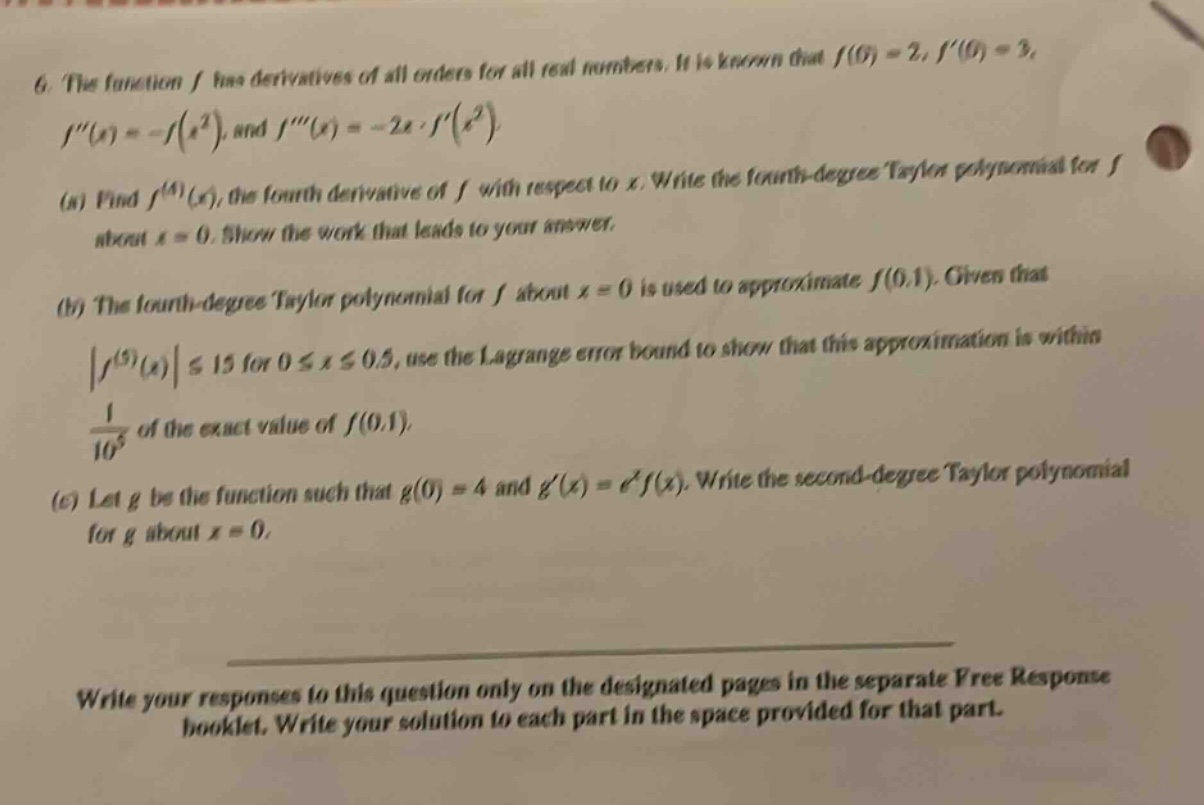
6. the function f has derivatives of all orders for all real numbers. it is known that f(0) = 2, f(0) = 3, f(x)=-f(x²), and f(x)=-2x·f(x²). (a) find f^(4)(x), the fourth - derivative of f with respect to x. write the fourth - degree taylor polynomial for f about x = 0. show the work that leads to your answer. (b) the fourth - degree taylor polynomial for f about x = 0 is used to approximate f(0.1). given that |f^(5)(x)|≤15 for 0≤x≤0.5, use the lagrange error bound to show that this approximation is within 1/10^5 of the exact value of f(0.1). (c) let g be the function such that g(0) = 4 and g(x)=e^xf(x). write the second - degree taylor polynomial for g about x = 0. write your responses to this question only on the designated pages in the separate free response booklet. write your solution to each part in the space provided for that part.
Answer
Answer:
(a)
The fourth - degree Taylor polynomial (P_4(x)) of (y = f(x)) about (x = 0) is given by (P_4(x)=\sum_{n = 0}^{4}\frac{f^{(n)}(0)}{n!}x^{n}=f(0)+f^{\prime}(0)x+\frac{f^{\prime\prime}(0)}{2!}x^{2}+\frac{f^{(3)}(0)}{3!}x^{3}+\frac{f^{(4)}(0)}{4!}x^{4}). First, find (f^{\prime\prime}(0)): Since (f^{\prime\prime}(x)=-f(x^{2})), then (f^{\prime\prime}(0)=-f(0)=- 2). Next, find (f^{(3)}(0)): Since (f^{(3)}(x)=-2x\cdot f^{\prime}(x^{2})), then (f^{(3)}(0)=-2\times0\times f^{\prime}(0) = 0). Then, find (f^{(4)}(x)) by differentiating (f^{(3)}(x)=-2x\cdot f^{\prime}(x^{2})) using the product - rule ((uv)^\prime = u^\prime v+uv^\prime) where (u=-2x) and (v = f^{\prime}(x^{2})). (u^\prime=-2) and (v^\prime = 2x\cdot f^{\prime\prime}(x^{2})). So (f^{(4)}(x)=-2f^{\prime}(x^{2})-2x\cdot(2x\cdot f^{\prime\prime}(x^{2}))). (f^{(4)}(0)=-2f^{\prime}(0)=-6). The fourth - degree Taylor polynomial (P_4(x)=2 + 3x-\frac{2}{2}x^{2}+0\cdot x^{3}-\frac{6}{24}x^{4}=2 + 3x - x^{2}-\frac{1}{4}x^{4}).
(b)
The Lagrange error bound for the (n)th - degree Taylor polynomial (P_n(x)) of a function (y = f(x)) is given by (|R_n(x)|\leq\frac{M}{(n + 1)!}|x - a|^{n+1}), where (M) is an upper - bound for (|f^{(n + 1)}(t)|) on the interval between (a) and (x). Here, (n = 4), (a = 0), (x=0.1), and (M = 15) (since (|f^{(5)}(x)|\leq15) for (0\leq x\leq0.5)). (|R_4(0.1)|\leq\frac{15}{(4 + 1)!}|0.1-0|^{5}=\frac{15}{120}\times(0.1)^{5}=\frac{15}{120\times10^{5}}=\frac{1}{8\times10^{5}}<\frac{1}{10^{5}}).
(c)
The second - degree Taylor polynomial (P_2(x)) of (y = g(x)) about (x = 0) is given by (P_2(x)=\sum_{n = 0}^{2}\frac{g^{(n)}(0)}{n!}x^{n}=g(0)+g^{\prime}(0)x+\frac{g^{\prime\prime}(0)}{2!}x^{2}). We know that (g(0)=4). Since (g^{\prime}(x)=e^{x}f(x)), then (g^{\prime}(0)=e^{0}f(0)=1\times2 = 2). Differentiate (g^{\prime}(x)=e^{x}f(x)) using the product - rule ((uv)^\prime=u^\prime v + uv^\prime) where (u = e^{x}) and (v = f(x)). (u^\prime=e^{x}) and (v^\prime=f^{\prime}(x)), so (g^{\prime\prime}(x)=e^{x}f(x)+e^{x}f^{\prime}(x)). (g^{\prime\prime}(0)=e^{0}f(0)+e^{0}f^{\prime}(0)=2 + 3=5). The second - degree Taylor polynomial (P_2(x)=4+2x+\frac{5}{2}x^{2}).
Explanation:
Step1: Find (f^{\prime\prime}(0))
Substitute (x = 0) into (f^{\prime\prime}(x)=-f(x^{2})). (f^{\prime\prime}(0)=-f(0)=-2)
Step2: Find (f^{(3)}(0))
Substitute (x = 0) into (f^{(3)}(x)=-2x\cdot f^{\prime}(x^{2})). (f^{(3)}(0)=0)
Step3: Find (f^{(4)}(x))
Use product - rule on (f^{(3)}(x)=-2x\cdot f^{\prime}(x^{2})). (f^{(4)}(x)=-2f^{\prime}(x^{2})-4x^{2}f^{\prime\prime}(x^{2}))
Step4: Find (f^{(4)}(0))
Substitute (x = 0) into (f^{(4)}(x)). (f^{(4)}(0)=-2f^{\prime}(0)=-6)
Step5: Write (P_4(x))
Use Taylor polynomial formula. (P_4(x)=2 + 3x - x^{2}-\frac{1}{4}x^{4})
Step6: Apply Lagrange error bound
Use (|R_n(x)|\leq\frac{M}{(n + 1)!}|x - a|^{n+1}). (|R_4(0.1)|\leq\frac{15}{5!}(0.1)^{5})
Step7: Find (g^{\prime}(0))
Substitute (x = 0) into (g^{\prime}(x)=e^{x}f(x)). (g^{\prime}(0)=2)
Step8: Find (g^{\prime\prime}(x))
Use product - rule on (g^{\prime}(x)=e^{x}f(x)). (g^{\prime\prime}(x)=e^{x}f(x)+e^{x}f^{\prime}(x))
Step9: Find (g^{\prime\prime}(0))
Substitute (x = 0) into (g^{\prime\prime}(x)). (g^{\prime\prime}(0)=5)
Step10: Write (P_2(x))
Use Taylor polynomial formula. (P_2(x)=4 + 2x+\frac{5}{2}x^{2})