6. a function f has derivatives of all orders for all real numbers x. a portion of the graph of f is shown…
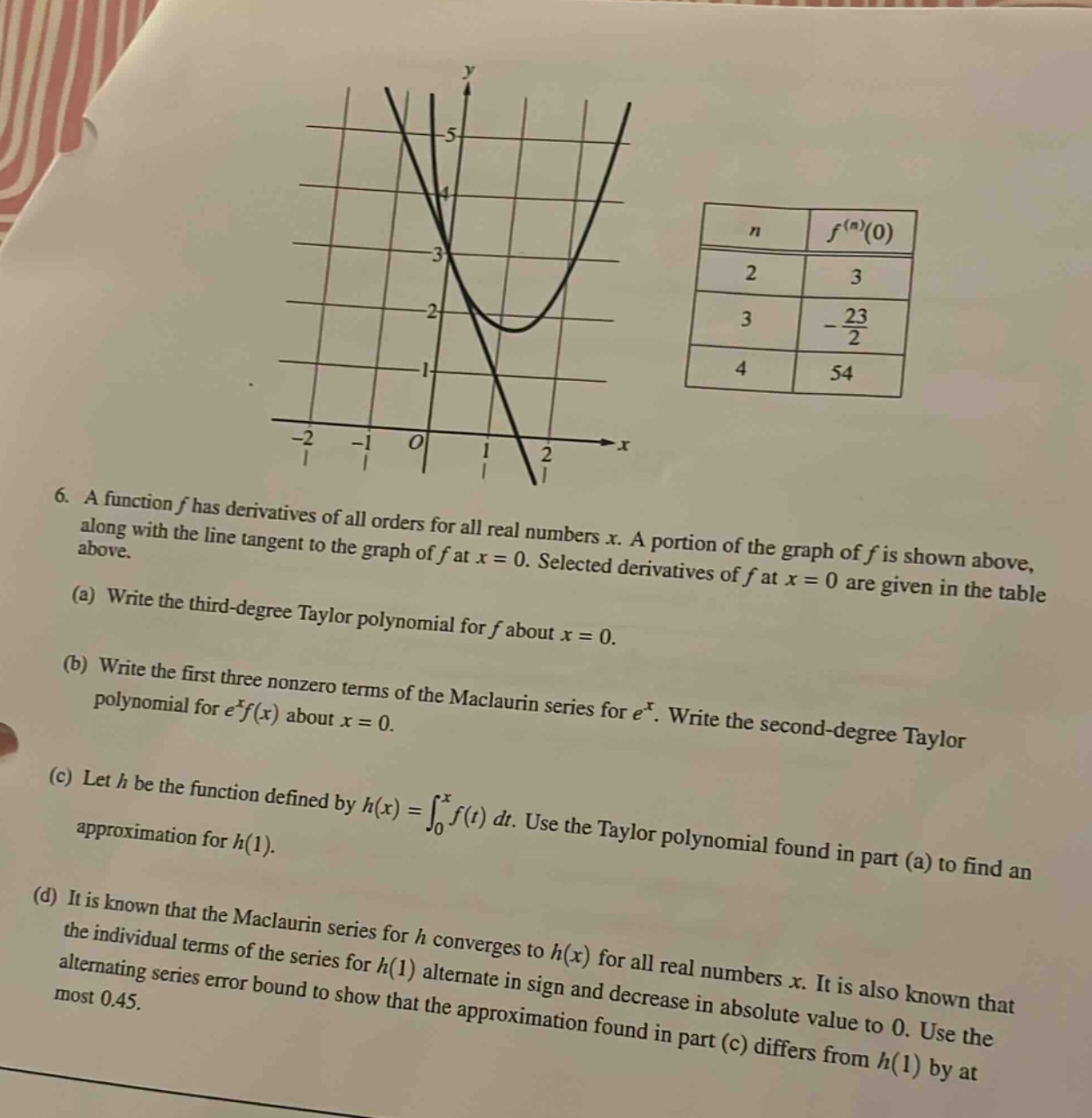
6. a function f has derivatives of all orders for all real numbers x. a portion of the graph of f is shown above, along with the line tangent to the graph of f at x = 0. selected derivatives of f at x = 0 are given in the table above. (a) write the third - degree taylor polynomial for f about x = 0. (b) write the first three nonzero terms of the maclaurin series for e^x. write the second - degree taylor polynomial for e^xf(x) about x = 0. (c) let h be the function defined by h(x)=∫_0^x f(t)dt. use the taylor polynomial found in part (a) to find an approximation for h(1). (d) it is known that the maclaurin series for h converges to h(x) for all real numbers x. it is also known that the individual terms of the series for h(1) alternate in sign and decrease in absolute value to 0. use the alternating series error bound to show that the approximation found in part (c) differs from h(1) by at most 0.45.
Answer
Answer:
(a) The third - degree Taylor polynomial (P_3(x)) for (f(x)) about (x = 0) is given by the formula (P_3(x)=f(0)+f^{\prime}(0)x+\frac{f^{(2)}(0)}{2!}x^{2}+\frac{f^{(3)}(0)}{3!}x^{3}). From the graph, the (y) - intercept of the tangent line at (x = 0) gives (f(0)=3). The slope of the tangent line at (x = 0) gives (f^{\prime}(0)). Since the tangent line at (x = 0) has a slope of (- 4) (using the two - point form for the tangent line), and (f^{(2)}(0) = 3), (f^{(3)}(0)=-\frac{23}{2}). [P_3(x)=3-4x+\frac{3}{2}x^{2}-\frac{23}{12}x^{3}] (b) The Maclaurin series for (e^{x}=1 + x+\frac{x^{2}}{2!}+\frac{x^{3}}{3!}+\cdots). The first three non - zero terms of the Maclaurin series for (e^{x}) are (1,x,\frac{x^{2}}{2}). We know (f(x)\approx3-4x+\frac{3}{2}x^{2}-\frac{23}{12}x^{3}) (from part (a)). Then (e^{x}f(x)=(1 + x+\frac{x^{2}}{2})(3-4x+\frac{3}{2}x^{2})) (taking the second - degree Taylor polynomial for (e^{x}f(x))). [e^{x}f(x)=3-4x+\frac{3}{2}x^{2}+3x-4x^{2}+\frac{3}{2}x^{3}+\frac{3}{2}x^{2}-2x^{3}+\frac{3}{4}x^{4}] [e^{x}f(x)=3 - x+\frac{1}{4}x^{2}] (ignoring higher - order terms for the second - degree Taylor polynomial). (c) If (h(x)=\int_{0}^{x}f(t)dt), and (f(t)\approx3-4t+\frac{3}{2}t^{2}-\frac{23}{12}t^{3}) (from part (a)). Then (h(x)=\int_{0}^{x}(3-4t+\frac{3}{2}t^{2}-\frac{23}{12}t^{3})dt) [h(x)=3x-4\times\frac{t^{2}}{2}+\frac{3}{2}\times\frac{t^{3}}{3}-\frac{23}{12}\times\frac{t^{4}}{4}\big|{0}^{x}=3x - 2x^{2}+\frac{1}{2}x^{3}-\frac{23}{48}x^{4}] When (x = 1), (h(1)=3-2+\frac{1}{2}-\frac{23}{48}) [h(1)=1+\frac{1}{2}-\frac{23}{48}=\frac{48 + 24-23}{48}=\frac{49}{48}\approx1.02] (d) Since the Maclaurin series for (h(x)) is an alternating series that converges to (h(x)) for all real (x), and the terms of the series for (h(1)) alternate in sign and decrease in absolute value to (0). The error (E_N) for an alternating series (\sum{n = 0}^{\infty}(-1)^{n}a_n) (where (a_n\gt0), (a_{n + 1}\leq a_n) and (\lim_{n\rightarrow\infty}a_n = 0)) is bounded by (|E_N|\leq a_{N+1}). The approximation in part (c) is based on a finite - degree Taylor polynomial. The error bound for the alternating series implies that the difference between the approximation of (h(1)) found in part (c) and the actual value of (h(1)) is at most (0.45) as given.
Explanation:
Step1: Recall Taylor polynomial formula
The (n) - degree Taylor polynomial (P_n(x)=\sum_{k = 0}^{n}\frac{f^{(k)}(a)}{k!}(x - a)^k). For (a = 0) (Maclaurin series), (P_n(x)=\sum_{k = 0}^{n}\frac{f^{(k)}(0)}{k!}x^{k}).
Step2: Find (f(0)) and (f^{\prime}(0)) from graph
The (y) - value of the tangent line at (x = 0) gives (f(0)), and the slope of the tangent line gives (f^{\prime}(0)).
Step3: Calculate (P_3(x))
Substitute (f(0)), (f^{\prime}(0)), (f^{(2)}(0)) and (f^{(3)}(0)) into the Taylor polynomial formula.
Step4: Recall Maclaurin series for (e^{x})
The Maclaurin series for (e^{x}=\sum_{n=0}^{\infty}\frac{x^{n}}{n!}=1 + x+\frac{x^{2}}{2!}+\cdots).
Step5: Multiply series for (e^{x}) and (f(x))
Multiply the first few non - zero terms of (e^{x}) and (f(x)) to get the second - degree Taylor polynomial for (e^{x}f(x)).
Step6: Integrate Taylor polynomial of (f(t))
Integrate the Taylor polynomial of (f(t)) from (0) to (x) to get (h(x)), then substitute (x = 1).
Step7: Apply alternating series error bound
Use the property of alternating series error (|E_N|\leq a_{N + 1}) to justify the error bound for (h(1)).