question 3(multiple choice worth 1 points) (rates of change in polar functions lc) the numerical value of…
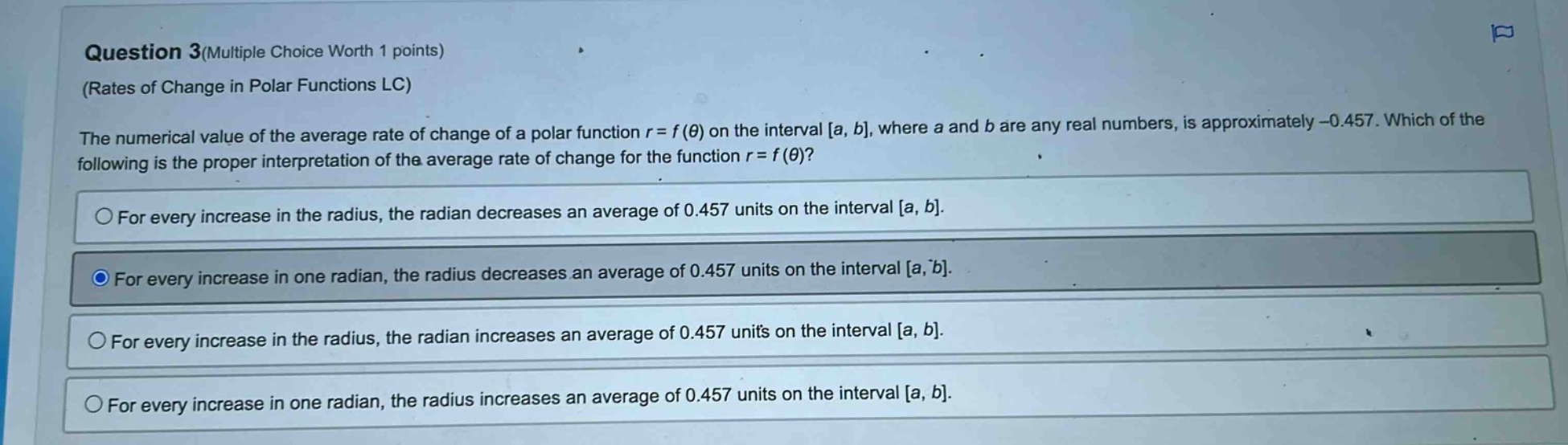
question 3(multiple choice worth 1 points) (rates of change in polar functions lc) the numerical value of the average rate of change of a polar function r = f(θ) on the interval a, b, where a and b are any real numbers, is approximately -0.457. which of the following is the proper interpretation of the average rate of change for the function r = f(θ)? for every increase in the radius, the radian decreases an average of 0.457 units on the interval a, b. for every increase in one radian, the radius decreases an average of 0.457 units on the interval a, b. for every increase in the radius, the radian increases an average of 0.457 units on the interval a, b. for every increase in one radian, the radius increases an average of 0.457 units on the interval a, b.
Answer
Brief Explanations:
In a polar - function $r = f(\theta)$, the average rate of change is $\frac{\Delta r}{\Delta\theta}$. A negative average rate of change of approximately - 0.457 means that as $\theta$ (in radians) increases, $r$ (the radius) decreases. Specifically, for every unit increase in $\theta$ (one radian), $r$ decreases on average by 0.457 units.
Answer:
For every increase in one radian, the radius decreases an average of 0.457 units on the interval [a, b].