question 1(multiple choice worth 1 points) (rates of change in polar functions lc) the table gives selected…
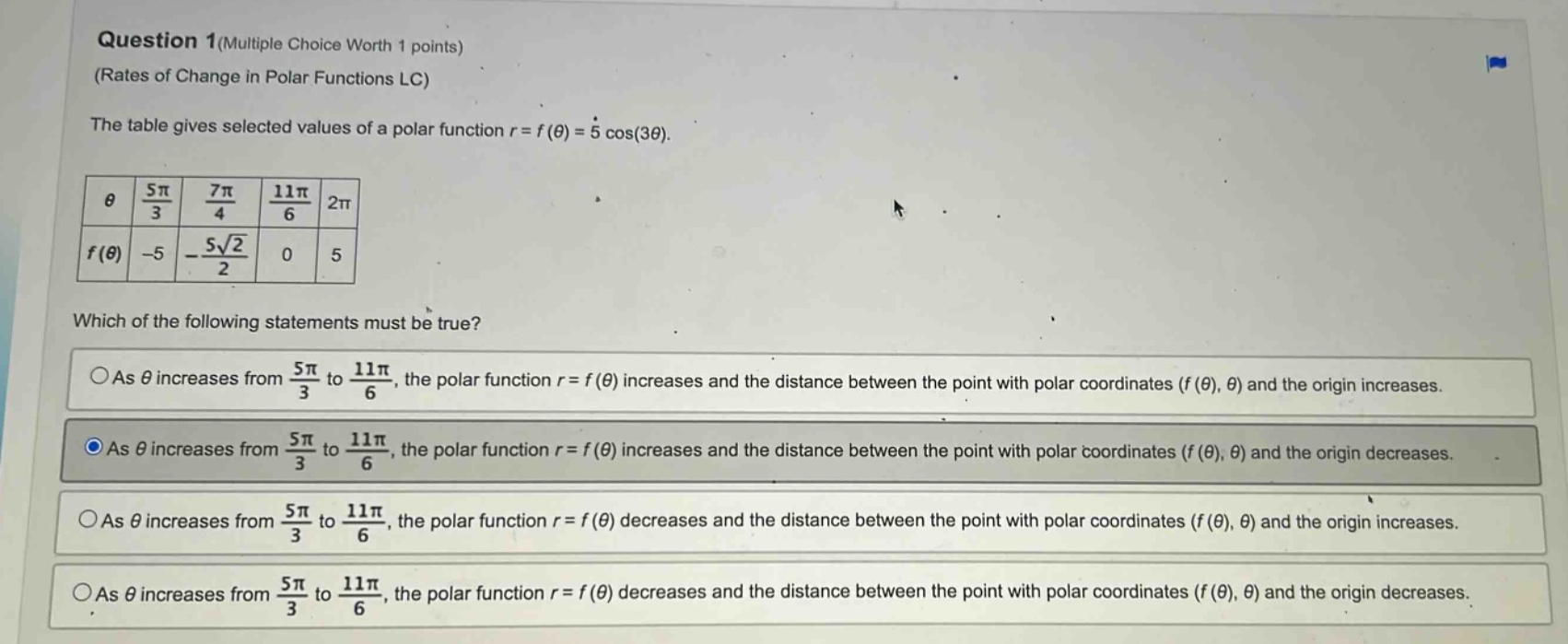
question 1(multiple choice worth 1 points) (rates of change in polar functions lc) the table gives selected values of a polar function r = f(θ)=5 cos(3θ). θ 5π/3 7π/4 11π/6 2π f(θ) -5 -5√2/2 0 5 which of the following statements must be true? as θ increases from 5π/3 to 11π/6, the polar function r = f(θ) increases and the distance between the point with polar coordinates (f(θ), θ) and the origin increases. as θ increases from 5π/3 to 11π/6, the polar function r = f(θ) increases and the distance between the point with polar coordinates (f(θ), θ) and the origin decreases. as θ increases from 5π/3 to 11π/6, the polar function r = f(θ) decreases and the distance between the point with polar coordinates (f(θ), θ) and the origin increases. as θ increases from 5π/3 to 11π/6, the polar function r = f(θ) decreases and the distance between the point with polar coordinates (f(θ), θ) and the origin decreases.
Answer
Explanation:
Step1: Identify function values at given $\theta$ values
When $\theta=\frac{5\pi}{3}$, $f(\frac{5\pi}{3})=- 5$. When $\theta = \frac{11\pi}{6}$, $f(\frac{11\pi}{6}) = 0$.
Step2: Analyze change of function value
Since $-5<0$, as $\theta$ increases from $\frac{5\pi}{3}$ to $\frac{11\pi}{6}$, the value of $r = f(\theta)$ increases.
Step3: Analyze distance from origin
The distance between the point with polar - coordinates $(r,\theta)$ and the origin is given by $|r|$. $|f(\frac{5\pi}{3})| = 5$ and $|f(\frac{11\pi}{6})|=0$. So as $\theta$ increases from $\frac{5\pi}{3}$ to $\frac{11\pi}{6}$, the distance between the point $(f(\theta),\theta)$ and the origin decreases.
Answer:
As $\theta$ increases from $\frac{5\pi}{3}$ to $\frac{11\pi}{6}$, the polar function $r = f(\theta)$ increases and the distance between the point with polar coordinates $(f(\theta),\theta)$ and the origin decreases.