question 8(multiple choice worth 1 points) (rates of change in polar functions mc) if the graph of the polar…
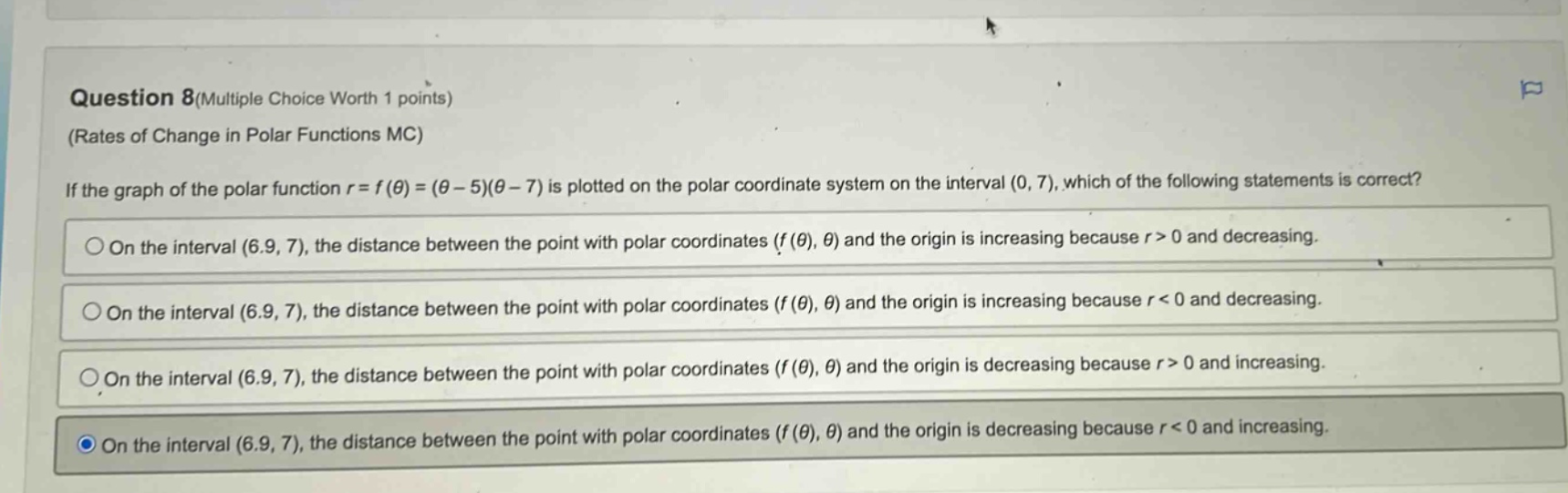
question 8(multiple choice worth 1 points) (rates of change in polar functions mc) if the graph of the polar function r = f(θ)=(θ - 5)(θ - 7) is plotted on the polar coordinate system on the interval (0, 7), which of the following statements is correct? on the interval (6.9, 7), the distance between the point with polar coordinates (f(θ), θ) and the origin is increasing because r > 0 and decreasing. on the interval (6.9, 7), the distance between the point with polar coordinates (f(θ), θ) and the origin is increasing because r < 0 and decreasing. on the interval (6.9, 7), the distance between the point with polar coordinates (f(θ), θ) and the origin is decreasing because r > 0 and increasing. on the interval (6.9, 7), the distance between the point with polar coordinates (f(θ), θ) and the origin is decreasing because r < 0 and increasing.
Answer
Explanation:
Step1: Analyze the polar - function
Given (r = f(\theta)=(\theta - 5)(\theta - 7)=\theta^{2}-12\theta + 35).
Step2: Determine the sign of (r) on the interval ((6.9,7))
Let's substitute a value from the interval ((6.9,7)) into (r = f(\theta)). For example, if (\theta=6.95), then (r=(6.95 - 5)(6.95 - 7)=(1.95)\times(-0.05)<0).
Step3: Understand the relationship between (r) and distance in polar coordinates
In polar coordinates, the distance between the point ((r,\theta)) and the origin is (|r|). When (r<0) and (|r|) is increasing (i.e., (r) is getting more negative), the distance between the point ((r,\theta)) and the origin is decreasing.
Answer:
On the interval ((6.9,7)), the distance between the point with polar coordinates ((f(\theta),\theta)) and the origin is decreasing because (r < 0) and increasing.