question 4(multiple choice worth 1 points) (rates of change in polar functions mc) consider the polar…
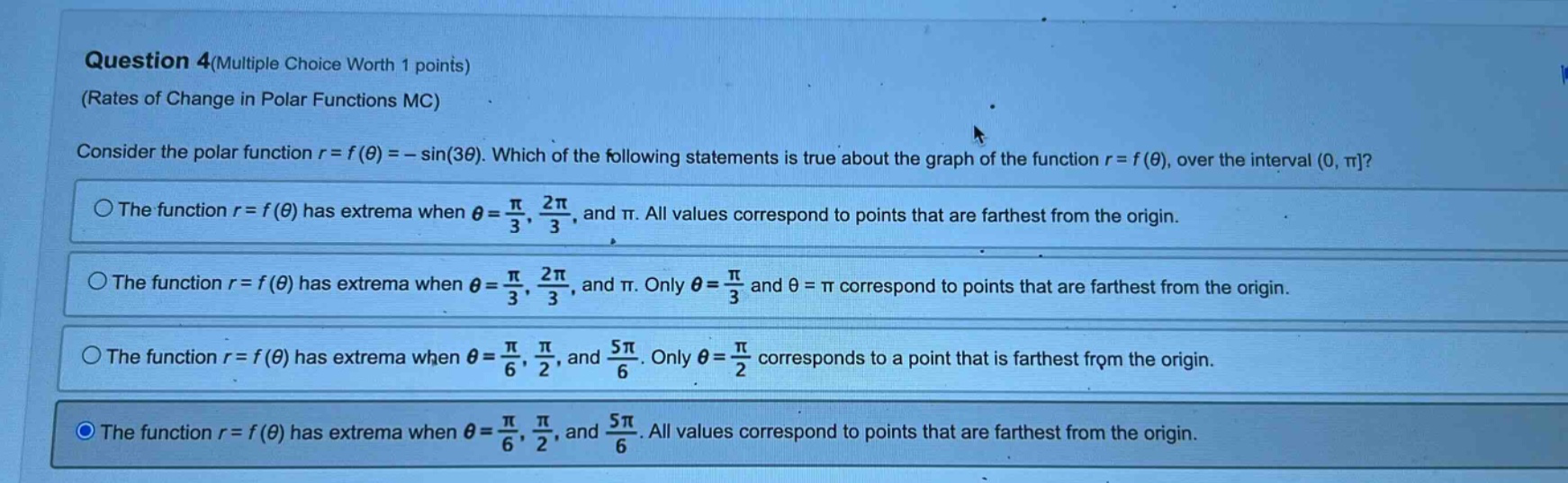
question 4(multiple choice worth 1 points) (rates of change in polar functions mc) consider the polar function r = f(θ)= - sin(3θ). which of the following statements is true about the graph of the function r = f(θ), over the interval (0, π? the function r = f(θ) has extrema when θ = π/3, 2π/3, and π. all values correspond to points that are farthest from the origin. the function r = f(θ) has extrema when θ = π/3, 2π/3, and π. only θ = π/3 and θ = π correspond to points that are farthest from the origin. the function r = f(θ) has extrema when θ = π/6, π/2, and 5π/6. only θ = π/2 corresponds to a point that is farthest from the origin. the function r = f(θ) has extrema when θ = π/6, π/2, and 5π/6. all values correspond to points that are farthest from the origin.
Answer
Explanation:
Step1: Recall derivative for polar - function extrema
For a polar function $r = f(\theta)$, we find its derivative $\frac{dr}{d\theta}$ and set it equal to 0 to find the extrema. Given $r=-\sin(3\theta)$, by the chain - rule, $\frac{dr}{d\theta}=-3\cos(3\theta)$.
Step2: Solve for $\theta$ when $\frac{dr}{d\theta}=0$
Set $-3\cos(3\theta) = 0$. Then $\cos(3\theta)=0$. We know that $\cos x = 0$ when $x=(2n + 1)\frac{\pi}{2},n\in\mathbb{Z}$. So $3\theta=(2n + 1)\frac{\pi}{2}$, and $\theta=(2n + 1)\frac{\pi}{6}$.
Step3: Find $\theta$ values in the interval $(0,\pi]$
When $n = 0$, $\theta=\frac{\pi}{6}$; when $n = 1$, $\theta=\frac{\pi}{2}$; when $n = 2$, $\theta=\frac{5\pi}{6}$.
Step4: Analyze the distance from the origin
The distance from the origin in polar coordinates is given by $|r|$. For $r =-\sin(3\theta)$, when $\theta=\frac{\pi}{6}$, $r=-\sin(\frac{\pi}{2})=-1$; when $\theta=\frac{\pi}{2}$, $r=-\sin(\frac{3\pi}{2}) = 1$; when $\theta=\frac{5\pi}{6}$, $r=-\sin(\frac{5\pi}{2})=-1$. The absolute - value of $r$ at these points is 1, which represents the maximum distance from the origin for this function in the given interval.
Answer:
The function $r = f(\theta)$ has extrema when $\theta=\frac{\pi}{6},\frac{\pi}{2}$, and $\frac{5\pi}{6}$. All values correspond to points that are farthest from the origin.