question during the time interval 0 ≤ t ≤ 11, the total number of wolves in a forest can be modeled by the…
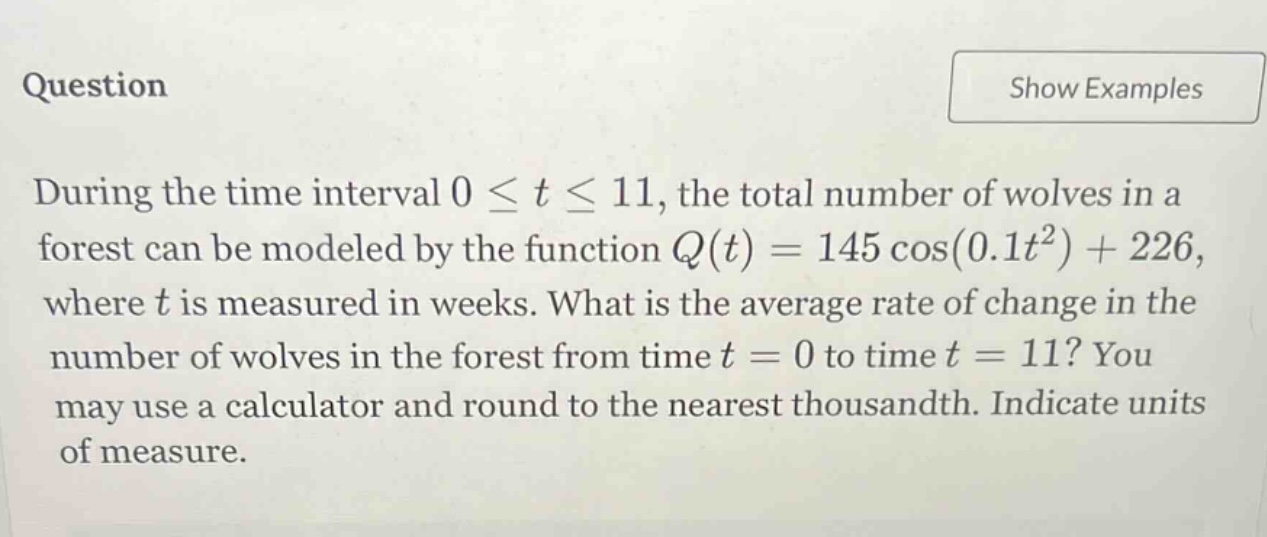
question during the time interval 0 ≤ t ≤ 11, the total number of wolves in a forest can be modeled by the function q(t)=145 cos(0.1t²)+226, where t is measured in weeks. what is the average rate of change in the number of wolves in the forest from time t = 0 to time t = 11? you may use a calculator and round to the nearest thousandth. indicate units of measure.
Answer
Explanation:
Step1: Recall average - rate - of - change formula
The average rate of change of a function $y = f(x)$ from $x=a$ to $x = b$ is $\frac{f(b)-f(a)}{b - a}$. Here, $Q(t)=145\cos(0.1t^{2})+226$, $a = 0$, and $b = 11$.
Step2: Calculate $Q(11)$
$Q(11)=145\cos(0.1\times11^{2})+226=145\cos(12.1)+226$. Using a calculator, $\cos(12.1)\approx - 0.367$, so $Q(11)=145\times(-0.367)+226=-53.115 + 226=172.885$.
Step3: Calculate $Q(0)$
$Q(0)=145\cos(0.1\times0^{2})+226=145\cos(0)+226$. Since $\cos(0)=1$, $Q(0)=145\times1 + 226=371$.
Step4: Calculate the average rate of change
The average rate of change is $\frac{Q(11)-Q(0)}{11 - 0}=\frac{172.885 - 371}{11}=\frac{-198.115}{11}\approx - 18.010$.
Answer:
The average rate of change is approximately $-18.010$ wolves per week.