select the correct answer. scientists in a test lab are testing the hardness of a surface before…
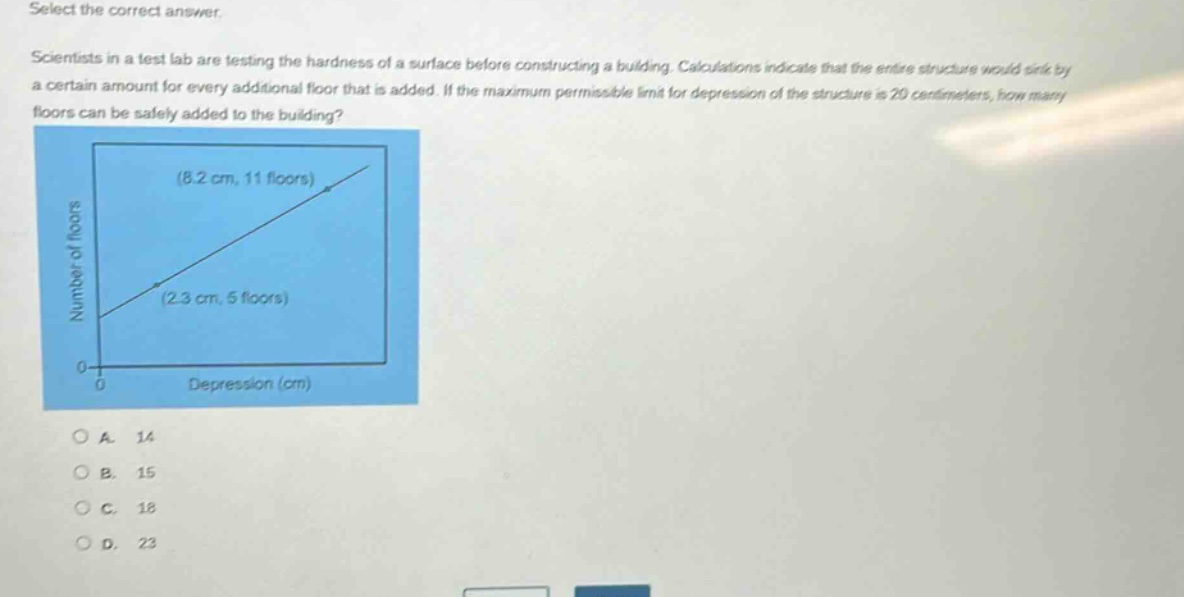
select the correct answer. scientists in a test lab are testing the hardness of a surface before constructing a building. calculations indicate that the entire structure would sink by a certain amount for every additional floor that is added. if the maximum permissible limit for depression of the structure is 20 centimeters, how many floors can be safely added to the building? (8.2 cm, 11 floors) (2.3 cm, 5 floors) number of floors 0 depression (cm) o a. 14 o b. 15 o c. 18 o d. 23
Answer
Explanation:
Step1: Find the rate of depression per floor
We have two points ((2.3,5)) and ((8.2,11)). The rate of change (slope (m)) of the linear - relationship between the number of floors (y) and the depression (x) is given by the formula (m=\frac{y_2 - y_1}{x_2 - x_1}). [m=\frac{11 - 5}{8.2 - 2.3}=\frac{6}{5.9}\approx1.017]
Step2: Set up an equation to find the number of floors
Let (y) be the number of floors and (x) be the depression. The equation of the line in slope - intercept form is (y=mx + b). Using the point ((2.3,5)) and (m\approx1.017), we first find (b): [5 = 1.017\times2.3+b] [b=5 - 1.017\times2.3=5 - 2.3391 = 2.6609] The equation is (y = 1.017x+2.6609). We know that (x = 20) (maximum depression). Substitute (x = 20) into the equation: [y=1.017\times20 + 2.6609=20.34+2.6609=23.0009] Since we can't have a fraction of a floor, we take the integer part of (y). So the number of floors is (23).
Answer:
D. 23