#____ - suppose that the function f(x) is approximated near x = 2 by a third - degree taylor polynomial 3…
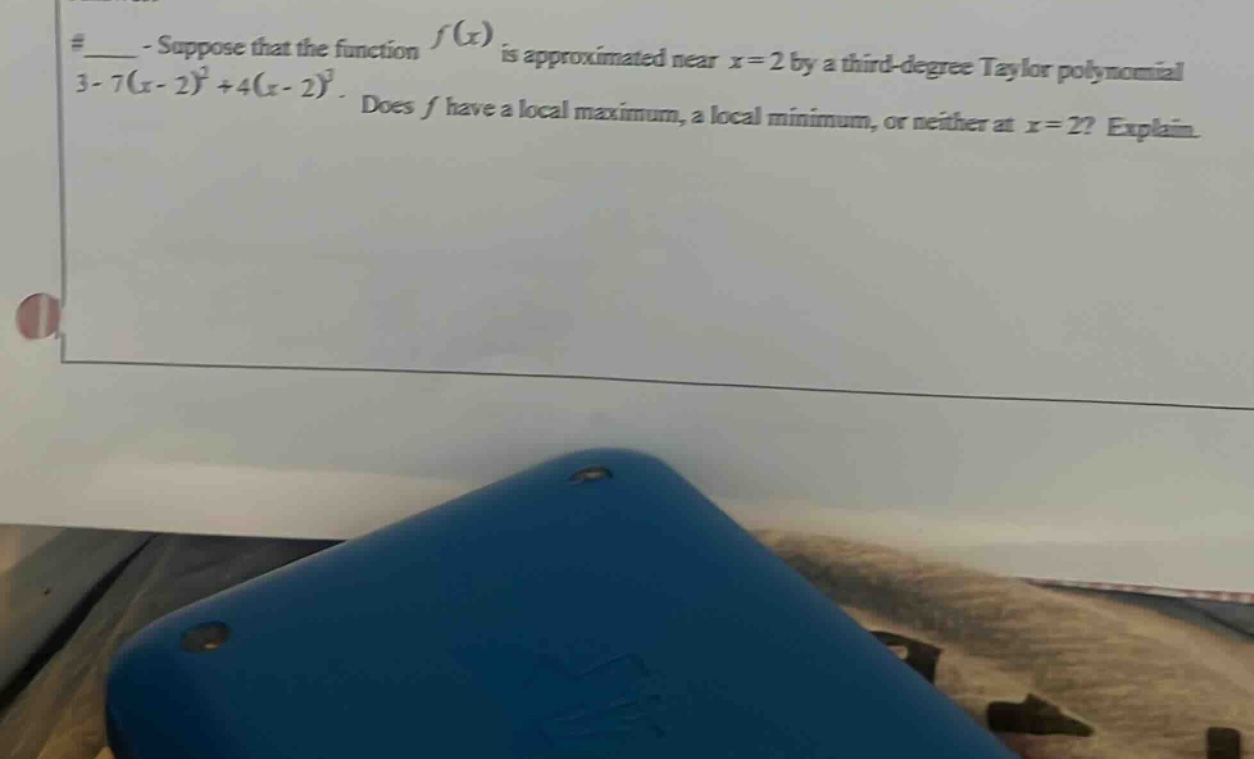
#____ - suppose that the function f(x) is approximated near x = 2 by a third - degree taylor polynomial 3 - 7(x - 2)^2+4(x - 2)^3. does f have a local maximum, a local minimum, or neither at x = 2? explain.
Answer
Explanation:
Step1: Recall Taylor - series properties
The Taylor polynomial of degree $n$ of a function $f(x)$ centered at $a$ is $P_n(x)=\sum_{k = 0}^{n}\frac{f^{(k)}(a)}{k!}(x - a)^k$. For a third - degree Taylor polynomial $P_3(x)=3-7(x - 2)^2+4(x - 2)^3$ centered at $a = 2$, we can analyze the behavior of the function near $x = 2$ using the polynomial.
Step2: Find the first - derivative of the Taylor polynomial
Differentiate $P_3(x)=3-7(x - 2)^2+4(x - 2)^3$ with respect to $x$. Using the power rule $\frac{d}{dx}(u^n)=nu^{n - 1}\frac{du}{dx}$, we have $P_3^\prime(x)=-14(x - 2)+12(x - 2)^2$.
Step3: Evaluate the first - derivative at $x = 2$
Substitute $x = 2$ into $P_3^\prime(x)$: $P_3^\prime(2)=-14(2 - 2)+12(2 - 2)^2=0$. So $x = 2$ is a critical point.
Step4: Find the second - derivative of the Taylor polynomial
Differentiate $P_3^\prime(x)=-14(x - 2)+12(x - 2)^2$ with respect to $x$. $P_3^{\prime\prime}(x)=-14 + 24(x - 2)$.
Step5: Evaluate the second - derivative at $x = 2$
Substitute $x = 2$ into $P_3^{\prime\prime}(x)$: $P_3^{\prime\prime}(2)=-14+24(2 - 2)=-14<0$.
Step6: Apply the second - derivative test
By the second - derivative test, if $f^\prime(c)=0$ and $f^{\prime\prime}(c)<0$ at a critical point $c$, then the function $f(x)$ has a local maximum at $x = c$. Since $P_3(x)$ approximates $f(x)$ near $x = 2$, and $P_3^\prime(2)=0$ and $P_3^{\prime\prime}(2)<0$, the function $f(x)$ has a local maximum at $x = 2$.
Answer:
The function $f$ has a local maximum at $x = 2$.