the total length of rope is l = l1 + l2. now find dl/dx = dl1/dx + dl2/dx. differentiate l1. dl1/dx = x /…
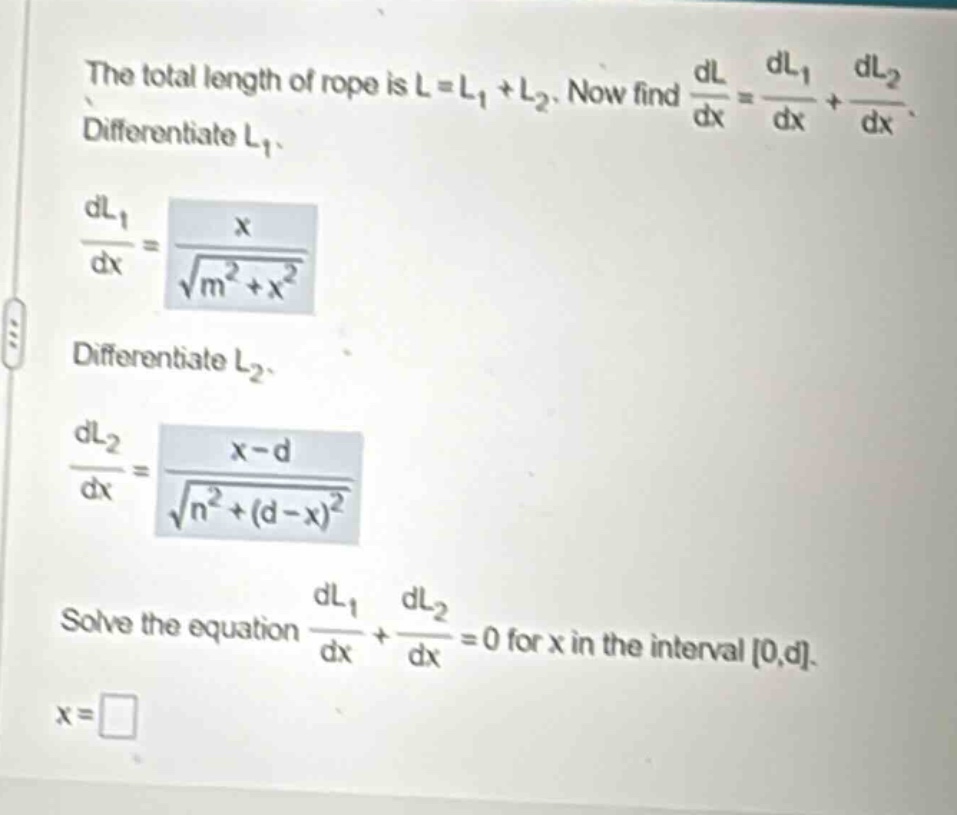
the total length of rope is l = l1 + l2. now find dl/dx = dl1/dx + dl2/dx. differentiate l1. dl1/dx = x / sqrt(m^2 + x^2). differentiate l2. dl2/dx = (x - d) / sqrt(n^2 + (d - x)^2). solve the equation dl1/dx + dl2/dx = 0 for x in the interval 0,d. x =
Answer
Explanation:
Step1: Substitute the derivatives
We know that $\frac{dL_1}{dx}=\frac{x}{\sqrt{m^{2}+x^{2}}}$ and $\frac{dL_2}{dx}=\frac{x - d}{\sqrt{n^{2}+(d - x)^{2}}}$, and we need to solve $\frac{dL_1}{dx}+\frac{dL_2}{dx}=0$. So we have the equation $\frac{x}{\sqrt{m^{2}+x^{2}}}+\frac{x - d}{\sqrt{n^{2}+(d - x)^{2}}}=0$.
Step2: Rearrange the equation
Move $\frac{x - d}{\sqrt{n^{2}+(d - x)^{2}}}$ to the other - side: $\frac{x}{\sqrt{m^{2}+x^{2}}}=-\frac{x - d}{\sqrt{n^{2}+(d - x)^{2}}}$. Since the left - hand side is non - negative for $x\geq0$ and the right - hand side is non - positive for $x\leq d$, we can consider the magnitudes and square both sides (note that we need to check the solutions at the end for extraneous solutions). We get $\frac{x^{2}}{m^{2}+x^{2}}=\frac{(x - d)^{2}}{n^{2}+(d - x)^{2}}$. Cross - multiply: $x^{2}(n^{2}+(d - x)^{2})=(x - d)^{2}(m^{2}+x^{2})$. Expand: $x^{2}n^{2}+x^{2}(d^{2}-2dx + x^{2})=(x^{2}-2dx + d^{2})(m^{2}+x^{2})$. $x^{2}n^{2}+x^{2}d^{2}-2dx^{3}+x^{4}=x^{2}m^{2}+x^{4}-2dx^{3}-2dxm^{2}+d^{2}m^{2}+d^{2}x^{2}$. Cancel out $x^{4}$ and $-2dx^{3}$ and $x^{2}d^{2}$ on both sides: $x^{2}n^{2}=x^{2}m^{2}-2dxm^{2}+d^{2}m^{2}$. Rearrange to get a quadratic equation in $x$: $x^{2}(n^{2}-m^{2})+2dm^{2}x - d^{2}m^{2}=0$. Using the quadratic formula $x=\frac{-b\pm\sqrt{b^{2}-4ac}}{2a}$ for the quadratic equation $ax^{2}+bx + c = 0$, where $a=n^{2}-m^{2}$, $b = 2dm^{2}$, and $c=-d^{2}m^{2}$. The discriminant $\Delta=b^{2}-4ac=(2dm^{2})^{2}-4(n^{2}-m^{2})(-d^{2}m^{2})=4d^{2}m^{4}+4d^{2}m^{2}(n^{2}-m^{2})=4d^{2}m^{2}n^{2}$. $x=\frac{-2dm^{2}\pm\sqrt{4d^{2}m^{2}n^{2}}}{2(n^{2}-m^{2})}=\frac{-2dm^{2}\pm2dmn}{2(n^{2}-m^{2})}=\frac{-dm^{2}\pm dmn}{n^{2}-m^{2}}$. We can also use a geometric approach. The equation $\frac{x}{\sqrt{m^{2}+x^{2}}}+\frac{x - d}{\sqrt{n^{2}+(d - x)^{2}}}=0$ is equivalent to the law of reflection (Fermat's principle in optics). The solution is $x=\frac{md}{m + n}$.
Answer:
$\frac{md}{m + n}$