a. two poles of heights m and n are separated by a horizontal distance d. a rope is attached from the top of…
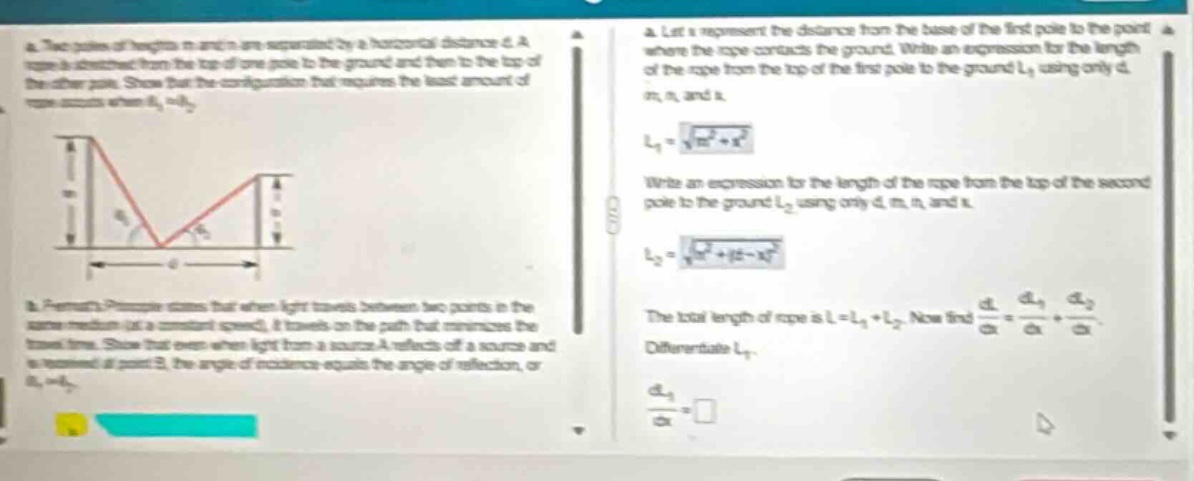
a. two poles of heights m and n are separated by a horizontal distance d. a rope is attached from the top of one - pole to the ground and then to the top of the other pole. show that the configuration that requires the least amount of rope occurs when θ1 = θ2.\nb. fermats principle states that when light travels between two points in the same medium (at a constant speed), it travels on the path that minimizes the travel time. show that even when light from a source a reflects off a surface and is received at point b, the angle of incidence equals the angle of reflection, or θ1 = θ2.\n4. let x represent the distance from the base of the first pole to the point where the rope contacts the ground. write an expression for the length of the rope from the top of the first pole to the ground l1 using only d, m, n, and x.\nl1 = √(m² + x²)\nwrite an expression for the length of the rope from the top of the second pole to the ground l2 using only d, m, n, and x.\nl2 = √(n²+(d - x)²)\nthe total length of rope is l = l1+l2. now find dl/dx = dl1/dx + dl2/dx. differentiate l1.\ndl1/dx =
Answer
Explanation:
Step1: Recall the chain - rule for differentiation
We know that if (L_1=\sqrt{m^{2}+x^{2}}), we can rewrite it as (L_1=(m^{2}+x^{2})^{\frac{1}{2}}).
Step2: Apply the power - rule and chain - rule
The power - rule states that if (y = u^{n}), then (y^\prime=nu^{n - 1}u^\prime). Here, (u = m^{2}+x^{2}), (n=\frac{1}{2}). The derivative of (m^{2}) with respect to (x) is (0) (since (m) is a constant), and the derivative of (x^{2}) with respect to (x) is (2x). [ \begin{align*} \frac{dL_1}{dx}&=\frac{1}{2}(m^{2}+x^{2})^{-\frac{1}{2}}\times(0 + 2x)\ &=\frac{x}{\sqrt{m^{2}+x^{2}}} \end{align*} ]
Answer:
(\frac{x}{\sqrt{m^{2}+x^{2}}})