unit 39: hydraulic, pneumatic, and robot\n1. what is fluid power?\nan integral part of agricultural and…
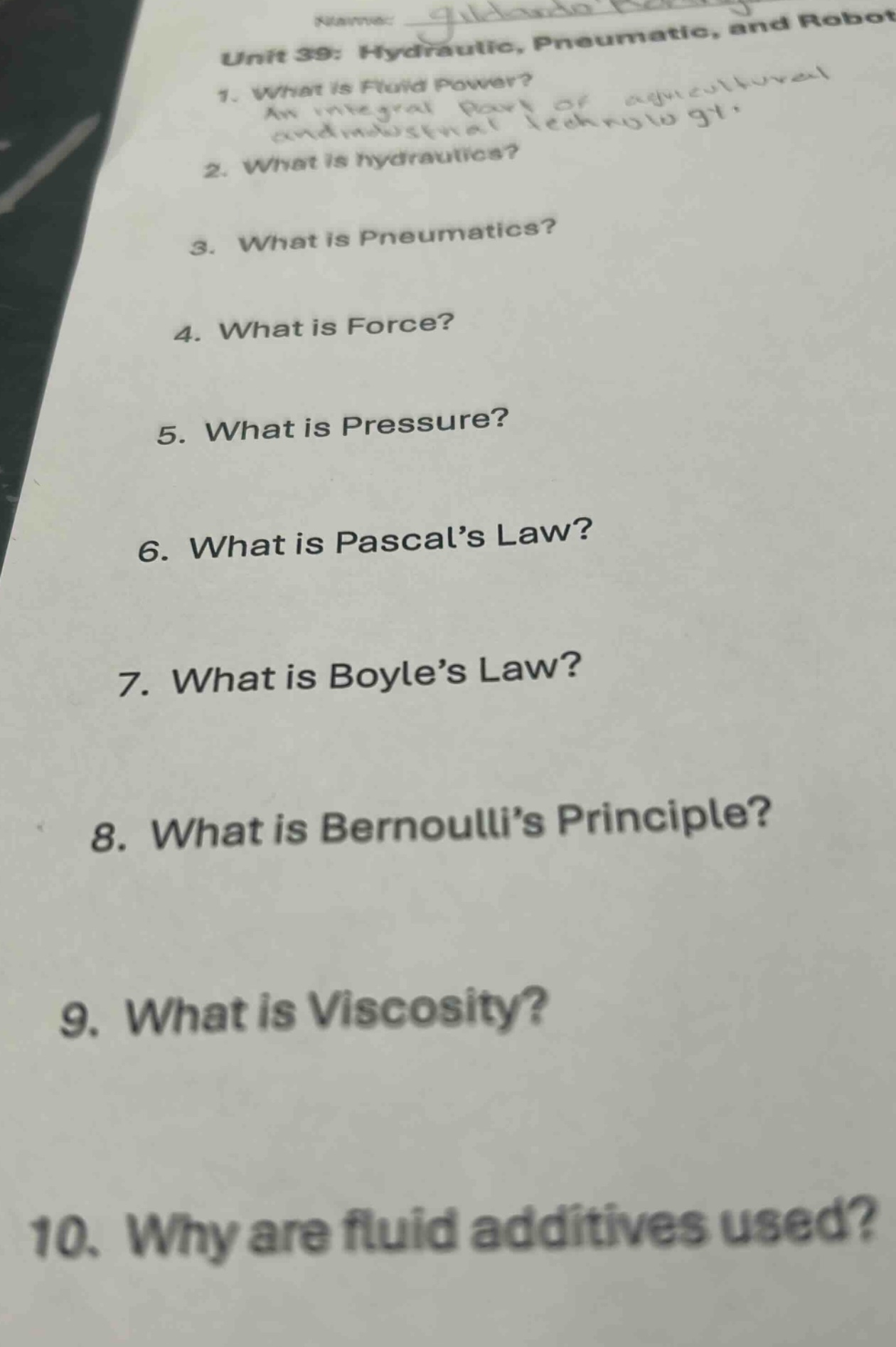
unit 39: hydraulic, pneumatic, and robot\n1. what is fluid power?\nan integral part of agricultural and industrial technology.\n2. what is hydraulics?\n3. what is pneumatics?\n4. what is force?\n5. what is pressure?\n6. what is pascal’s law?\n7. what is boyle’s law?\n8. what is bernoulli’s principle?\n9. what is viscosity?\n10. why are fluid additives used?
Answer
Brief Explanations:
These questions pertain to concepts in fluid - related physics such as fluid power, hydraulics, pneumatics, and related physical laws and properties. They are fundamental questions in the study of fluid mechanics within physics.
- Fluid power is the use of pressurized fluids to generate, control, and transmit power.
- Hydraulics is the branch of science and technology concerned with the mechanical properties of liquids, especially when under pressure for power - transmission applications.
- Pneumatics deals with the mechanical properties of gases, using compressed air for power and control.
- Force is a push or pull upon an object resulting from the object's interaction with another object.
- Pressure is the force applied perpendicular to the surface of an object per unit area over which that force is distributed.
- Pascal's Law states that a pressure change occurring anywhere in a confined incompressible fluid is transmitted throughout the fluid such that the same change occurs everywhere.
- Boyle's Law states that for a fixed amount of an ideal gas kept at a fixed temperature, pressure and volume are inversely proportional.
- Bernoulli's Principle relates the pressure, velocity, and elevation in a moving fluid (liquid or gas), stating that an increase in the speed of the fluid occurs simultaneously with a decrease in pressure or a decrease in the fluid's potential energy.
- Viscosity is a measure of a fluid's resistance to flow.
- Fluid additives are used to improve the properties of fluids, such as reducing friction, preventing corrosion, and controlling viscosity.
Answer:
- Fluid power is the use of pressurized fluids for power generation, control, and transmission.
- Hydraulics is about the mechanical properties of liquids under pressure for power - transmission.
- Pneumatics concerns the mechanical properties of gases using compressed air.
- Force is a push or pull due to object - object interaction.
- Pressure is force per unit area applied perpendicular to a surface.
- Pascal's Law: Pressure change in a confined incompressible fluid is transmitted everywhere equally.
- Boyle's Law: For a fixed - amount of ideal gas at constant temperature, pressure and volume are inversely proportional.
- Bernoulli's Principle: In a moving fluid, an increase in speed is accompanied by a decrease in pressure or potential energy.
- Viscosity is a fluid's resistance to flow.
- Fluid additives are used to enhance fluid properties like reducing friction and preventing corrosion.