10 ml of a 3% hydrogen peroxide solution is added to five test tubes. as the hydrogen peroxide decomposes to…
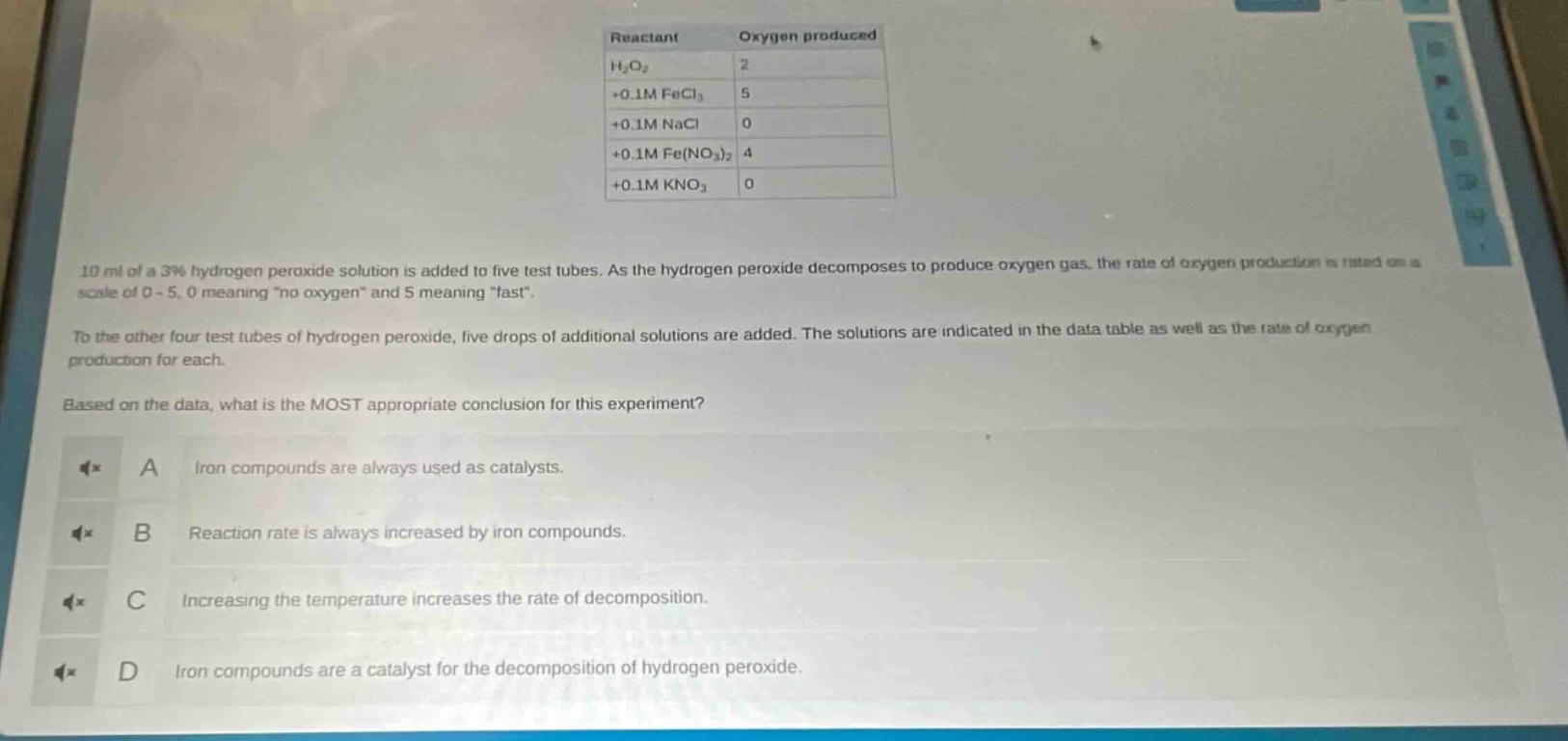
10 ml of a 3% hydrogen peroxide solution is added to five test tubes. as the hydrogen peroxide decomposes to produce oxygen gas, the rate of oxygen production is rated on a scale of 0 - 5, 0 meaning \no oxygen\ and 5 meaning \fast\.\nto the other four test tubes of hydrogen peroxide, five drops of additional solutions are added. the solutions are indicated in the data table as well as the rate of oxygen production for each.\nbased on the data, what is the most appropriate conclusion for this experiment?\na iron compounds are always used as catalysts.\nb reaction rate is always increased by iron compounds.\nc increasing the temperature increases the rate of decomposition.\nd iron compounds are a catalyst for the decomposition of hydrogen peroxide.
Answer
Brief Explanations:
The experiment shows that when iron - containing compounds ($\text{FeCl}_3$ and $\text{Fe(NO}_3)_2$) are added to hydrogen peroxide, the rate of oxygen production increases compared to hydrogen peroxide alone and non - iron containing compounds ($\text{NaCl}$, $\text{KNO}_3$). A catalyst is a substance that increases the rate of a chemical reaction without being consumed in the reaction. Based on this data, iron compounds act as a catalyst for hydrogen peroxide decomposition. Option A is too general as it says "always", and we only have data from this one experiment. Option B is also too general with "always". Option C is not related to the variables tested in this experiment (temperature was not a variable).
Answer:
D. Iron compounds are a catalyst for the decomposition of hydrogen peroxide.