10.) how can we change the solubility of a substance?\n11.) what is a saturated solution?\n12.) what is an…
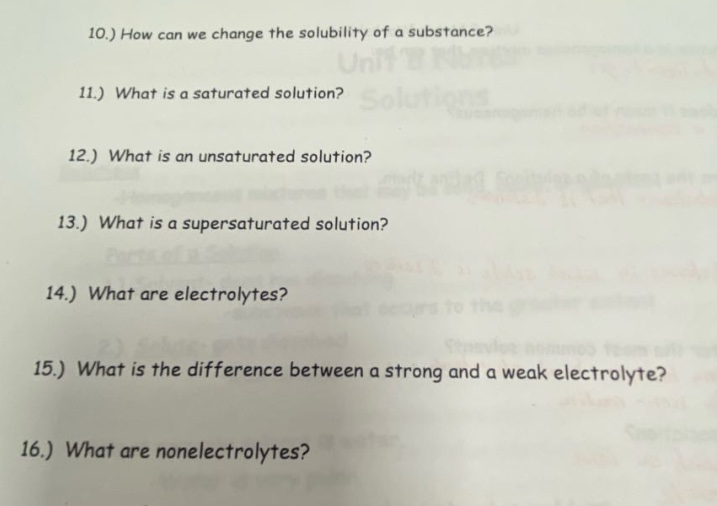
10.) how can we change the solubility of a substance?\n11.) what is a saturated solution?\n12.) what is an unsaturated solution?\n13.) what is a supersaturated solution?\n14.) what are electrolytes?\n15.) what is the difference between a strong and a weak electrolyte?\n16.) what are nonelectrolytes?
Answer
Brief Explanations:
- Solubility can be changed by altering temperature (for most solids in liquids, solubility increases with temperature; for gases in liquids, it decreases with temperature), pressure (affects gas - liquid solubility significantly), and by adding other substances that may react or complex with the solute.
- A saturated solution is one in which the maximum amount of solute has been dissolved in a given amount of solvent at a specific temperature and pressure, and any additional solute will not dissolve.
- An unsaturated solution contains less solute than the maximum amount that can be dissolved in the solvent at a particular temperature and pressure.
- A supersaturated solution has more solute dissolved than the maximum amount that would be dissolved under normal conditions at a given temperature and pressure. It is unstable and the excess solute may crystallize out.
- Electrolytes are substances that conduct electricity when dissolved in water or melted, because they dissociate into ions.
- A strong electrolyte dissociates completely into ions in solution, while a weak electrolyte only partially dissociates.
- Nonelectrolytes are substances that do not conduct electricity when dissolved in water or melted as they do not dissociate into ions.
Answer:
- By changing temperature, pressure, or adding other substances.
- A solution with maximum dissolved solute at a given T and P.
- A solution with less than maximum dissolved solute at a given T and P.
- A solution with more than maximum dissolved solute (unstable).
- Substances that conduct electricity when dissolved or melted due to ion dissociation.
- Strong electrolytes dissociate completely, weak ones partially.
- Substances that do not conduct electricity as they do not dissociate into ions.