11. which chemical equation contains the fewest oxygen atoms? a. 2na + 2h2o → 2naoh + h2 b. h2o + o2 → co2 +…
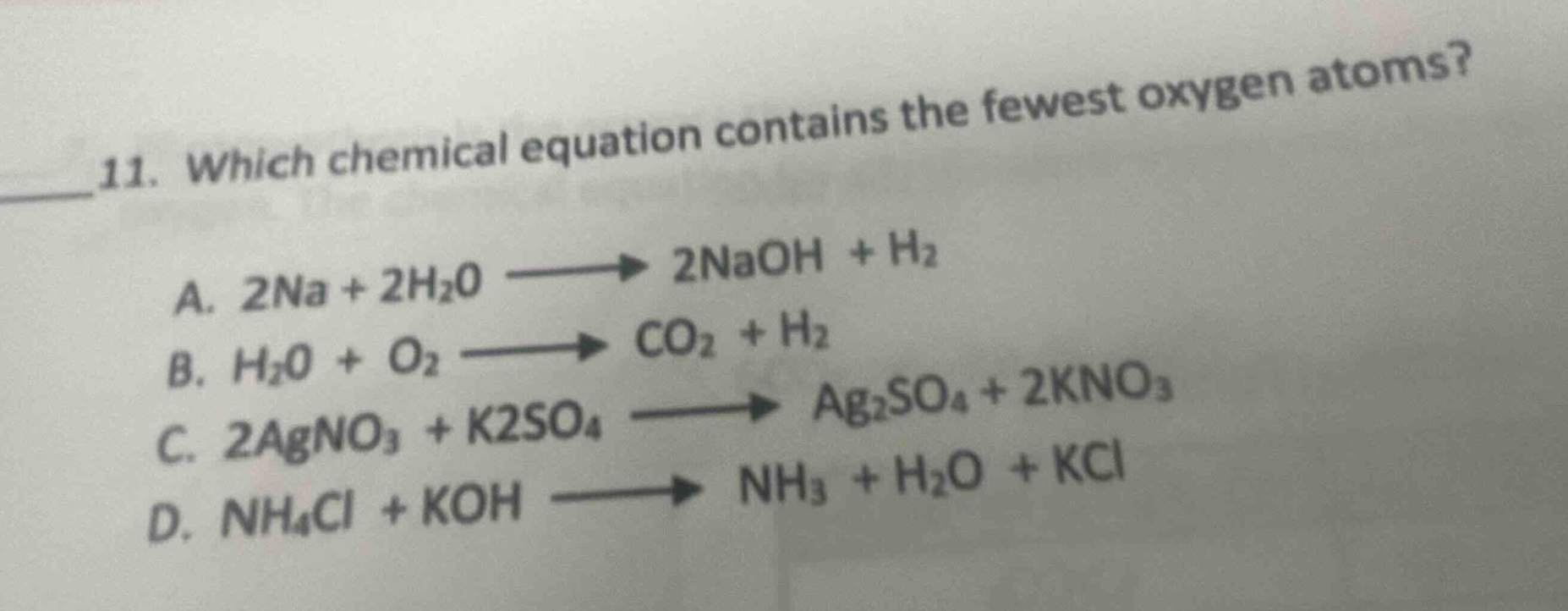
11. which chemical equation contains the fewest oxygen atoms? a. 2na + 2h2o → 2naoh + h2 b. h2o + o2 → co2 + h2 c. 2agno3 + k2so4 → ag2so4 + 2kno3 d. nh4cl + koh → nh3 + h2o + kcl
Answer
Explanation:
Step1: Count oxygen atoms in A
In $2Na + 2H_2O\rightarrow2NaOH + H_2$, on the left - hand side, from $2H_2O$ we have 2 oxygen atoms, and on the right - hand side, from $2NaOH$ we have 2 oxygen atoms, total 4 oxygen atoms.
Step2: Count oxygen atoms in B
In $H_2O+O_2\rightarrow CO_2 + H_2$, on the left - hand side, from $H_2O$ we have 1 oxygen atom and from $O_2$ we have 2 oxygen atoms, total 3 oxygen atoms on the left. On the right - hand side, from $CO_2$ we have 2 oxygen atoms. But we need to balance this equation first. After balancing $2H_2O + O_2\rightarrow2CO_2+2H_2$ (assuming there is a carbon source not shown in the original wrong - written equation), the total oxygen atoms are 4 on the left and 4 on the right.
Step3: Count oxygen atoms in C
In $2AgNO_3+K_2SO_4\rightarrow Ag_2SO_4 + 2KNO_3$, on the left - hand side, from $2AgNO_3$ we have $2\times3 = 6$ oxygen atoms and from $K_2SO_4$ we have 4 oxygen atoms, total 10 oxygen atoms. On the right - hand side, from $Ag_2SO_4$ we have 4 oxygen atoms and from $2KNO_3$ we have $2\times3=6$ oxygen atoms, total 10 oxygen atoms.
Step4: Count oxygen atoms in D
In $NH_4Cl+KOH\rightarrow NH_3 + H_2O+KCl$, on the left - hand side, from $KOH$ we have 1 oxygen atom, and on the right - hand side, from $H_2O$ we have 1 oxygen atom, total 2 oxygen atoms.
Answer:
D. $NH_4Cl + KOH\rightarrow NH_3 + H_2O+KCl$