12. (4:01) will the charge of each of those three sulfur anions be? in fe₂s₃, what will the charge of those…
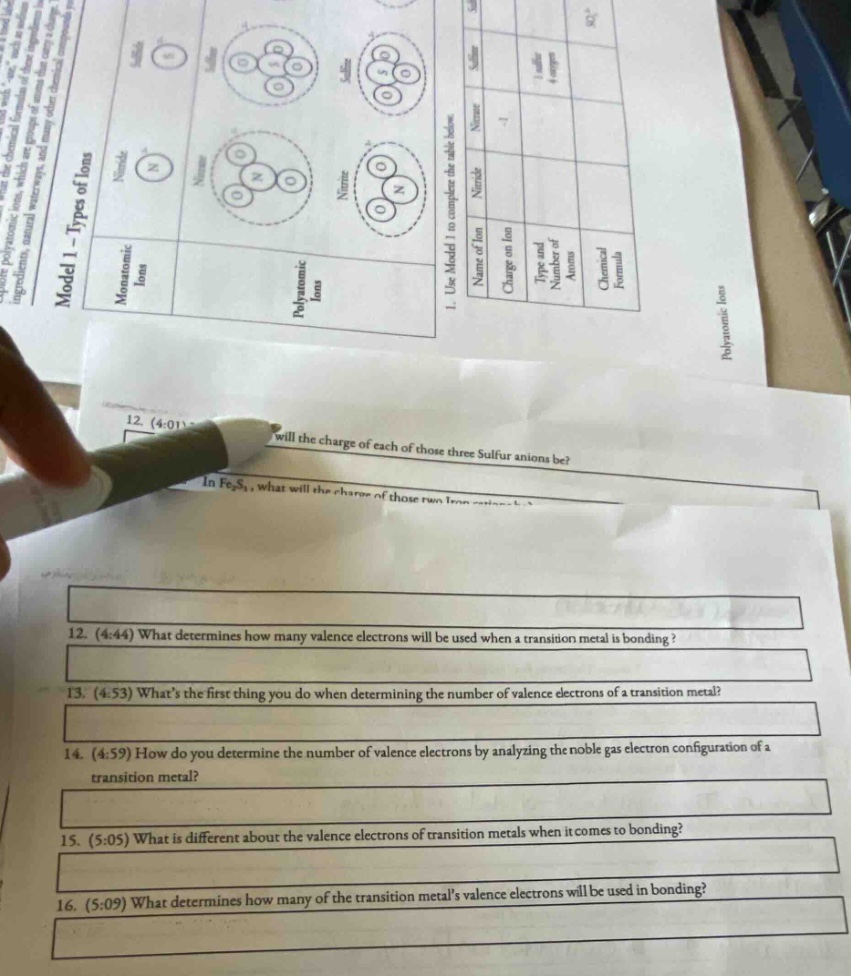
12. (4:01) will the charge of each of those three sulfur anions be? in fe₂s₃, what will the charge of those two iron cations be? 12. (4:44) what determines how many valence electrons will be used when a transition metal is bonding? 13. (4:53) what’s the first thing you do when determining the number of valence electrons of a transition metal? 14. (4:59) how do you determine the number of valence electrons by analyzing the noble - gas electron configuration of a transition metal? 15. (5:05) what is different about the valence electrons of transition metals when it comes to bonding? 16. (5:09) what determines how many of the transition metal’s valence electrons will be used in bonding?
Answer
Answer:
- The charge of sulfur anions in a compound depends on the oxidation - state rules. In many cases, sulfur can have a charge of - 2. In (Fe_2S_3), since the compound is neutral and sulfur has a charge of - 2 and there are 3 sulfur atoms (total negative charge of - 6), the two iron cations must have a total positive charge of + 6. So each iron cation has a charge of + 3. What determines how many valence electrons will be used when a transition metal is bonding: The oxidation state it forms in the compound and the nature of the other atoms it is bonding with. What's the first thing you do when determining the number of valence electrons of a transition metal: Identify the electron - configuration of the neutral atom. How do you determine the number of valence electrons by analyzing the noble gas electron configuration of a transition metal: Look at the electrons in the outermost shell(s) beyond the noble - gas core. What is different about the valence electrons of transition metals when it comes to bonding: Transition metals can use electrons from the (d) - subshell in addition to the outer (s) - subshell electrons for bonding, allowing for variable oxidation states. What determines how many of the transition metal's valence electrons will be used in bonding: The electronegativity of the other atoms in the compound, the type of bonding (ionic, covalent etc.), and the overall stability of the resulting compound.
Explanation:
Step1: Analyze sulfur charge
Sulfur commonly forms a - 2 anion.
Step2: Analyze iron charge in (Fe_2S_3)
Let charge of iron be (x). (2x+3\times(- 2)=0), so (2x = 6) and (x = + 3).
Step3: Determine valence - electron use in bonding
Oxidation state and other atoms' nature matter.
Step4: First step for valence - electron count
Find neutral - atom electron - configuration.
Step5: Use noble - gas configuration
Look at outer - shell electrons beyond core.
Step6: Note transition - metal difference
Can use (d) - subshell electrons for bonding.
Step7: Determine valence - electron use
Electronegativity, bonding type, and stability matter.