12. the compound below is classified as what type of compound?\na. alkyne\nb. alkane\nc. alkene\nd. aromatic…
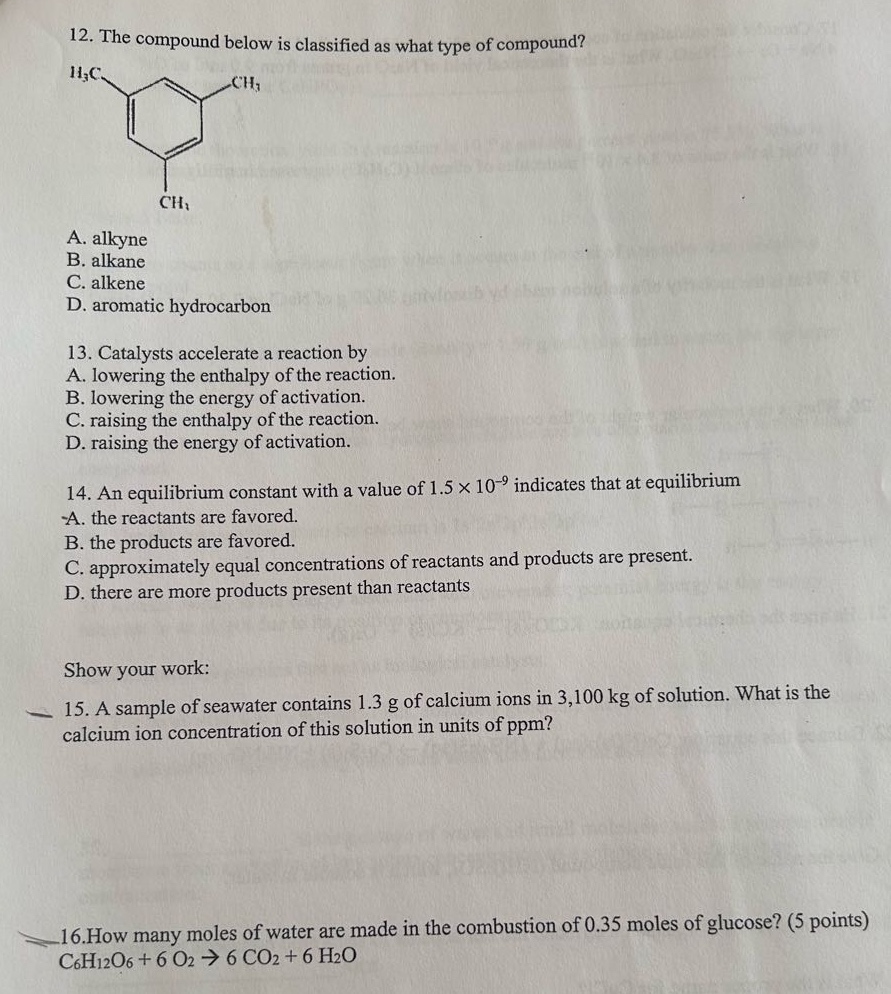
12. the compound below is classified as what type of compound?\na. alkyne\nb. alkane\nc. alkene\nd. aromatic hydrocarbon\n13. catalysts accelerate a reaction by\na. lowering the enthalpy of the reaction.\nb. lowering the energy of activation.\nc. raising the enthalpy of the reaction.\nd. raising the energy of activation.\n14. an equilibrium constant with a value of 1.5×10⁻⁹ indicates that at equilibrium\na. the reactants are favored.\nb. the products are favored.\nc. approximately equal concentrations of reactants and products are present.\nd. there are more products present than reactants\nshow your work:\n15. a sample of seawater contains 1.3 g of calcium ions in 3,100 kg of solution. what is the calcium ion concentration of this solution in units of ppm?\n16.how many moles of water are made in the combustion of 0.35 moles of glucose? (5 points)\nc₆h₁₂o₆ + 6 o₂ → 6 co₂ + 6 h₂o
Answer
Explanation:
Step1: Identify the compound type in question 12
The given compound has a benzene - ring structure with methyl groups attached. Aromatic hydrocarbons contain benzene - like rings. Alkynes have triple bonds, alkanes have only single bonds, and alkenes have double bonds. So it is an aromatic hydrocarbon.
Step2: Recall the function of catalysts in question 13
Catalysts work by providing an alternative reaction pathway with a lower activation energy. They do not change the enthalpy of the reaction. So catalysts accelerate a reaction by lowering the energy of activation.
Step3: Analyze the equilibrium constant in question 14
The equilibrium constant $K = \frac{[products]}{[reactants]}$. When $K<1$, the reactants are favored. Since $K = 1.5\times10^{-9}<1$, the reactants are favored at equilibrium.
Step4: Calculate ppm in question 15
The formula for parts - per - million (ppm) is $ppm=\frac{mass\ of\ solute}{mass\ of\ solution}\times10^{6}$. Given mass of solute (calcium ions) $m = 1.3\ g$ and mass of solution $M=3100\ kg = 3100\times10^{3}\ g$. Then $ppm=\frac{1.3}{3100\times10^{3}}\times10^{6}=\frac{1.3\times10^{6}}{3100\times10^{3}}=\frac{1300}{3100}\approx0.42$ ppm.
Step5: Use stoichiometry in question 16
From the balanced equation $C_{6}H_{12}O_{6}+6O_{2}\rightarrow6CO_{2}+6H_{2}O$, the mole - ratio of glucose to water is $1:6$. If $n_{glucose}=0.35\ mol$, then $n_{water}=0.35\ mol\times6 = 2.1\ mol$.
Answer:
- D. aromatic hydrocarbon
- B. lowering the energy of activation
- A. the reactants are favored
- Approximately 0.42 ppm
- 2.1 moles