12. which of the following phase changes involves the transfer of heat from the surroundings to the…
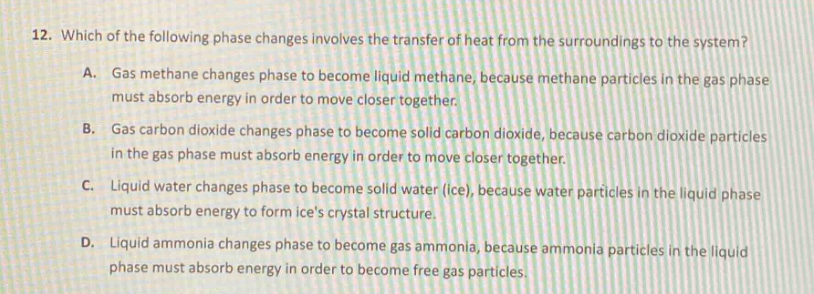
12. which of the following phase changes involves the transfer of heat from the surroundings to the system?\na. gas methane changes phase to become liquid methane, because methane particles in the gas phase must absorb energy in order to move closer together.\nb. gas carbon dioxide changes phase to become solid carbon dioxide, because carbon dioxide particles in the gas phase must absorb energy in order to move closer together.\nc. liquid water changes phase to become solid water (ice), because water particles in the liquid phase must absorb energy to form ices crystal structure.\nd. liquid ammonia changes phase to become gas ammonia, because ammonia particles in the liquid phase must absorb energy in order to become free gas particles.
Answer
Brief Explanations:
When heat is transferred from the surroundings to the system, the process is endothermic. Phase changes from solid - liquid - gas are endothermic as energy is required to break intermolecular forces. In option D, liquid ammonia changing to gas ammonia is a vaporization process which is endothermic. Options A and B are exothermic (gas to liquid and gas to solid respectively, releasing heat to surroundings). Option C is also exothermic (liquid to solid, releasing heat).
Answer:
D. Liquid ammonia changes phase to become gas ammonia, because ammonia particles in the liquid phase must absorb energy in order to become free gas particles.