a 13.00 g sample of citric acid ($h_3c_6h_5o_7$) reacts with an excess of baking soda as shown in the…
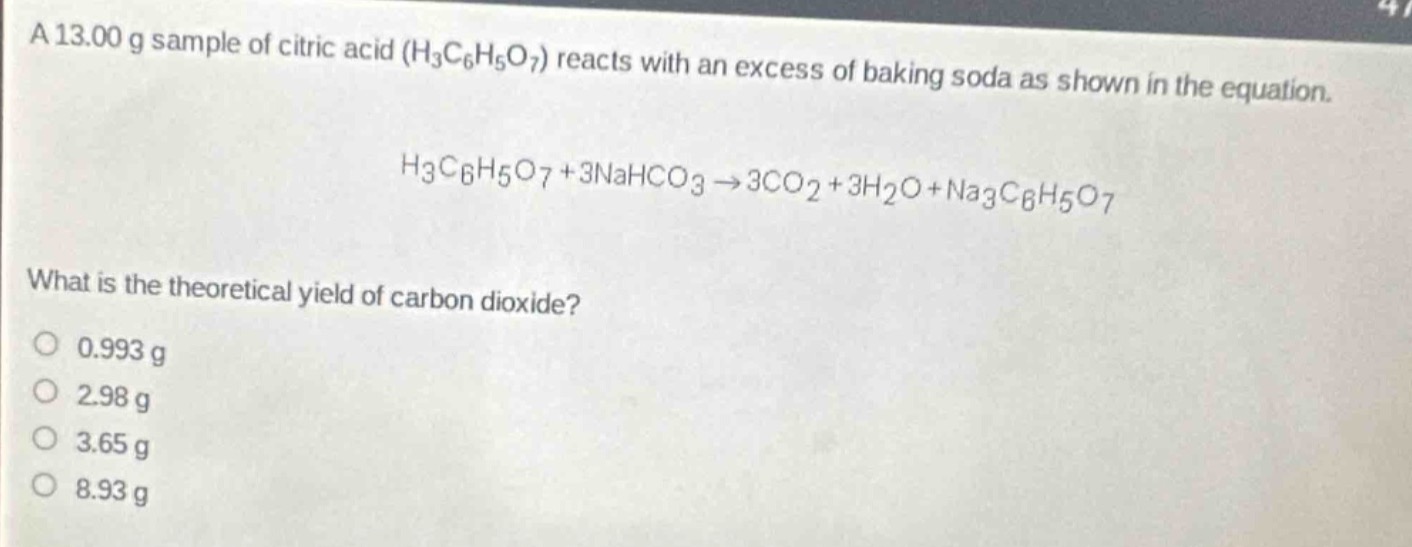
a 13.00 g sample of citric acid ($h_3c_6h_5o_7$) reacts with an excess of baking soda as shown in the equation.\n$h_3c_6h_5o_7 + 3nahco_3 \rightarrow 3co_2+3h_2o + na_3c_6h_5o_7$\nwhat is the theoretical yield of carbon dioxide?\n0.993 g\n2.98 g\n3.65 g\n8.93 g
Answer
Explanation:
Step1: Calculate molar mass of citric acid
The molar mass of $H_3C_6H_5O_7$: $H$ has molar - mass $1.01\ g/mol$, $C$ has molar - mass $12.01\ g/mol$, $O$ has molar - mass $16.00\ g/mol$. $M(H_3C_6H_5O_7)=3\times1.01 + 6\times12.01+5\times1.01 + 7\times16.00=192.12\ g/mol$.
Step2: Calculate moles of citric acid
$n=\frac{m}{M}$, where $m = 13.00\ g$ and $M = 192.12\ g/mol$. $n(H_3C_6H_5O_7)=\frac{13.00\ g}{192.12\ g/mol}=0.0677\ mol$.
Step3: Determine mole ratio
From the balanced chemical equation $H_3C_6H_5O_7+3NaHCO_3\rightarrow3CO_2 + 3H_2O+Na_3C_6H_5O_7$, the mole ratio of $H_3C_6H_5O_7$ to $CO_2$ is $1:3$. So, $n(CO_2)=3\times n(H_3C_6H_5O_7)$. $n(CO_2)=3\times0.0677\ mol = 0.2031\ mol$.
Step4: Calculate molar mass of $CO_2$
The molar mass of $CO_2$ is $M(CO_2)=12.01+2\times16.00 = 44.01\ g/mol$.
Step5: Calculate mass of $CO_2$
$m(CO_2)=n\times M$. $m(CO_2)=0.2031\ mol\times44.01\ g/mol\approx8.93\ g$.
Answer:
$8.93\ g$