13. which of the following statements about chemical bonds is true? a. covalent bonds are stronger than…
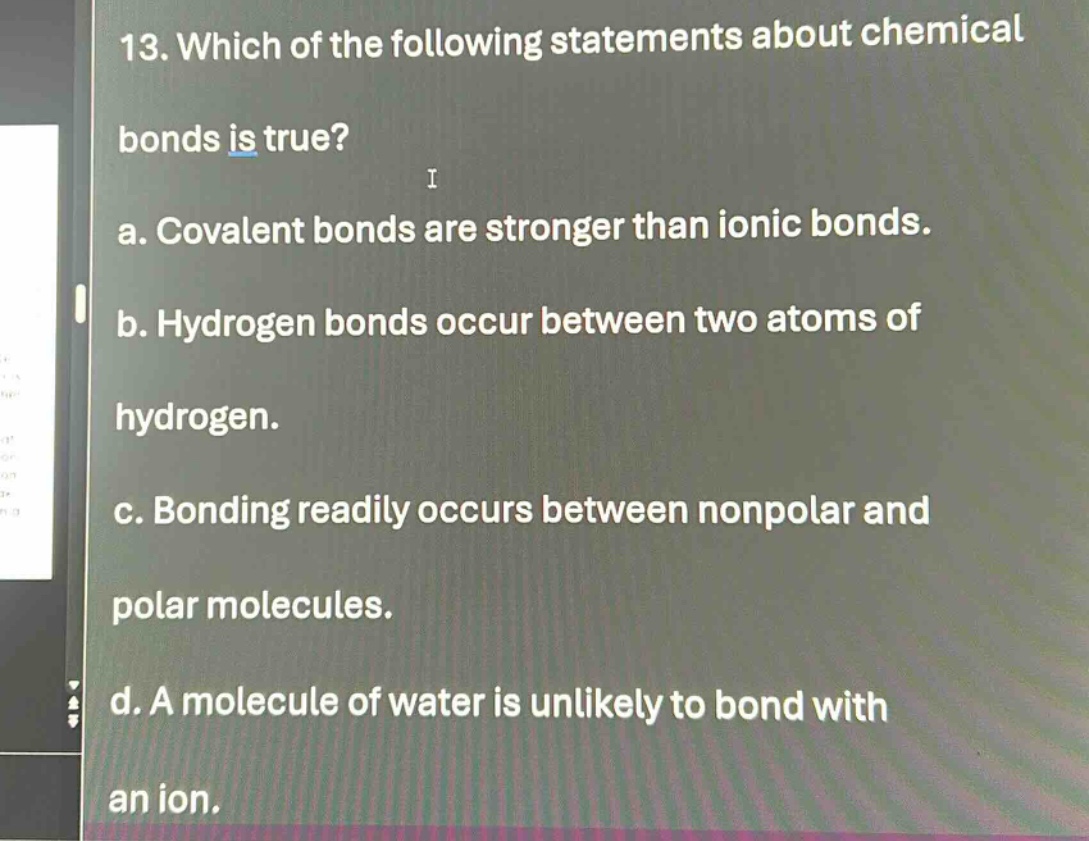
13. which of the following statements about chemical bonds is true? a. covalent bonds are stronger than ionic bonds. b. hydrogen bonds occur between two atoms of hydrogen. c. bonding readily occurs between nonpolar and polar molecules. d. a molecule of water is unlikely to bond with an ion.
Answer
Answer:
None of the above options are true.
Brief Explanations:
- Option a: The strength of covalent and ionic bonds can vary depending on the context, and it's not always true that covalent bonds are stronger than ionic bonds.
- Option b: Hydrogen bonds occur between a hydrogen atom covalently bonded to a highly - electronegative atom (such as N, O, or F) and another electronegative atom, not between two hydrogen atoms.
- Option c: Non - polar and polar molecules do not readily bond because of differences in their electrical charge distributions.
- Option d: Water is a polar molecule and can readily bond with ions through ion - dipole interactions.