15. how many moles of gas are contained in a scuba divers 12.6 - l tank filled with 3422 psi of air at 25…
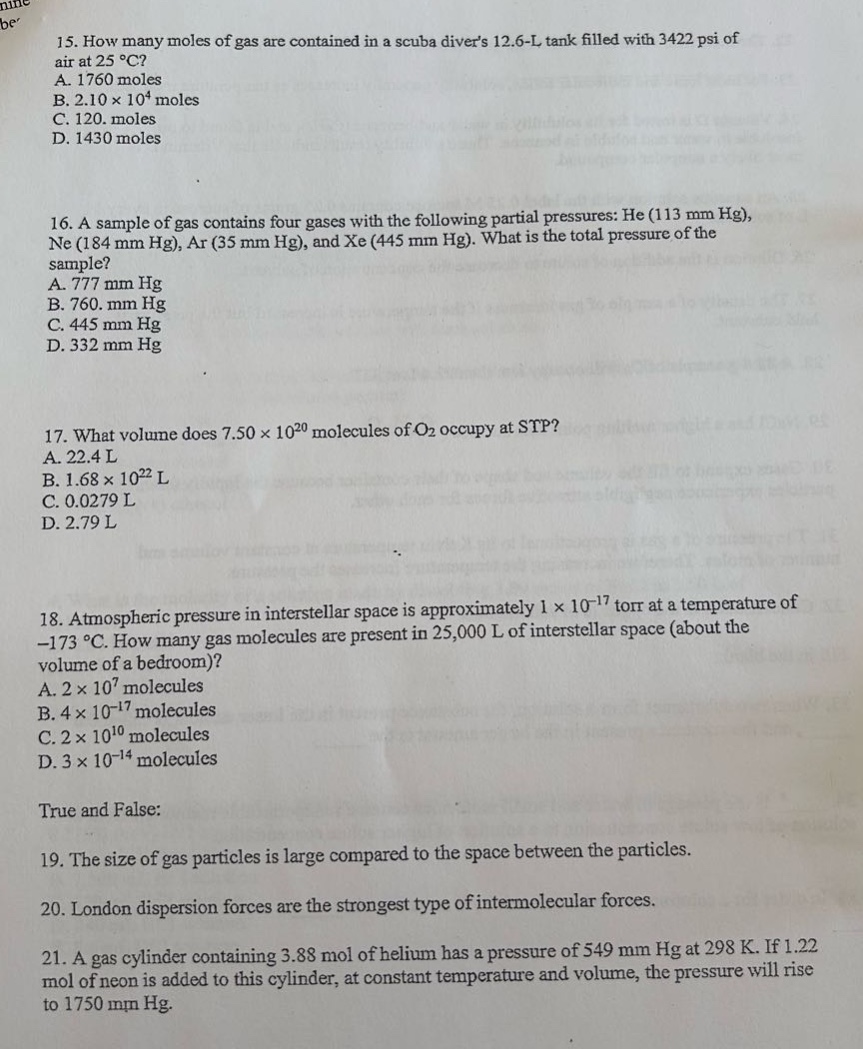
15. how many moles of gas are contained in a scuba divers 12.6 - l tank filled with 3422 psi of air at 25 °c?\na. 1760 moles\nb. 2.10×10⁴ moles\nc. 120. moles\nd. 1430 moles\n\n16. a sample of gas contains four gases with the following partial pressures: he (113 mm hg), ne (184 mm hg), ar (35 mm hg), and xe (445 mm hg). what is the total pressure of the sample?\na. 777 mm hg\nb. 760. mm hg\nc. 445 mm hg\nd. 332 mm hg\n\n17. what volume does 7.50×10²⁰ molecules of o₂ occupy at stp?\na. 22.4 l\nb. 1.68×10²² l\nc. 0.0279 l\nd. 2.79 l\n\n18. atmospheric pressure in interstellar space is approximately 1×10⁻¹⁷ torr at a temperature of - 173 °c. how many gas molecules are present in 25,000 l of interstellar space (about the volume of a bedroom)?\na. 2×10⁷ molecules\nb. 4×10⁻¹⁷ molecules\nc. 2×10¹⁰ molecules\nd. 3×10⁻¹⁴ molecules\n\ntrue and false:\n\n19. the size of gas particles is large compared to the space between the particles.\n\n20. london dispersion forces are the strongest type of intermolecular forces.\n\n21. a gas cylinder containing 3.88 mol of helium has a pressure of 549 mm hg at 298 k. if 1.22 mol of neon is added to this cylinder, at constant temperature and volume, the pressure will rise to 1750 mm hg.
Answer
15.
Explanation:
Step1: Convert pressure units
First, convert 3422 psi to atm. 1 psi = 0.068046 atm, so $P = 3422\times0.068046\ atm\approx232.85\ atm$. Convert temperature to Kelvin: $T=(25 + 273)K=298K$. Use the ideal - gas law $PV = nRT$, where $R = 0.0821\ L\cdot atm/(mol\cdot K)$ and $V = 12.6L$.
Step2: Solve for n
Rearrange the ideal - gas law $n=\frac{PV}{RT}$. Substitute the values: $n=\frac{232.85\ atm\times12.6L}{0.0821\ L\cdot atm/(mol\cdot K)\times298K}\approx120\ mol$.
Answer:
C. 120. moles
16.
Explanation:
According to Dalton's law of partial pressures, the total pressure of a gas mixture $P_{total}=P_{He}+P_{Ne}+P_{Ar}+P_{Xe}$.
Step1: Add partial pressures
$P_{total}=113\ mmHg + 184\ mmHg+35\ mmHg + 445\ mmHg=777\ mmHg$.
Answer:
A. 777 mm Hg
17.
Explanation:
First, use Avogadro's number ($N_A = 6.022\times10^{23}\ molecules/mol$) to find the number of moles of $O_2$. Then, at STP ($P = 1\ atm$, $T = 273K$), use the molar volume of a gas at STP ($V_m=22.4L/mol$).
Step1: Calculate moles of $O_2$
$n=\frac{N}{N_A}=\frac{7.50\times10^{20}\ molecules}{6.022\times10^{23}\ molecules/mol}\approx0.00125\ mol$.
Step2: Calculate volume at STP
$V=n\times V_m=0.00125\ mol\times22.4L/mol = 0.0279L$.
Answer:
C. 0.0279 L
18.
Explanation:
First, convert pressure to atm ($1\ torr=\frac{1}{760}atm$), temperature to Kelvin ($T=- 173^{\circ}C+273 = 100K$), and use the ideal - gas law $PV = nRT$ to find the number of moles, then use $N = nN_A$ ($N_A = 6.022\times10^{23}\ molecules/mol$).
Step1: Convert pressure
$P = 1\times10^{-17}\ torr=\frac{1\times10^{-17}}{760}atm\approx1.32\times10^{-20}atm$.
Step2: Calculate moles using ideal - gas law
$n=\frac{PV}{RT}=\frac{1.32\times10^{-20}atm\times25000L}{0.0821\ L\cdot atm/(mol\cdot K)\times100K}\approx4\times10^{-17}mol$.
Step3: Calculate number of molecules
$N=nN_A=4\times10^{-17}mol\times6.022\times10^{23}\ molecules/mol\approx2\times10^{7}\ molecules$.
Answer:
A. $2\times10^{7}$ molecules
19.
Explanation:
In a gas, the size of gas particles is very small compared to the space between the particles.
Answer:
False
20.
Explanation:
London dispersion forces are the weakest type of intermolecular forces. Stronger intermolecular forces include hydrogen - bonding and dipole - dipole forces.
Answer:
False
21.
Explanation:
At constant temperature and volume, the pressure of a gas is directly proportional to the number of moles ($P = n\frac{RT}{V}$, and $\frac{RT}{V}$ is constant). Initially, $n_1 = 3.88mol$ and $P_1 = 549mmHg$. After adding $n_{Ne}=1.22mol$, $n_2=3.88mol + 1.22mol=5.1mol$. Using $\frac{P_1}{n_1}=\frac{P_2}{n_2}$, $P_2=\frac{n_2}{n_1}P_1=\frac{5.1mol}{3.88mol}\times549mmHg\approx727mmHg\neq1750mmHg$.
Answer:
False