16.1 experiments on rates of reaction\nq1 the reaction between sodium thiosulphate and hydrochloric acid…
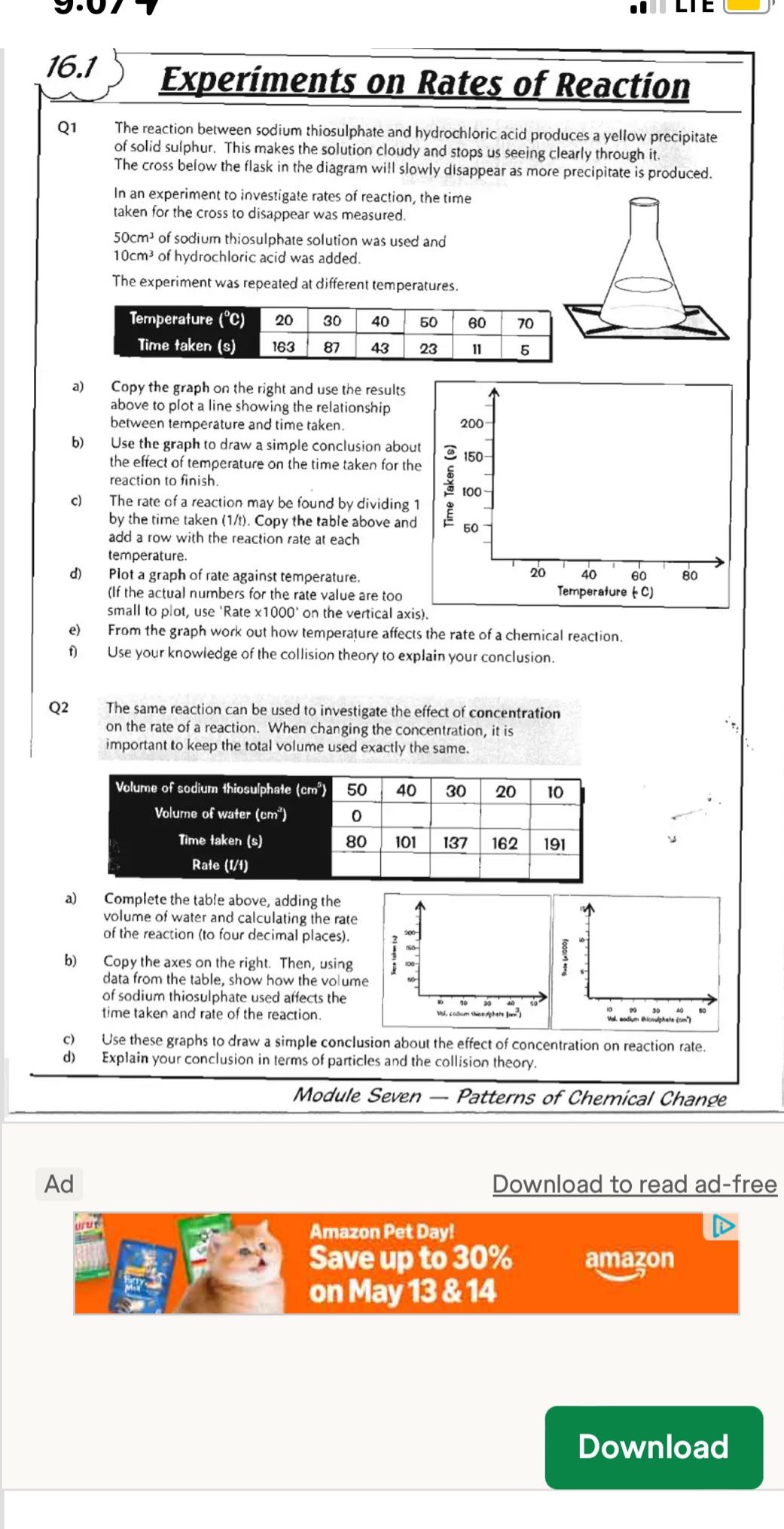
16.1 experiments on rates of reaction\nq1 the reaction between sodium thiosulphate and hydrochloric acid produces a yellow precipitate of solid sulphur. this makes the solution cloudy and stops us seeing clearly through it. the cross below the flask in the diagram will slowly disappear as more precipitate is produced.\nin an experiment to investigate rates of reaction, the time taken for the cross to disappear was measured.\n50cm³ of sodium thiosulphate solution was used and 10cm³ of hydrochloric acid was added.\nthe experiment was repeated at different temperatures.\ntemperature (°c) 20 30 40 50 60 70\ntime taken (s) 163 87 43 23 11 5\na) copy the graph on the right and use the results above to plot a line showing the relationship between temperature and time taken.\nb) use the graph to draw a simple conclusion about the effect of temperature on the time taken for the reaction to finish.\nc) the rate of a reaction may be found by dividing 1 by the time taken (1/t). copy the table above and add a row with the reaction rate at each temperature.\nd) plot a graph of rate against temperature.\n(if the actual numbers for the rate value are too small to plot, use rate x1000 on the vertical axis).\ne) from the graph work out how temperature affects the rate of a chemical reaction.\nf) use your knowledge of the collision theory to explain your conclusion.\nq2 the same reaction can be used to investigate the effect of concentration on the rate of a reaction. when changing the concentration, it is important to keep the total volume used exactly the same.\nvolume of sodium thiosulphate (cm³) 50 40 30 20 10\nvolume of water (cm³) 0\ntime taken (s) 80 101 137 162 191\nrate (1/t)\na) complete the table above, adding the volume of water and calculating the rate of the reaction (to four decimal places).\nb) copy the axes on the right. then, using data from the table, show how the volume of sodium thiosulphate used affects the time taken and rate of the reaction.\nc) use these graphs to draw a simple conclusion about the effect of concentration on reaction rate.\nd) explain your conclusion in terms of particles and the collision theory.\nmodule seven — patterns of chemical change
Answer
Q1
a)
This requires manual graph - plotting which cannot be done in this text - based format. But the general process is to mark the points (temperature, time taken) from the table (e.g., (20, 163), (30, 87) etc.) on the given graph and draw a smooth curve through them.
b)
Explanation:
Step1: Observe the trend
As the temperature increases from 20°C to 70°C, the time taken for the cross to disappear decreases from 163 s to 5 s.
Answer:
As the temperature increases, the time taken for the reaction to finish decreases.
c)
Explanation:
Step1: Calculate reaction rate
For each temperature, use the formula rate = $\frac{1}{t}$. For 20°C: rate = $\frac{1}{163}\approx0.0061$ s⁻¹ For 30°C: rate = $\frac{1}{87}\approx0.0115$ s⁻¹ For 40°C: rate = $\frac{1}{43}\approx0.0233$ s⁻¹ For 50°C: rate = $\frac{1}{23}\approx0.0435$ s⁻¹ For 60°C: rate = $\frac{1}{11}\approx0.0909$ s⁻¹ For 70°C: rate = $\frac{1}{5}= 0.2$ s⁻¹ The new table with reaction rate row:
| Temperature (°C) | 20 | 30 | 40 | 50 | 60 | 70 |
|---|---|---|---|---|---|---|
| Time taken (s) | 163 | 87 | 43 | 23 | 11 | 5 |
| Reaction rate (s⁻¹) | 0.0061 | 0.0115 | 0.0233 | 0.0435 | 0.0909 | 0.2 |
d)
This requires manual graph - plotting. Mark the points (temperature, rate) from the new table on the graph. If the actual numbers for the rate value are too small to plot, use 'Rate x1000' on the vertical axis. For example, for 20°C, the value to plot is 6.1 (0.0061×1000), for 30°C it is 11.5 (0.0115×1000) etc.
e)
Explanation:
Step1: Analyze the rate - temperature graph
As the temperature increases, the rate of the chemical reaction increases.
Answer:
The rate of the chemical reaction increases with an increase in temperature.
f)
Brief Explanations:
According to the collision theory, at higher temperatures, reactant particles have more kinetic energy. This leads to more frequent and more energetic collisions between the sodium thiosulphate and hydrochloric acid particles. More energetic collisions are more likely to overcome the activation energy barrier, resulting in a higher reaction rate.
Answer:
Higher temperature gives particles more kinetic energy, leading to more frequent and energetic collisions and a higher reaction rate.
Q2
a)
The total volume is kept constant at 60 cm³. For 40 cm³ of sodium thiosulphate, volume of water = 60 - 40=20 cm³, rate = $\frac{1}{101}\approx0.0099$ s⁻¹ For 30 cm³ of sodium thiosulphate, volume of water = 60 - 30 = 30 cm³, rate = $\frac{1}{137}\approx0.0073$ s⁻¹ For 20 cm³ of sodium thiosulphate, volume of water = 60 - 20 = 40 cm³, rate = $\frac{1}{162}\approx0.0062$ s⁻¹ For 10 cm³ of sodium thiosulphate, volume of water = 60 - 10 = 50 cm³, rate = $\frac{1}{191}\approx0.0052$ s⁻¹ The completed table:
| Volume of sodium thiosulphate (cm³) | 50 | 40 | 30 | 20 | 10 |
|---|---|---|---|---|---|
| Volume of water (cm³) | 0 | 20 | 30 | 40 | 50 |
| Time taken (s) | 80 | 101 | 137 | 162 | 191 |
| Rate (s⁻¹) | 0.0125 | 0.0099 | 0.0073 | 0.0062 | 0.0052 |
b)
This requires manual graph - plotting. Mark the points (volume of sodium thiosulphate, time taken) and (volume of sodium thiosulphate, rate) on the given axes.
c)
Explanation:
Step1: Analyze the graphs
As the volume of sodium thiosulphate (and thus its concentration as the total volume is constant) decreases, the time taken for the reaction to finish increases and the rate of the reaction decreases.
Answer:
The rate of the reaction is directly proportional to the concentration of sodium thiosulphate.
d)
Brief Explanations:
According to the collision theory, a higher concentration of sodium thiosulphate means more reactant particles in the same volume. This increases the frequency of collisions between sodium thiosulphate and hydrochloric acid particles. More collisions lead to a higher reaction rate. When the concentration is lower, there are fewer particles, less frequent collisions, and a lower reaction rate.
Answer:
Higher concentration means more particles, more frequent collisions and a higher reaction rate.