17. consider the oxidation of sodium metal to sodium oxide described by the balanced equation: 4 na + o₂ → 2…
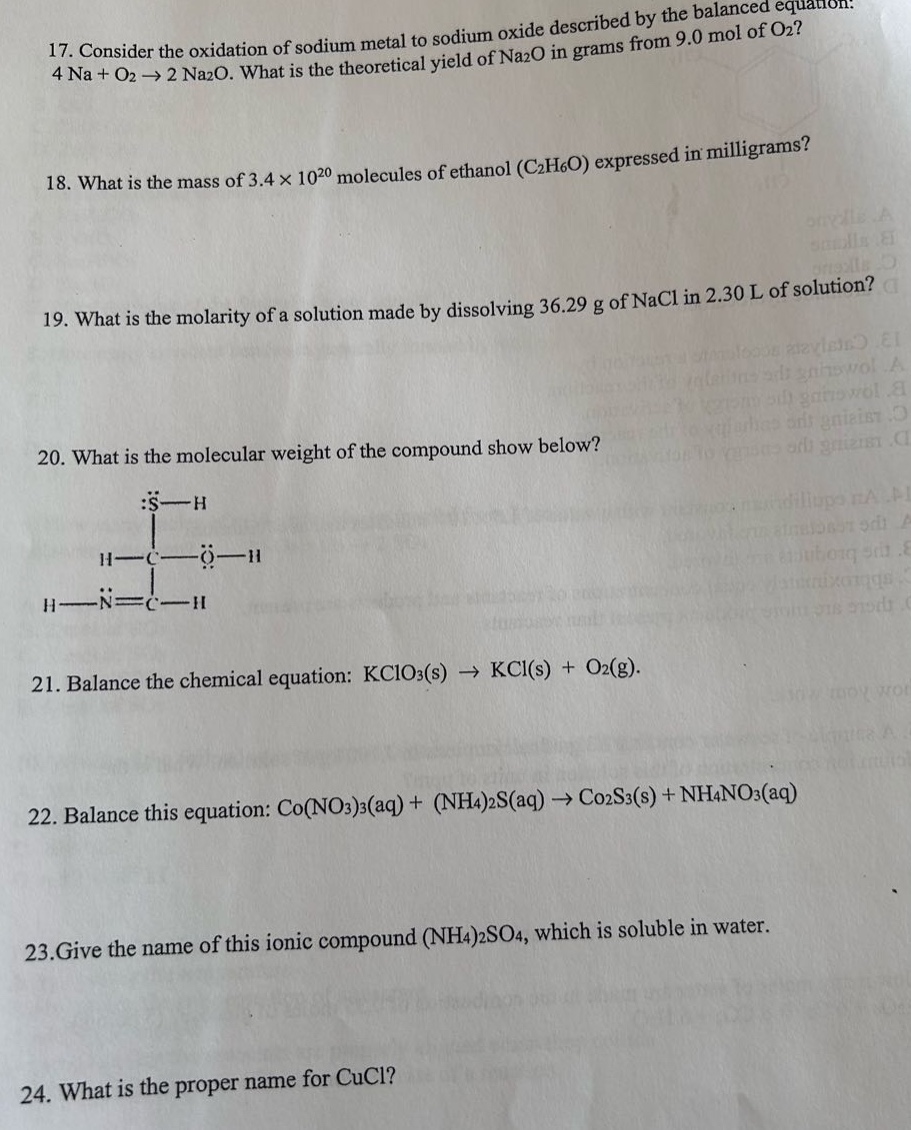
17. consider the oxidation of sodium metal to sodium oxide described by the balanced equation: 4 na + o₂ → 2 na₂o. what is the theoretical yield of na₂o in grams from 9.0 mol of o₂?\n18. what is the mass of 3.4×10²⁰ molecules of ethanol (c₂h₆o) expressed in milligrams?\n19. what is the molarity of a solution made by dissolving 36.29 g of nacl in 2.30 l of solution?\n20. what is the molecular weight of the compound show below?\nh - c - h\n| |\nh - n = c - h\n| |\nh - s - h\n21. balance the chemical equation: kclo₃(s) → kcl(s) + o₂(g).\n22. balance this equation: co(no₃)₃(aq) + (nh₄)₂s(aq) → co₂s₃(s) + nh₄no₃(aq)\n23.give the name of this ionic compound (nh₄)₂so₄, which is soluble in water.\n24. what is the proper name for cucl?
Answer
Question 17
Explanation:
Step1: Determine mole - ratio
From the balanced equation $4Na + O_2\rightarrow2Na_2O$, the mole - ratio of $O_2$ to $Na_2O$ is $1:2$.
Step2: Calculate moles of $Na_2O$
If we have $n_{O_2}=9.0$ mol of $O_2$, then the number of moles of $Na_2O$, $n_{Na_2O}=2\times n_{O_2}=2\times9.0$ mol = 18.0 mol.
Step3: Calculate molar mass of $Na_2O$
The molar mass of $Na$ is $M_{Na}=22.99$ g/mol and of $O$ is $M_O = 16.00$ g/mol. So, $M_{Na_2O}=2\times22.99+16.00=61.98$ g/mol.
Step4: Calculate mass of $Na_2O$
The mass of $Na_2O$, $m = n_{Na_2O}\times M_{Na_2O}=18.0$ mol $\times61.98$ g/mol = 1115.64 g.
Answer:
1115.64 g
Question 18
Explanation:
Step1: Use Avogadro's number
Avogadro's number $N_A = 6.022\times10^{23}$ molecules/mol. First, find the number of moles of ethanol, $n=\frac{N}{N_A}$, where $N = 3.4\times10^{20}$ molecules. So, $n=\frac{3.4\times10^{20}}{6.022\times10^{23}}$ mol $\approx0.000565$ mol.
Step2: Calculate molar mass of ethanol
The molar mass of $C_2H_6O$: $M=(2\times12.01 + 6\times1.01+16.00)$ g/mol = 46.08 g/mol.
Step3: Calculate mass of ethanol
The mass $m=n\times M=0.000565$ mol $\times46.08$ g/mol = 0.0260 g. Convert to milligrams: $m = 0.0260$ g $\times1000$ mg/g = 26.0 mg.
Answer:
26.0 mg
Question 19
Explanation:
Step1: Calculate moles of $NaCl$
The molar mass of $NaCl$ is $M_{NaCl}=22.99 + 35.45=58.44$ g/mol. The number of moles of $NaCl$, $n=\frac{m}{M}=\frac{36.29\ g}{58.44\ g/mol}\approx0.621$ mol.
Step2: Calculate molarity
Molarity $M=\frac{n}{V}$, where $V = 2.30$ L. So, $M=\frac{0.621\ mol}{2.30\ L}\approx0.270$ mol/L.
Answer:
0.270 mol/L
Question 20
Explanation:
Step1: Identify elements and their counts
The compound has 1 $S$, 1 $O$, 2 $C$, 5 $H$, and 1 $N$.
Step2: Calculate molar mass
$M=(32.07+16.00 + 2\times12.01+5\times1.01 + 14.01)$ g/mol $M=(32.07+16.00+24.02 + 5.05+14.01)$ g/mol = 91.15 g/mol.
Answer:
91.15 g/mol
Question 21
Explanation:
Step1: Balance oxygen atoms
To balance the oxygen atoms in $KClO_3(s)\rightarrow KCl(s)+O_2(g)$, we need to make the number of oxygen atoms equal on both sides. The least - common multiple of 3 and 2 (the number of oxygen atoms in $KClO_3$ and $O_2$ respectively) is 6. So, we put a 2 in front of $KClO_3$ and a 3 in front of $O_2$: $2KClO_3(s)\rightarrow KCl(s)+3O_2(g)$.
Step2: Balance potassium and chlorine atoms
Now, to balance potassium and chlorine atoms, we put a 2 in front of $KCl$. The balanced equation is $2KClO_3(s)\rightarrow2KCl(s)+3O_2(g)$.
Answer:
$2KClO_3(s)\rightarrow2KCl(s)+3O_2(g)$
Question 22
Explanation:
Step1: Balance cobalt and sulfur atoms
In the equation $Co(NO_3)_3(aq)+(NH_4)_2S(aq)\rightarrow Co_2S_3(s)+NH_4NO_3(aq)$, to balance cobalt and sulfur atoms, we put a 2 in front of $Co(NO_3)_3$ and a 3 in front of $(NH_4)_2S$: $2Co(NO_3)_3(aq)+3(NH_4)_2S(aq)\rightarrow Co_2S_3(s)+NH_4NO_3(aq)$.
Step2: Balance nitrate and ammonium ions
Now, to balance nitrate and ammonium ions, we put a 6 in front of $NH_4NO_3$. The balanced equation is $2Co(NO_3)_3(aq)+3(NH_4)_2S(aq)\rightarrow Co_2S_3(s)+6NH_4NO_3(aq)$.
Answer:
$2Co(NO_3)_3(aq)+3(NH_4)_2S(aq)\rightarrow Co_2S_3(s)+6NH_4NO_3(aq)$
Question 23
Explanation:
The cation is ammonium ion ($NH_4^+$) and the anion is sulfate ion ($SO_4^{2 -}$).
Answer:
Ammonium sulfate
Question 24
Explanation:
Copper can have +1 or +2 oxidation states. In $CuCl$, copper has a +1 oxidation state. The anion is chloride.
Answer:
Copper(I) chloride