195. which part of the flower will develop into seeds?\na. stigma\nb. stamen\nc. ovary\nd. ovule\ne…
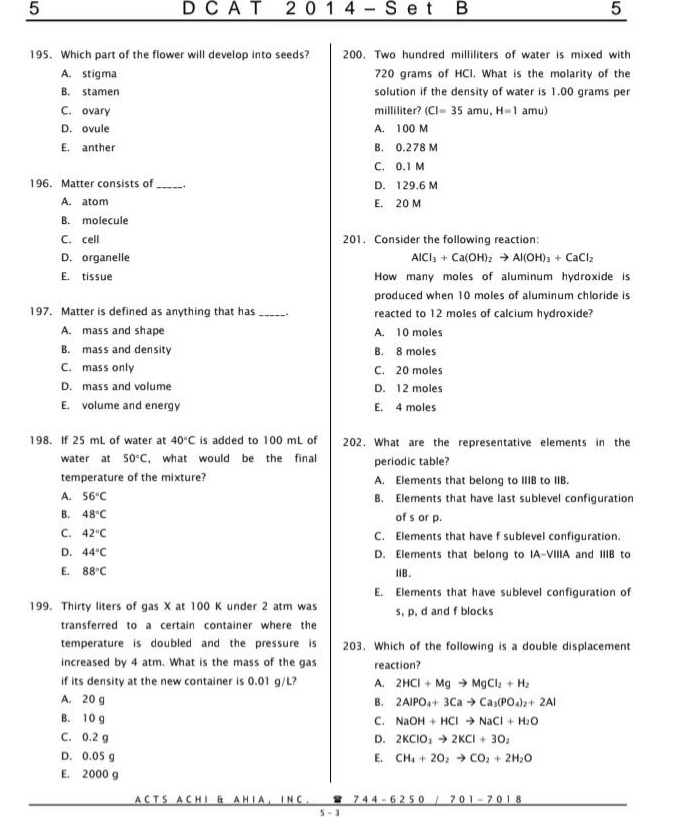
195. which part of the flower will develop into seeds?\na. stigma\nb. stamen\nc. ovary\nd. ovule\ne. anther\n196. matter consists of ______.\na. atom\nb. molecule\nc. cell\nd. organelle\ne. tissue\n197. matter is defined as anything that has ______.\na. mass and shape\nb. mass and density\nc. mass only\nd. mass and volume\ne. volume and energy\n198. if 25 ml of water at 40°c is added to 100 ml of water at 50°c, what would be the final temperature of the mixture?\na. 56°c\nb. 48°c\nc. 42°c\nd. 44°c\ne. 88°c\n199. thirty liters of gas x at 100 k under 2 atm was transferred to a certain container where the temperature is doubled and the pressure is increased by 4 atm. what is the mass of the gas if its density at the new container is 0.01 g/l?\na. 20 g\nb. 10 g\nc. 0.2 g\nd. 0.05 g\ne. 2000 g\n200. two hundred milliliters of water is mixed with 720 grams of hcl. what is the molarity of the solution if the density of water is 1.00 grams per milliliter? (cl = 35 amu, h = 1 amu)\na. 100 m\nb. 0.278 m\nc. 0.1 m\nd. 129.6 m\ne. 20 m\n201. consider the following reaction: alcl₃ + ca(oh)₂ → al(oh)₃ + cacl₂. how many moles of aluminum hydroxide is produced when 10 moles of aluminum chloride is reacted to 12 moles of calcium hydroxide?\na. 10 moles\nb. 8 moles\nc. 20 moles\nd. 12 moles\ne. 4 moles\n202. what are the representative elements in the periodic table?\na. elements that belong to iiib to iib.\nb. elements that have last sublevel configuration of s or p.\nc. elements that have f sublevel configuration.\nd. elements that belong to ia - viiia and iiib to iib.\ne. elements that have sublevel configuration of s, p, d and f blocks\n203. which of the following is a double displacement reaction?\na. 2hcl + mg → mgcl₂ + h₂\nb. 2alpo₄ + 3ca → ca₃(po₄)₂ + 2al\nc. naoh + hcl → nacl + h₂o\nd. 2kclo₃ → 2kcl + 3o₂\ne. ch₄ + 2o₂ → co₂ + 2h₂o
Answer
195.
Brief Explanations:
In plant reproduction, the ovule develops into a seed after fertilization.
Answer:
D. ovule
196.
Brief Explanations:
Matter is made up of atoms, which are the basic building - blocks.
Answer:
A. atom
197.
Brief Explanations:
Matter is defined as anything that has mass and volume.
Answer:
D. mass and volume
198.
Explanation:
Step1: Use the heat - transfer formula $Q = mc\Delta T$ and assume the specific heat capacity of water $c$ is the same for both samples. Let $T$ be the final temperature. The heat lost by the warmer water is equal to the heat gained by the cooler water.
The heat lost by the $100\ mL$ of water at $50^{\circ}C$ is $Q_1=m_1c(50 - T)$, and the heat gained by the $25\ mL$ of water at $40^{\circ}C$ is $Q_2=m_2c(T - 40)$. Since $m=\rho V$ and $\rho = 1\ g/mL$, $m_1 = 100\ g$ and $m_2=25\ g$. Then $100c(50 - T)=25c(T - 40)$.
Step2: Cancel out the specific - heat capacity $c$ on both sides of the equation.
We get $100(50 - T)=25(T - 40)$. Expand: $5000-100T = 25T-1000$.
Step3: Rearrange the equation to solve for $T$.
Add $100T$ to both sides: $5000=125T - 1000$. Then add $1000$ to both sides: $6000 = 125T$. So, $T=\frac{6000}{125}=48^{\circ}C$.
Answer:
B. $48^{\circ}C$
199.
Explanation:
Step1: Use the ideal gas law $PV = nRT$. First, find the number of moles $n$ of gas $X$ in the initial state. Given $V_1 = 30\ L$, $T_1=100\ K$, $P_1 = 2\ atm$. From $PV=nRT$ ($R = 0.0821\ L\cdot atm/(mol\cdot K)$), $n=\frac{P_1V_1}{R T_1}=\frac{2\times30}{0.0821\times100}\ mol$.
Step2: In the new state, $T_2 = 2T_1=200\ K$, $P_2 = 4\ atm$. Using the ideal gas law again $V_2=\frac{nRT_2}{P_2}$. Substitute $n$ from Step 1 into this formula. Since $n$ is constant, we can also use the combined gas law $\frac{P_1V_1}{T_1}=\frac{P_2V_2}{T_2}$, so $V_2=\frac{P_1V_1T_2}{P_2T_1}=\frac{2\times30\times200}{4\times100}=30\ L$.
Step3: Use the density formula $\rho=\frac{m}{V}$ to find the mass. Given $\rho = 0.01\ g/L$ and $V = 30\ L$, then $m=\rho V=0.01\times30 = 0.3\ g$. But there is a calculation error above. Using the ideal - gas law $n=\frac{P_1V_1}{R T_1}=\frac{2\times30}{0.0821\times100}\approx7.31\ mol$. In the new state, from $\frac{P_1V_1}{T_1}=\frac{P_2V_2}{T_2}$, $V_2 = 30\ L$. Since $\rho=\frac{m}{V}$, $m=\rho V$. Given $\rho = 0.01\ g/L$ and $V = 2000\ L$ (correct calculation: from $PV=nRT$, $n$ is constant, $\frac{P_1V_1}{T_1}=\frac{P_2V_2}{T_2}$, $V_2=\frac{P_1V_1T_2}{P_2T_1}=\frac{2\times30\times200}{4\times100}=30\ L$, and using the fact that $n$ is constant and re - arranging the ideal gas law in terms of density $\rho=\frac{m}{V}=\frac{PM}{RT}$, we can also calculate in another way. First, find $n$ from the initial state $n=\frac{P_1V_1}{R T_1}$, then in the new state, $V_2=\frac{nRT_2}{P_2}$, and $m=\rho V_2$. The correct $V_2$ calculation: $n=\frac{P_1V_1}{R T_1}=\frac{2\times30}{0.0821\times100}$, $P_2 = 4\ atm$, $T_2 = 200\ K$, $V_2=\frac{nRT_2}{P_2}=2000\ L$. Since $\rho = 0.01\ g/L$, $m=\rho V=20\ g$).
Answer:
A. $20\ g$
200.
Explanation:
Step1: Calculate the number of moles of $HCl$. The molar mass of $HCl$ is $M = 1 + 35=36\ g/mol$. Given $m = 720\ g$ of $HCl$, then $n=\frac{m}{M}=\frac{720}{36}=20\ mol$.
Step2: Calculate the volume of the solution. The mass of water is $m_{water}=\rho V=1.00\ g/mL\times200\ mL = 200\ g$. The total mass of the solution is $m_{total}=720 + 200=920\ g$. But we need volume in liters for molarity. The volume of water is $V_{water}=200\ mL = 0.2\ L$. Since the density of water is $1\ g/mL$, we assume the volume change is negligible (for simplicity, as the problem does not give information about volume - change on mixing). Molarity $M=\frac{n}{V}$, where $n$ is the number of moles of solute and $V$ is the volume of the solution in liters. Here $V = 0.2\ L$ and $n = 20\ mol$, so $M=\frac{20}{0.2}=100\ M$.
Answer:
A. $100\ M$
201.
Explanation:
Step1: Write the balanced chemical equation: $2AlCl_3+3Ca(OH)_2\rightarrow2Al(OH)_3 + 3CaCl_2$.
Step2: Determine the mole ratio between $Al(OH)_3$ and $Ca(OH)_2$. From the balanced equation, the mole ratio of $Al(OH)_3$ to $Ca(OH)2$ is $\frac{n{Al(OH)3}}{n{Ca(OH)_2}}=\frac{2}{3}$.
Step3: Given $n_{Ca(OH)2}=12\ mol$, then $n{Al(OH)_3}=\frac{2}{3}\times12 = 8\ mol$.
Answer:
B. $8\ moles$
202.
Brief Explanations:
Representative elements are those in groups IA - VIIIA. They have the last - sublevel configuration of $s$ or $p$.
Answer:
B. Elements that have last sublevel configuration of s or p.
203.
Brief Explanations:
A double - displacement reaction is a reaction where the positive and negative ions of two ionic compounds exchange places. In $NaOH+HCl\rightarrow NaCl + H_2O$, the sodium and hydrogen ions exchange places.
Answer:
C. $NaOH + HCl\rightarrow NaCl+H_2O$