21. when carbon and oxygen combine what more likely the type compound resulted in this combination?\n\na…
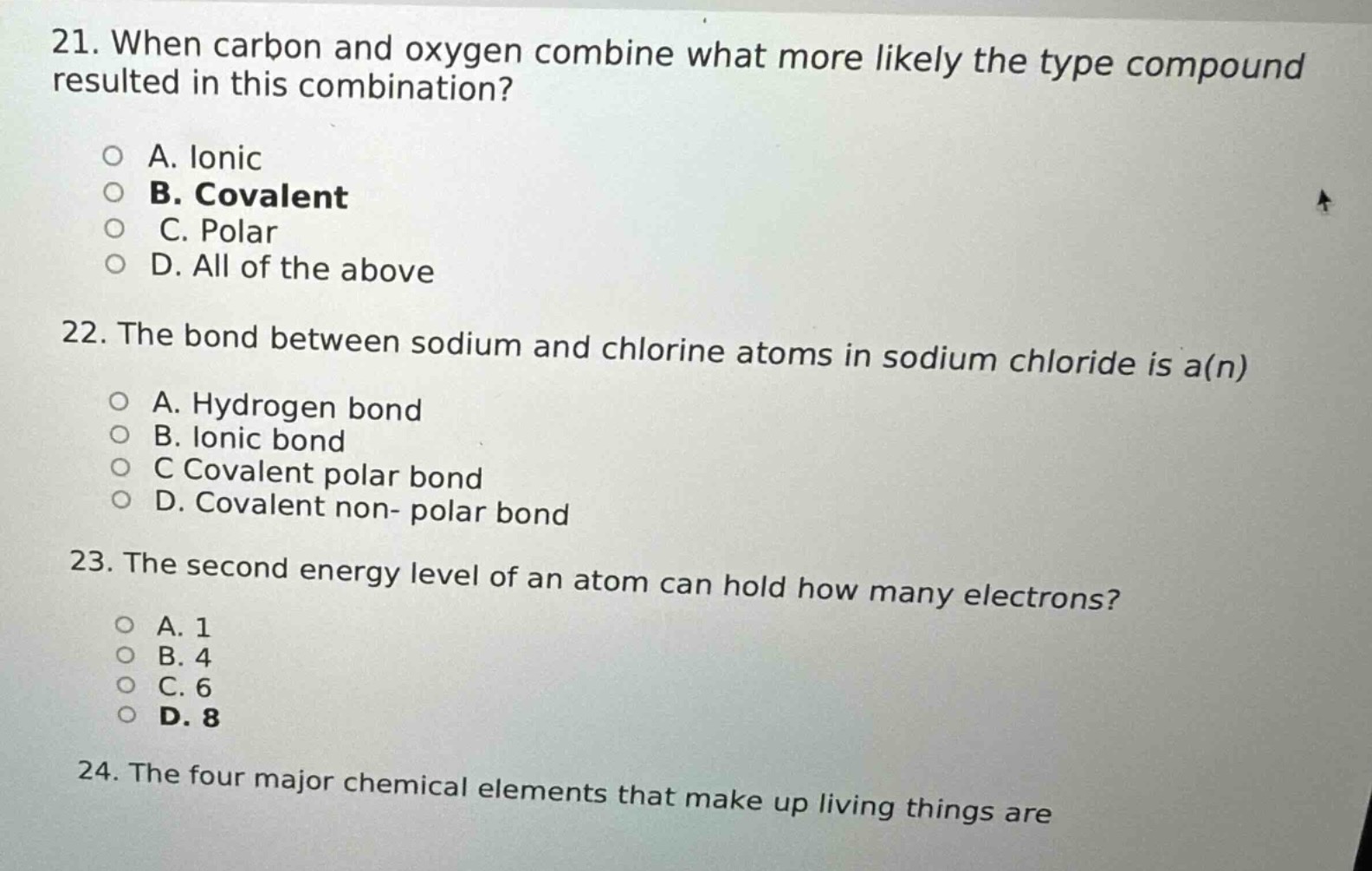
21. when carbon and oxygen combine what more likely the type compound resulted in this combination?\n\na. ionic\nb. covalent\nc. polar\nd. all of the above\n\n22. the bond between sodium and chlorine atoms in sodium chloride is a(n)\n\na. hydrogen bond\nb. ionic bond\nc covalent polar bond\nd. covalent non - polar bond\n\n23. the second energy level of an atom can hold how many electrons?\n\na. 1\nb. 4\nc. 6\nd. 8\n\n24. the four major chemical elements that make up living things are
Answer
Brief Explanations:
- For question 21: Carbon and oxygen are non - metals. Non - metals combine to form covalent compounds.
- For question 22: Sodium is a metal and chlorine is a non - metal. Metals and non - metals form ionic bonds.
- For question 23: The formula to calculate the number of electrons in an energy level is (2n^{2}), where (n = 2) for the second energy level. So (2\times2^{2}=8).
- For question 24: The four major chemical elements in living things are carbon, hydrogen, oxygen, and nitrogen.
Answer:
- B. Covalent
- B. Ionic bond
- D. 8
- (No options provided in the question for this part, but the elements are carbon, hydrogen, oxygen, nitrogen)