21. how many molecules are in 18.0 g of h₂o?\n22. how many atoms are in 24.0 g of carbon?\n23. how many…
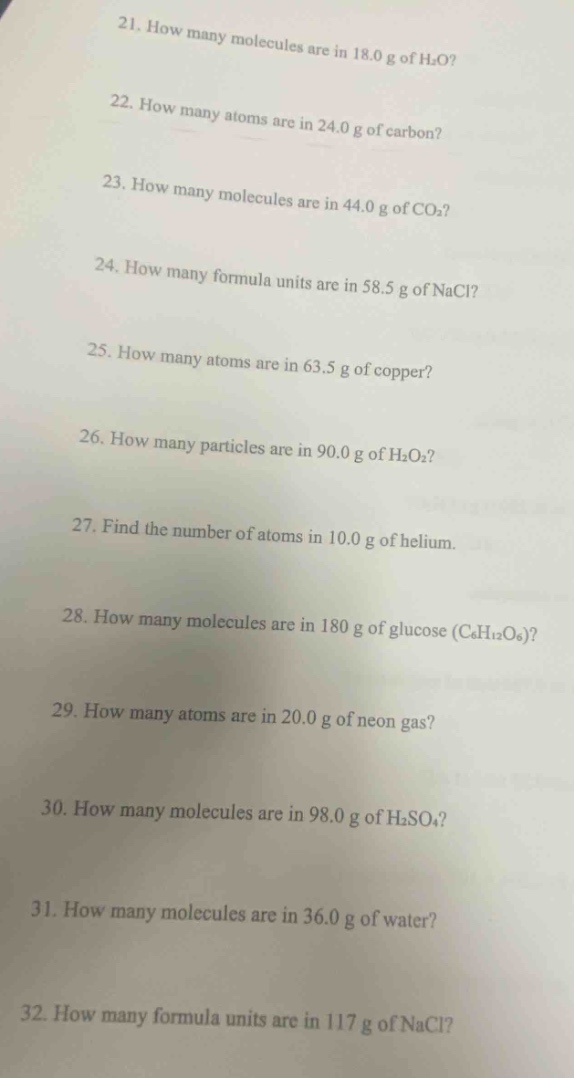
21. how many molecules are in 18.0 g of h₂o?\n22. how many atoms are in 24.0 g of carbon?\n23. how many molecules are in 44.0 g of co₂?\n24. how many formula units are in 58.5 g of nacl?\n25. how many atoms are in 63.5 g of copper?\n26. how many particles are in 90.0 g of h₂o₂?\n27. find the number of atoms in 10.0 g of helium.\n28. how many molecules are in 180 g of glucose (c₆h₁₂o₆)?\n29. how many atoms are in 20.0 g of neon gas?\n30. how many molecules are in 98.0 g of h₂so₄?\n31. how many molecules are in 36.0 g of water?\n32. how many formula units are in 117 g of nacl?
Answer
21. How many molecules are in 18.0 g of H₂O?
Explanation:
Step1: Calculate molar mass of H₂O
The molar mass of H₂O: H has a molar - mass of 1.01 g/mol and O has a molar - mass of 16.00 g/mol. So, $M_{H_2O}=2\times1.01 + 16.00=18.02$ g/mol.
Step2: Calculate number of moles
The number of moles $n=\frac{m}{M}$, where $m = 18.0$ g and $M = 18.02$ g/mol. So, $n=\frac{18.0}{18.02}\approx1.00$ mol.
Step3: Calculate number of molecules
Using Avogadro's number $N_A = 6.022\times10^{23}$ molecules/mol. The number of molecules $N=n\times N_A$. So, $N = 1.00\times6.022\times10^{23}=6.022\times10^{23}$ molecules.
Answer:
$6.022\times10^{23}$ molecules
22. How many atoms are in 24.0 g of carbon?
Explanation:
Step1: Determine molar mass of carbon
The molar mass of carbon $M = 12.01$ g/mol.
Step2: Calculate number of moles
$n=\frac{m}{M}$, with $m = 24.0$ g and $M = 12.01$ g/mol. So, $n=\frac{24.0}{12.01}\approx2.00$ mol.
Step3: Calculate number of atoms
Using Avogadro's number $N_A=6.022\times10^{23}$ atoms/mol. The number of atoms $N=n\times N_A$. So, $N = 2.00\times6.022\times10^{23}=1.2044\times10^{24}$ atoms.
Answer:
$1.2044\times10^{24}$ atoms
23. How many molecules are in 44.0 g of CO₂?
Explanation:
Step1: Calculate molar mass of CO₂
The molar mass of CO₂: C has a molar - mass of 12.01 g/mol and O has a molar - mass of 16.00 g/mol. So, $M_{CO_2}=12.01+2\times16.00 = 44.01$ g/mol.
Step2: Calculate number of moles
$n=\frac{m}{M}$, with $m = 44.0$ g and $M = 44.01$ g/mol. So, $n=\frac{44.0}{44.01}\approx1.00$ mol.
Step3: Calculate number of molecules
Using Avogadro's number $N_A = 6.022\times10^{23}$ molecules/mol. The number of molecules $N=n\times N_A$. So, $N = 1.00\times6.022\times10^{23}=6.022\times10^{23}$ molecules.
Answer:
$6.022\times10^{23}$ molecules
24. How many formula units are in 58.5 g of NaCl?
Explanation:
Step1: Calculate molar mass of NaCl
The molar mass of NaCl: Na has a molar - mass of 22.99 g/mol and Cl has a molar - mass of 35.45 g/mol. So, $M_{NaCl}=22.99 + 35.45=58.44$ g/mol.
Step2: Calculate number of moles
$n=\frac{m}{M}$, with $m = 58.5$ g and $M = 58.44$ g/mol. So, $n=\frac{58.5}{58.44}\approx1.00$ mol.
Step3: Calculate number of formula units
Using Avogadro's number $N_A = 6.022\times10^{23}$ formula units/mol. The number of formula units $N=n\times N_A$. So, $N = 1.00\times6.022\times10^{23}=6.022\times10^{23}$ formula units.
Answer:
$6.022\times10^{23}$ formula units
25. How many atoms are in 63.5 g of copper?
Explanation:
Step1: Determine molar mass of copper
The molar mass of copper $M = 63.55$ g/mol.
Step2: Calculate number of moles
$n=\frac{m}{M}$, with $m = 63.5$ g and $M = 63.55$ g/mol. So, $n=\frac{63.5}{63.55}\approx1.00$ mol.
Step3: Calculate number of atoms
Using Avogadro's number $N_A=6.022\times10^{23}$ atoms/mol. The number of atoms $N=n\times N_A$. So, $N = 1.00\times6.022\times10^{23}=6.022\times10^{23}$ atoms.
Answer:
$6.022\times10^{23}$ atoms
26. How many particles are in 90.0 g of H₂O₂?
Explanation:
Step1: Calculate molar mass of H₂O₂
The molar mass of H₂O₂: H has a molar - mass of 1.01 g/mol and O has a molar - mass of 16.00 g/mol. So, $M_{H_2O_2}=2\times1.01+2\times16.00 = 34.02$ g/mol.
Step2: Calculate number of moles
$n=\frac{m}{M}$, with $m = 90.0$ g and $M = 34.02$ g/mol. So, $n=\frac{90.0}{34.02}\approx2.65$ mol.
Step3: Calculate number of particles
Using Avogadro's number $N_A = 6.022\times10^{23}$ particles/mol. The number of particles $N=n\times N_A$. So, $N = 2.65\times6.022\times10^{23}=1.596\times10^{24}$ particles.
Answer:
$1.596\times10^{24}$ particles
27. Find the number of atoms in 10.0 g of helium.
Explanation:
Step1: Determine molar mass of helium
The molar mass of helium $M = 4.00$ g/mol.
Step2: Calculate number of moles
$n=\frac{m}{M}$, with $m = 10.0$ g and $M = 4.00$ g/mol. So, $n=\frac{10.0}{4.00}=2.5$ mol.
Step3: Calculate number of atoms
Using Avogadro's number $N_A=6.022\times10^{23}$ atoms/mol. The number of atoms $N=n\times N_A$. So, $N = 2.5\times6.022\times10^{23}=1.5055\times10^{24}$ atoms.
Answer:
$1.5055\times10^{24}$ atoms
28. How many molecules are in 180 g of glucose (C₆H₁₂O₆)?
Explanation:
Step1: Calculate molar mass of C₆H₁₂O₆
$M_{C_6H_{12}O_6}=6\times12.01+12\times1.01 + 6\times16.00=180.18$ g/mol.
Step2: Calculate number of moles
$n=\frac{m}{M}$, with $m = 180$ g and $M = 180.18$ g/mol. So, $n=\frac{180}{180.18}\approx1.00$ mol.
Step3: Calculate number of molecules
Using Avogadro's number $N_A = 6.022\times10^{23}$ molecules/mol. The number of molecules $N=n\times N_A$. So, $N = 1.00\times6.022\times10^{23}=6.022\times10^{23}$ molecules.
Answer:
$6.022\times10^{23}$ molecules
29. How many atoms are in 20.0 g of neon gas?
Explanation:
Step1: Determine molar mass of neon
The molar mass of neon $M = 20.18$ g/mol.
Step2: Calculate number of moles
$n=\frac{m}{M}$, with $m = 20.0$ g and $M = 20.18$ g/mol. So, $n=\frac{20.0}{20.18}\approx0.991$ mol.
Step3: Calculate number of atoms
Using Avogadro's number $N_A=6.022\times10^{23}$ atoms/mol. The number of atoms $N=n\times N_A$. So, $N = 0.991\times6.022\times10^{23}=5.968\times10^{23}$ atoms.
Answer:
$5.968\times10^{23}$ atoms
30. How many molecules are in 98.0 g of H₂SO₄?
Explanation:
Step1: Calculate molar mass of H₂SO₄
$M_{H_2SO_4}=2\times1.01+32.07+4\times16.00 = 98.09$ g/mol.
Step2: Calculate number of moles
$n=\frac{m}{M}$, with $m = 98.0$ g and $M = 98.09$ g/mol. So, $n=\frac{98.0}{98.09}\approx1.00$ mol.
Step3: Calculate number of molecules
Using Avogadro's number $N_A = 6.022\times10^{23}$ molecules/mol. The number of molecules $N=n\times N_A$. So, $N = 1.00\times6.022\times10^{23}=6.022\times10^{23}$ molecules.
Answer:
$6.022\times10^{23}$ molecules
31. How many molecules are in 36.0 g of water?
Explanation:
Step1: Calculate molar mass of H₂O
$M_{H_2O}=2\times1.01 + 16.00=18.02$ g/mol.
Step2: Calculate number of moles
$n=\frac{m}{M}$, with $m = 36.0$ g and $M = 18.02$ g/mol. So, $n=\frac{36.0}{18.02}\approx2.00$ mol.
Step3: Calculate number of molecules
Using Avogadro's number $N_A = 6.022\times10^{23}$ molecules/mol. The number of molecules $N=n\times N_A$. So, $N = 2.00\times6.022\times10^{23}=1.2044\times10^{24}$ molecules.
Answer:
$1.2044\times10^{24}$ molecules
32. How many formula units are in 117 g of NaCl?
Explanation:
Step1: Calculate molar mass of NaCl
$M_{NaCl}=22.99 + 35.45=58.44$ g/mol.
Step2: Calculate number of moles
$n=\frac{m}{M}$, with $m = 117$ g and $M = 58.44$ g/mol. So, $n=\frac{117}{58.44}=2.00$ mol.
Step3: Calculate number of formula units
Using Avogadro's number $N_A = 6.022\times10^{23}$ formula units/mol. The number of formula units $N=n\times N_A$. So, $N = 2.00\times6.022\times10^{23}=1.2044\times10^{24}$ formula units.
Answer:
$1.2044\times10^{24}$ formula units