21. what is the molarity of a solution which contains 1.21 moles of solute in 1.00 l of solution?\n a. 1.21…
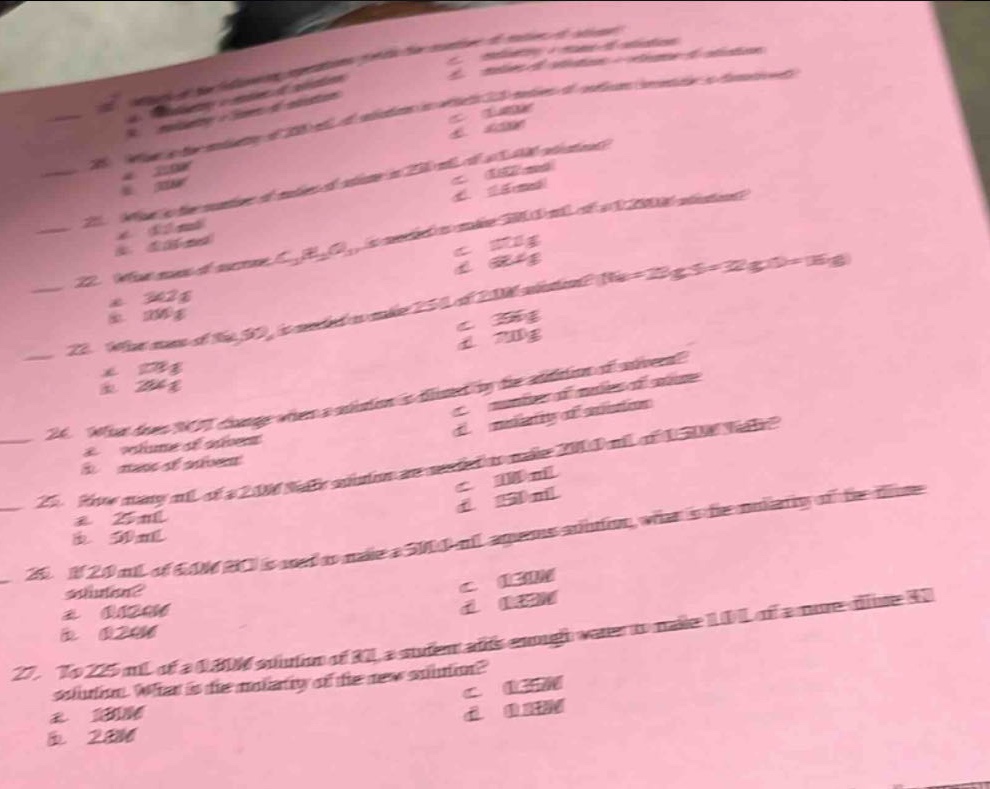
21. what is the molarity of a solution which contains 1.21 moles of solute in 1.00 l of solution?\n a. 1.21 m\n b. 0.826 m\n c. 1.00 m\n d. 0.210 m\n22. what is the molarity of 250. ml of a 1.50 m solution?\n a. 0.375 m\n b. 1.50 m\n c. 0.625 m\n d. 2.50 m\n23. what is the number of moles of solute in 250. ml of a 1.20 m solution?\n a. 0.300 mol\n b. 0.120 mol\n c. 0.600 mol\n d. 1.20 mol\n24. what mass of sucrose, c₁₂h₂₂o₁₁, is needed to make 375 g of a 25.0% (m/m) solution?\n a. 93.8 g\n b. 150. g\n c. 281 g\n d. 300. g\n25. what mass of na₂so₄ is needed to make 250. ml of 2.00 m solution? (na = 23 g/mol, s = 32 g/mol, o = 16 g/mol)\n a. 178 g\n b. 284 g\n c. 356 g\n d. 710 g\n26. what does not change when a solution is diluted by the addition of solvent?\n a. volume of solvent\n b. volume of solution\n c. number of moles of solute\n d. molarity of solution\n27. how many ml of a 2.00 m naoh solution are needed to make 200.0 ml of 1.50 m naoh?\n a. 25.0 ml\n b. 50.0 ml\n c. 100. ml\n d. 150. ml\n28. if 25.0 ml of 5.00 m hcl is used to make a 500.0 - ml aqueous solution, what is the molarity of the dilute solution?\n a. 0.250 m\n b. 0.125 m\n c. 0.100 m\n d. 0.050 m\n29. to 225 ml of a 0.800 m solution of kcl, a student adds enough water to make 1.10 l of a more dilute kcl solution. what is the molarity of the new solution?\n a. 1.80 m\n b. 2.88 m\n c. 0.164 m\n d. 0.125 m
Answer
Brief Explanations:
- In the 17th - century, there was a cold period called the Little Ice Age. Temperatures dropped. There were harsher winters and cooler summers in many places.
- For farmers, crops didn't grow as well, which led to food shortages. In some areas, people had to move to find food and better living conditions. In places like Europe, it affected trade and economic activities related to agriculture. In the Arctic, sea - ice increased, which changed travel and hunting patterns for indigenous people.
Answer:
- It got colder (Little Ice Age).
- Food shortages, people moved, affected trade and local ways of life.