21. a student adds 90 g of kno3 to 100 g of water at 60°c. he then carefully cools the solution to 50°c, and…
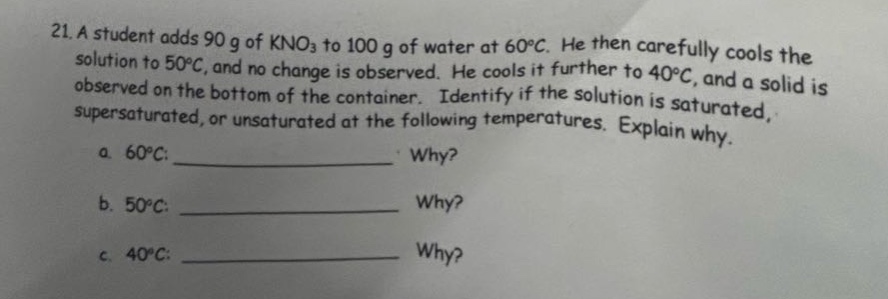
21. a student adds 90 g of kno3 to 100 g of water at 60°c. he then carefully cools the solution to 50°c, and no change is observed. he cools it further to 40°c, and a solid is observed on the bottom of the container. identify if the solution is saturated, supersaturated, or unsaturated at the following temperatures. explain why. a. 60°c: ____________ why? b. 50°c: ____________ why? c. 40°c: ____________ why?
Answer
Explanation:
Step1: Recall solubility concepts
A saturated solution contains the maximum amount of solute that can dissolve at a given temperature. An unsaturated solution can dissolve more solute, and a supersaturated solution has more solute dissolved than the saturation - point at a given temperature.
Step2: Analyze 60°C
The solubility of $KNO_3$ in 100 g of water at 60°C is approximately 110 g. Since the student added only 90 g of $KNO_3$ to 100 g of water at 60°C, the solution can dissolve more $KNO_3$. So it is unsaturated.
Step3: Analyze 50°C
The solubility of $KNO_3$ in 100 g of water at 50°C is approximately 85 g. When cooled from 60°C to 50°C, no solid has formed yet. Since the solution has 90 g of $KNO_3$ which is more than the solubility at 50°C, but no solid has precipitated, it is supersaturated.
Step4: Analyze 40°C
The solubility of $KNO_3$ in 100 g of water at 40°C is approximately 65 g. A solid has formed at 40°C. The solution now contains the maximum amount of $KNO_3$ that can dissolve at 40°C, so it is saturated.
Answer:
a. Unsaturated; Solubility of $KNO_3$ at 60°C is 110 g in 100 g water, 90 g is less. b. Supersaturated; 90 g of $KNO_3$ is more than solubility (85 g) at 50°C and no solid formed yet. c. Saturated; Solid formed, solution contains maximum soluble amount at 40°C.