25. what is left after a planetary nebula forms?\na) red dwarf\nb) protostar\nc) white dwarf\nd) neutron…
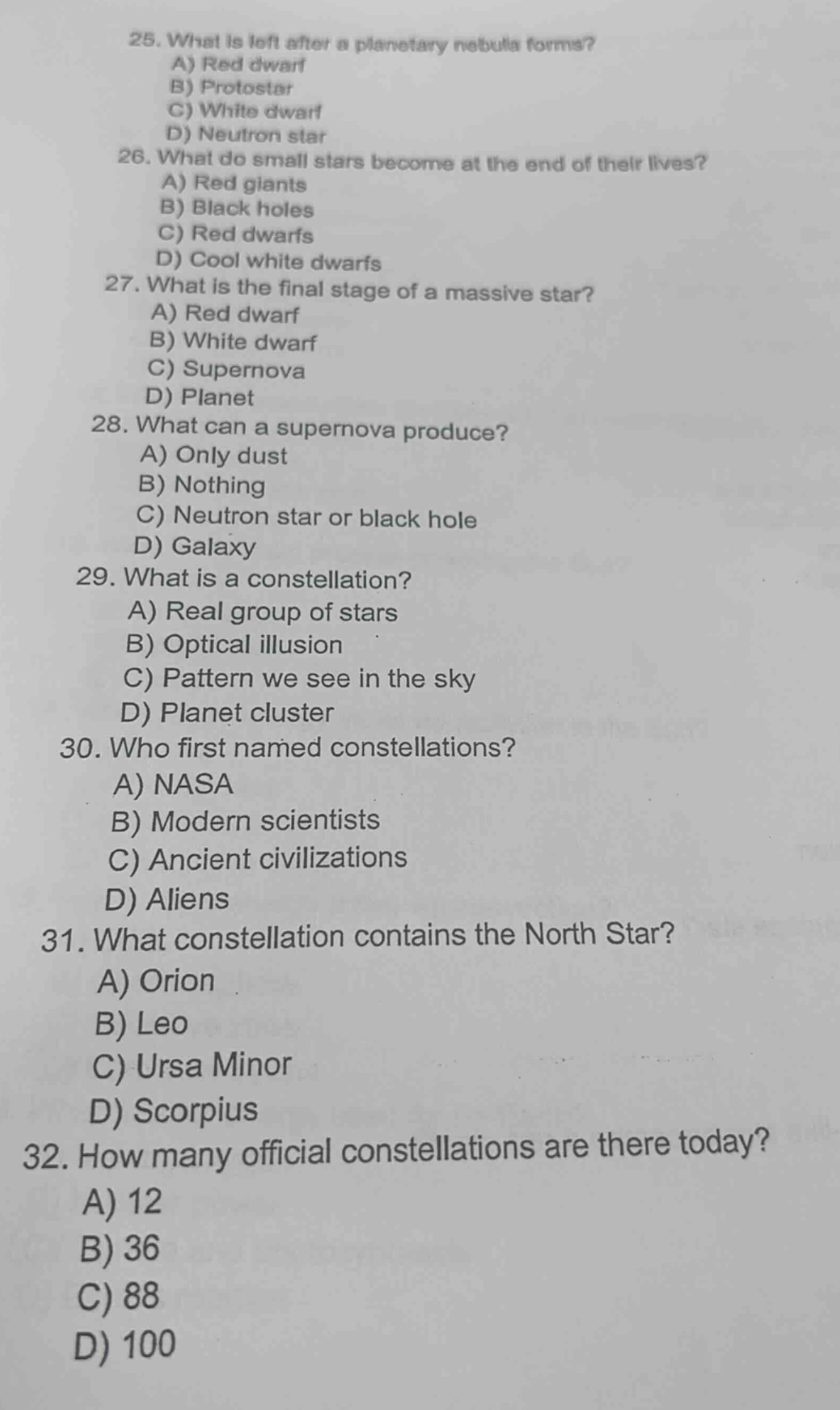
25. what is left after a planetary nebula forms?\na) red dwarf\nb) protostar\nc) white dwarf\nd) neutron star\n26. what do small stars become at the end of their lives?\na) red giants\nb) black holes\nc) red dwarfs\nd) cool white dwarfs\n27. what is the final stage of a massive star?\na) red dwarf\nb) white dwarf\nc) supernova\nd) planet\n28. what can a supernova produce?\na) only dust\nb) nothing\nc) neutron star or black hole\nd) galaxy\n29. what is a constellation?\na) real group of stars\nb) optical illusion\nc) pattern we see in the sky\nd) planet cluster\n30. who first named constellations?\na) nasa\nb) modern scientists\nc) ancient civilizations\nd) aliens\n31. what constellation contains the north star?\na) orion\nb) leo\nc) ursa minor\nd) scorpius\n32. how many official constellations are there today?\na) 12\nb) 36\nc) 88\nd) 100
Answer
Brief Explanations:
-
- When a planetary nebula forms, the core of the star is left as a white - dwarf.
-
- Small stars become cool white dwarfs at the end of their lives.
-
- The final stage of a massive star is a supernova.
-
- A supernova can produce a neutron star or a black hole.
-
- A constellation is a pattern we see in the sky.
-
- Ancient civilizations first named constellations.
-
- The constellation Ursa Minor contains the North Star.
-
- There are 88 official constellations today.
Answer:
- C. White dwarf
- D. Cool white dwarfs
- C. Supernova
- C. Neutron star or black hole
- C. Pattern we see in the sky
- C. Ancient civilizations
- C. Ursa Minor
- C. 88