26. the half - life of sulfur - 35 is 87.32 days. sulfur - 35 is used in radiation therapy to prevent…
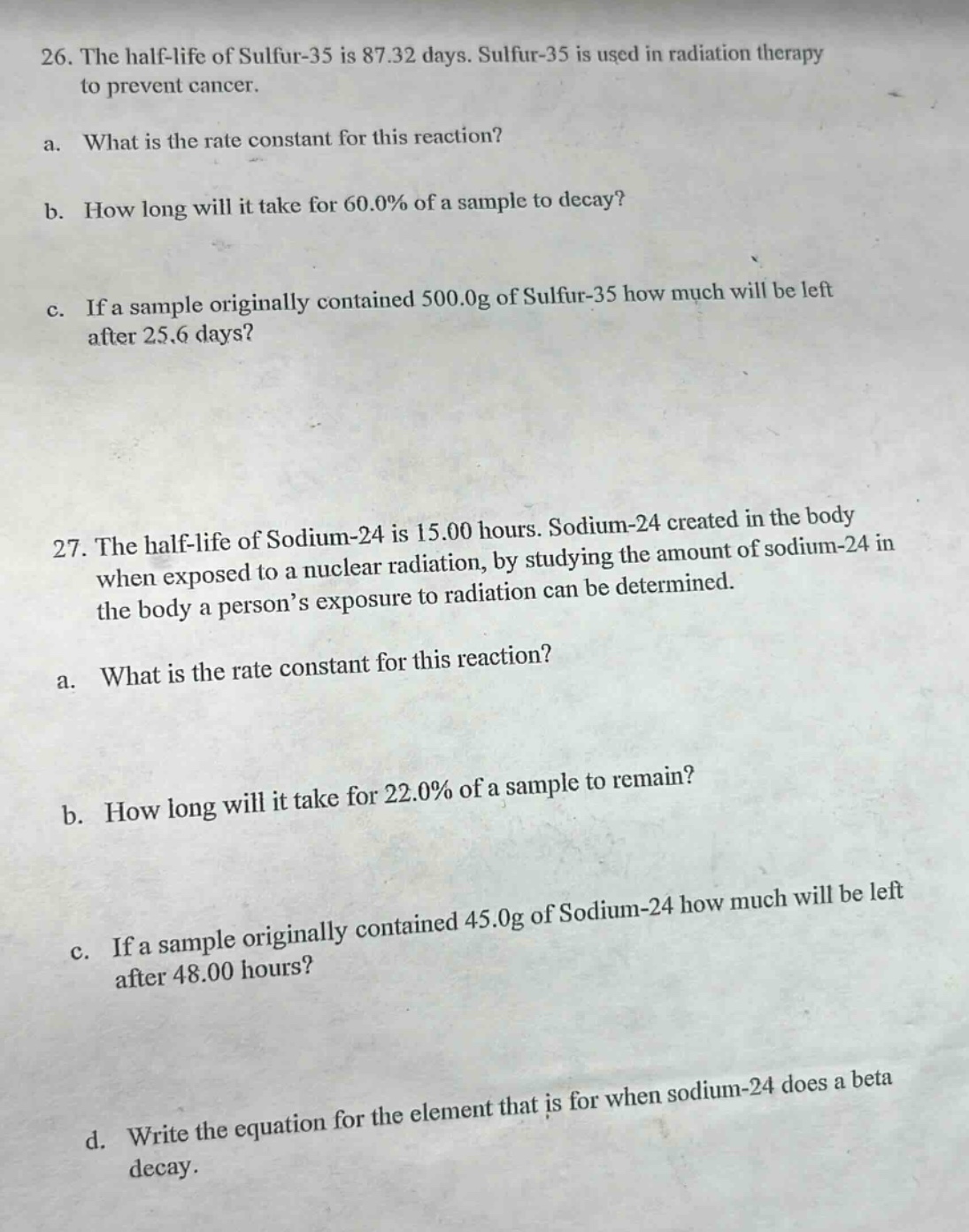
26. the half - life of sulfur - 35 is 87.32 days. sulfur - 35 is used in radiation therapy to prevent cancer.\na. what is the rate constant for this reaction?\nb. how long will it take for 60.0% of a sample to decay?\nc. if a sample originally contained 500.0g of sulfur - 35 how much will be left after 25.6 days?\n27. the half - life of sodium - 24 is 15.00 hours. sodium - 24 created in the body when exposed to a nuclear radiation, by studying the amount of sodium - 24 in the body a person’s exposure to radiation can be determined.\na. what is the rate constant for this reaction?\nb. how long will it take for 22.0% of a sample to remain?\nc. if a sample originally contained 45.0g of sodium - 24 how much will be left after 48.00 hours?\nd. write the equation for the element that is for when sodium - 24 does a beta decay.
Answer
Problem 26
a.
Explanation:
Step1: Recall half - life formula for first - order reaction
The formula for the half - life ($t_{1/2}$) of a first - order reaction is $t_{1/2}=\frac{\ln 2}{k}$, where $k$ is the rate constant. We can solve for $k$. $k = \frac{\ln 2}{t_{1/2}}$
Step2: Substitute the given half - life value
Given $t_{1/2}=87.32$ days, so $k=\frac{\ln 2}{87.32}\text{ days}^{-1}\approx\frac{0.693}{87.32}\text{ days}^{-1}\approx 7.94\times 10^{-3}\text{ days}^{-1}$
Answer:
$k\approx7.94\times 10^{-3}\text{ days}^{-1}$
b.
Explanation:
Step1: Determine the fraction remaining
If 60.0% decays, then the fraction remaining $N/N_0=1 - 0.600 = 0.400$. For a first - order reaction, the integrated rate law is $\ln\left(\frac{N}{N_0}\right)=-kt$. We can solve for $t$. $t=-\frac{\ln\left(\frac{N}{N_0}\right)}{k}$
Step2: Substitute the values of $k$ and $\frac{N}{N_0}$
We know $k = 7.94\times 10^{-3}\text{ days}^{-1}$ and $\frac{N}{N_0}=0.400$. So $t=-\frac{\ln(0.400)}{7.94\times 10^{-3}\text{ days}^{-1}}=\frac{-(- 0.916)}{7.94\times 10^{-3}\text{ days}^{-1}}\approx115\text{ days}$
Answer:
$t\approx115\text{ days}$
c.
Explanation:
Step1: Use the integrated rate law
The integrated rate law for a first - order reaction is $\ln\left(\frac{N}{N_0}\right)=-kt$. First, find $k = 7.94\times 10^{-3}\text{ days}^{-1}$ and $t = 25.6$ days. Then $\ln\left(\frac{N}{N_0}\right)=-7.94\times 10^{-3}\text{ days}^{-1}\times25.6\text{ days}\approx - 0.203$
Step2: Solve for $N$
Exponentiating both sides, $\frac{N}{N_0}=e^{- 0.203}\approx0.816$. Given $N_0 = 500.0$ g, then $N=0.816\times500.0\text{ g}=408\text{ g}$
Answer:
$N = 408\text{ g}$
Problem 27
a.
Explanation:
Step1: Recall half - life formula for first - order reaction
Using $t_{1/2}=\frac{\ln 2}{k}$, we solve for $k$. So $k=\frac{\ln 2}{t_{1/2}}$
Step2: Substitute the given half - life value
Given $t_{1/2}=15.00$ hours, then $k=\frac{\ln 2}{15.00}\text{ hours}^{-1}\approx\frac{0.693}{15.00}\text{ hours}^{-1}=4.62\times 10^{-2}\text{ hours}^{-1}$
Answer:
$k = 4.62\times 10^{-2}\text{ hours}^{-1}$
b.
Explanation:
Step1: Determine the fraction remaining
The fraction remaining $N/N_0 = 0.220$. Using the integrated rate law $\ln\left(\frac{N}{N_0}\right)=-kt$, we solve for $t$. So $t=-\frac{\ln\left(\frac{N}{N_0}\right)}{k}$
Step2: Substitute the values of $k$ and $\frac{N}{N_0}$
We know $k = 4.62\times 10^{-2}\text{ hours}^{-1}$ and $\frac{N}{N_0}=0.220$. Then $t=-\frac{\ln(0.220)}{4.62\times 10^{-2}\text{ hours}^{-1}}=\frac{-(-1.514)}{4.62\times 10^{-2}\text{ hours}^{-1}}\approx32.8\text{ hours}$
Answer:
$t\approx32.8\text{ hours}$
c.
Explanation:
Step1: Use the integrated rate law
The integrated rate law is $\ln\left(\frac{N}{N_0}\right)=-kt$. Here, $k = 4.62\times 10^{-2}\text{ hours}^{-1}$ and $t = 48.00$ hours. So $\ln\left(\frac{N}{N_0}\right)=-4.62\times 10^{-2}\text{ hours}^{-1}\times48.00\text{ hours}\approx - 2.22$
Step2: Solve for $N$
Exponentiating both sides, $\frac{N}{N_0}=e^{-2.22}\approx0.110$. Given $N_0 = 45.0$ g, then $N=0.110\times45.0\text{ g}=4.95\text{ g}$
Answer:
$N = 4.95\text{ g}$
d.
Explanation:
Step1: Write the beta - decay equation
In beta decay, a neutron in the nucleus is converted into a proton and an electron (beta particle). The atomic number increases by 1 and the mass number remains the same. For sodium - 24 (${11}^{24}Na$), the beta - decay equation is ${11}^{24}Na\rightarrow_{12}^{24}Mg + _{- 1}^{0}e$
Answer:
${11}^{24}Na\rightarrow{12}^{24}Mg + _{- 1}^{0}e$