26) how many moles of kcl are present in 95.3 ml of 2.10 m kcl?\n27) in the following reaction, identify the…
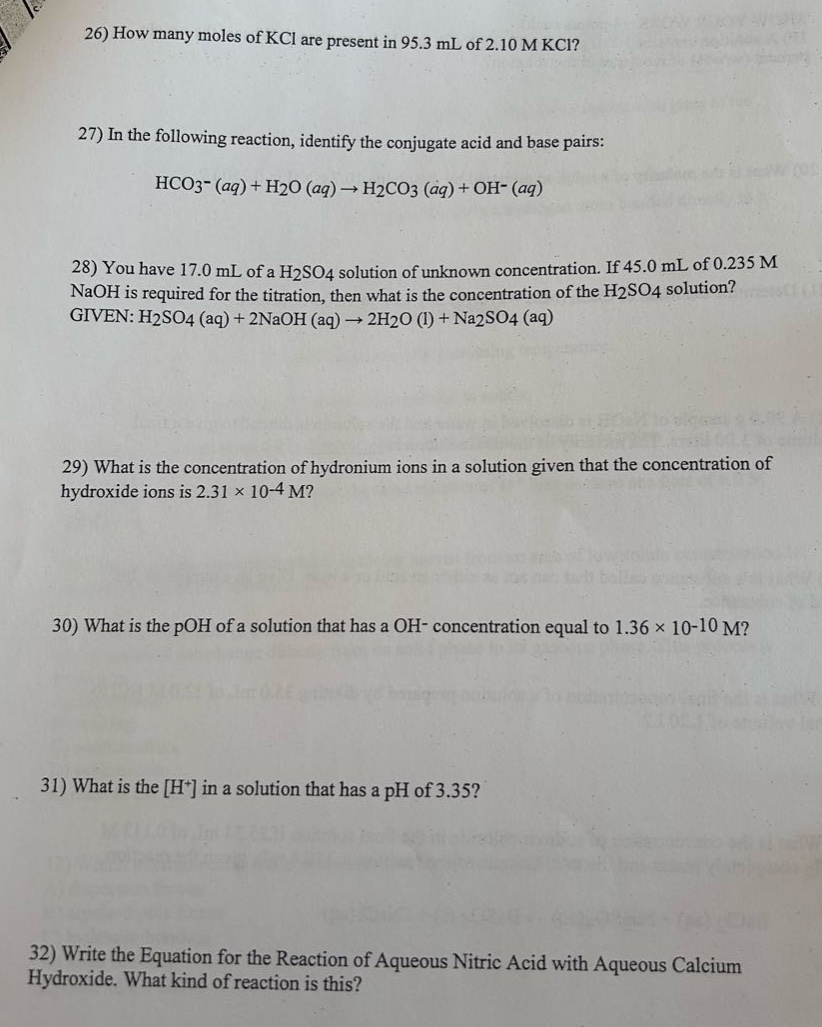
26) how many moles of kcl are present in 95.3 ml of 2.10 m kcl?\n27) in the following reaction, identify the conjugate acid and base pairs:\nhco3−(aq)+h2o(aq)→h2co3(aq)+oh−(aq)\n28) you have 17.0 ml of a h2so4 solution of unknown concentration. if 45.0 ml of 0.235 m naoh is required for the titration, then what is the concentration of the h2so4 solution? given: h2so4(aq)+2naoh(aq)→2h2o(l)+na2so4(aq)\n29) what is the concentration of hydronium ions in a solution given that the concentration of hydroxide ions is 2.31×10⁻⁴ m?\n30) what is the poh of a solution that has a oh− concentration equal to 1.36×10⁻¹⁰ m?\n31) what is the h+ in a solution that has a ph of 3.35?\n32) write the equation for the reaction of aqueous nitric acid with aqueous calcium hydroxide. what kind of reaction is this?
Answer
26)
Explanation:
Step1: Convert volume to liters
The volume $V = 95.3\ mL=95.3\times10^{- 3}\ L$.
Step2: Use the molarity formula
The molarity formula is $M=\frac{n}{V}$, where $M$ is molarity, $n$ is the number of moles and $V$ is volume in liters. Rearranging for $n$, we get $n = M\times V$. Given $M = 2.10\ M$ and $V=95.3\times10^{-3}\ L$, then $n=2.10\ mol/L\times95.3\times10^{-3}\ L$. $n = 2.10\times95.3\times10^{-3}\ mol=0.20013\ mol\approx0.200\ mol$.
Answer:
$0.200\ mol$
27)
Brief Explanations:
In the reaction $HCO_3^-(aq)+H_2O(aq)\rightarrow H_2CO_3(aq)+OH^-(aq)$, an acid - base conjugate pair differs by a single proton ($H^+$). The acid donates a proton to form its conjugate base and the base accepts a proton to form its conjugate acid. Here, $HCO_3^-$ is the base and $H_2CO_3$ is its conjugate acid; $H_2O$ is the acid and $OH^-$ is its conjugate base.
Answer:
Conjugate acid - base pairs: $HCO_3^-/H_2CO_3$ and $H_2O/OH^-$
28)
Explanation:
Step1: Determine the moles of $NaOH$
Use the formula $n = M\times V$. For $NaOH$, $M = 0.235\ M$ and $V = 45.0\ mL=45.0\times10^{-3}\ L$. So $n_{NaOH}=0.235\ mol/L\times45.0\times10^{-3}\ L = 0.010575\ mol$.
Step2: Use the mole - ratio from the balanced equation
From the balanced equation $H_2SO_4(aq)+2NaOH(aq)\rightarrow2H_2O(l)+Na_2SO_4(aq)$, the mole - ratio of $H_2SO_4$ to $NaOH$ is $n_{H_2SO_4}=\frac{1}{2}n_{NaOH}$. So $n_{H_2SO_4}=\frac{1}{2}\times0.010575\ mol = 0.0052875\ mol$.
Step3: Calculate the molarity of $H_2SO_4$
The volume of $H_2SO_4$ is $V_{H_2SO_4}=17.0\ mL = 17.0\times10^{-3}\ L$. Using the molarity formula $M=\frac{n}{V}$, we have $M_{H_2SO_4}=\frac{0.0052875\ mol}{17.0\times10^{-3}\ L}\approx0.311\ M$.
Answer:
$0.311\ M$
29)
Explanation:
Step1: Use the ion - product constant of water
The ion - product constant of water is $K_w=[H_3O^+][OH^-]=1.0\times10^{-14}$ at $25^{\circ}C$. We are given $[OH^-]=2.31\times10^{-4}\ M$. Rearranging for $[H_3O^+]$, we get $[H_3O^+]=\frac{K_w}{[OH^-]}$.
Step2: Calculate the hydronium ion concentration
$[H_3O^+]=\frac{1.0\times10^{-14}}{2.31\times10^{-4}}=\frac{1.0}{2.31}\times10^{-10}\ M\approx4.33\times10^{-11}\ M$.
Answer:
$4.33\times10^{-11}\ M$
30)
Explanation:
Step1: Use the pOH formula
The pOH formula is $pOH=-\log[OH^-]$. Given $[OH^-]=1.36\times10^{-10}\ M$.
Step2: Calculate pOH
$pOH =-\log(1.36\times10^{-10})=-( \log(1.36)+\log(10^{-10}))$. Since $\log(10^{-10})=- 10$ and $\log(1.36)\approx0.133$, then $pOH=-(0.133 - 10)=9.867\approx9.87$.
Answer:
$9.87$
31)
Explanation:
Step1: Use the pH formula
The pH formula is $pH =-\log[H^+]$. Rearranging for $[H^+]$, we get $[H^+]=10^{-pH}$.
Step2: Calculate the hydrogen ion concentration
Given $pH = 3.35$, then $[H^+]=10^{-3.35}\ M\approx4.47\times10^{-4}\ M$.
Answer:
$4.47\times10^{-4}\ M$
32)
Brief Explanations:
The reaction between aqueous nitric acid ($HNO_3$) and aqueous calcium hydroxide ($Ca(OH)_2$) is an acid - base neutralization reaction. The balanced chemical equation is $2HNO_3(aq)+Ca(OH)_2(aq)\rightarrow Ca(NO_3)_2(aq)+2H_2O(l)$. In an acid - base neutralization reaction, an acid reacts with a base to form a salt and water.
Answer:
Equation: $2HNO_3(aq)+Ca(OH)_2(aq)\rightarrow Ca(NO_3)_2(aq)+2H_2O(l)$; Reaction type: Acid - base neutralization reaction