27.) a sample of a chemical has an initial amount of 1400 mg. after 1 hour, the sample is 630 mg. after how…
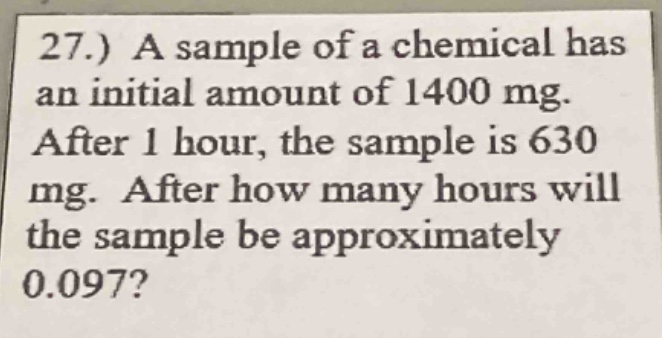
27.) a sample of a chemical has an initial amount of 1400 mg. after 1 hour, the sample is 630 mg. after how many hours will the sample be approximately 0.097?
Answer
Explanation:
Step1: Determine the decay formula
The general formula for exponential decay is $A = A_0e^{-kt}$, where $A$ is the final amount, $A_0$ is the initial amount, $k$ is the decay - constant, and $t$ is the time. Given $A_0 = 1400$ mg and when $t = 1$ hour, $A=630$ mg. Substitute these values into the formula: $630 = 1400e^{-k\times1}$.
Step2: Solve for the decay - constant $k$
First, divide both sides of the equation $630 = 1400e^{-k}$ by 1400: $\frac{630}{1400}=e^{-k}$. Simplify $\frac{630}{1400}=\frac{9}{20}= 0.45$. So, $0.45 = e^{-k}$. Take the natural logarithm of both sides: $\ln(0.45)=-k$. Then $k=-\ln(0.45)\approx0.7985$.
Step3: Find the time $t$ when $A = 0.097$
Substitute $A_0 = 1400$, $A = 0.097$, and $k\approx0.7985$ into the formula $A = A_0e^{-kt}$: $0.097 = 1400e^{-0.7985t}$. First, divide both sides by 1400: $\frac{0.097}{1400}=e^{-0.7985t}$. $\frac{0.097}{1400}\approx6.9286\times10^{-5}$. So, $6.9286\times10^{-5}=e^{-0.7985t}$. Take the natural logarithm of both sides: $\ln(6.9286\times10^{-5})=-0.7985t$. Since $\ln(6.9286\times10^{-5})\approx - 10.77$, then $t=\frac{-10.77}{-0.7985}\approx13.5$.
Answer:
$13.5$ hours