35. choose one discovery or invention that was discussed in this book and describe how ethics play a role in…
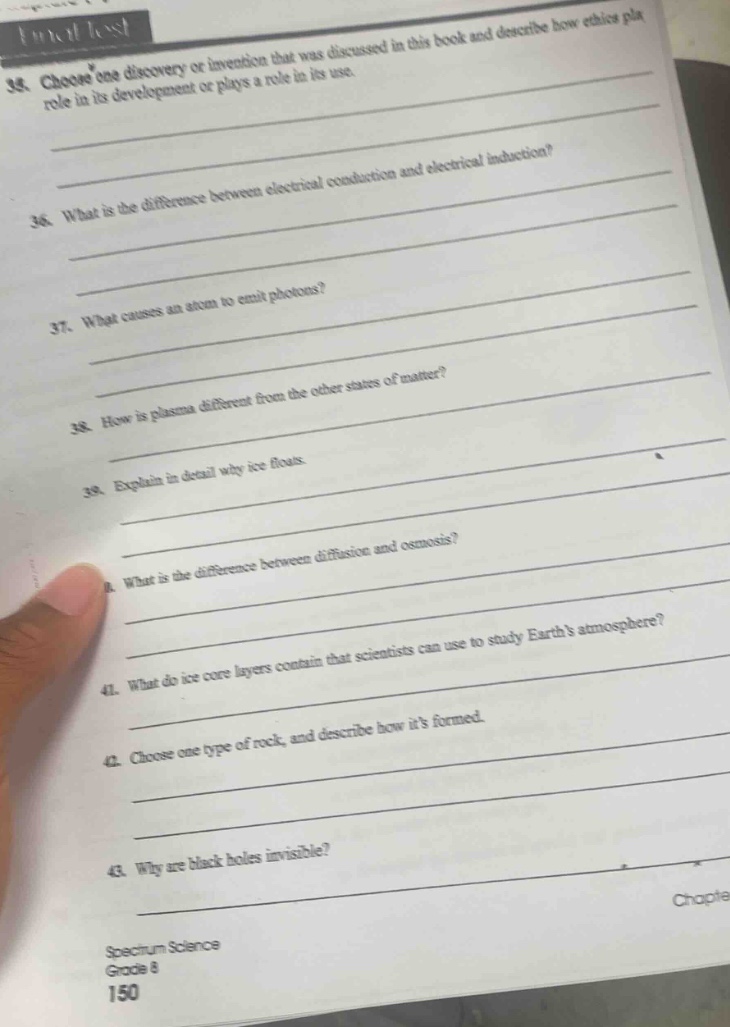
35. choose one discovery or invention that was discussed in this book and describe how ethics play a role in its development or plays a role in its use.\n36. what is the difference between electrical conduction and electrical induction?\n37. what causes an atom to emit photons?\n38. how is plasma different from the other states of matter?\n39. explain in detail why ice floats.\n40. what is the difference between diffusion and osmosis?\n41. what do ice - core layers contain that scientists can use to study earths atmosphere?\n42. choose one type of rock, and describe how its formed.\n43. why are black holes invisible?\nspectrum science\ngrade 8\n150
Answer
Answer:
- (Answer depends on the book content. For example, if the book is about the Internet, ethics played a role in privacy - related regulations during its development.)
- Electrical conduction is the flow of electric charge through a conductor due to an electric field, like electrons moving in a wire. Electrical induction is the production of an electromotive force across an electrical conductor in a changing magnetic field.
- An atom emits photons when an electron transitions from a higher - energy state to a lower - energy state. The energy difference is released as a photon.
- Plasma is different from other states of matter because it is composed of ionized particles (ions and free electrons), and it is affected by electric and magnetic fields in unique ways compared to solids, liquids, and gases.
- Ice floats because ice has a lower density than liquid water. When water freezes, its molecules form a hexagonal lattice structure that creates more space between them compared to liquid water molecules.
- Diffusion is the movement of particles from an area of high concentration to an area of low concentration. Osmosis is the diffusion of water across a semi - permeable membrane from an area of low solute concentration to an area of high solute concentration.
- Ice core layers contain air bubbles that trap ancient atmospheric gases, as well as chemical compounds like dust and isotopes of water molecules which scientists can analyze to study Earth's atmosphere in the past.
- For example, igneous rocks are formed when magma (molten rock beneath the Earth's surface) or lava (molten rock on the Earth's surface) cools and solidifies.
- Black holes are invisible because their gravitational pull is so strong that not even light can escape from them. Since we detect objects by the light they emit or reflect, black holes do not emit or reflect light and thus are invisible.
Explanation:
Step1: Analyze question 35
Answer depends on book.
Step2: Define electrical conduction
Flow of charge in conductor.
Step3: Define electrical induction
EMF production in changing B - field.
Step4: Explain photon emission
Electron energy transition.
Step5: Describe plasma uniqueness
Ionized particles, field effects.
Step6: Explain ice floating
Lower density of ice.
Step7: Differentiate diffusion
Particle movement by concentration.
Step8: Differentiate osmosis
Water diffusion across membrane.
Step9: Identify ice - core contents
Gases, chemicals for study.
Step10: Describe igneous rock formation
Cooling of magma/lava.
Step11: Explain black - hole invisibility
No light can escape.