40 mark for review zn(s) + cu²⁺ ⇌ zn²⁺ + cu(s) an electrolytic cell based on the reaction represented above…
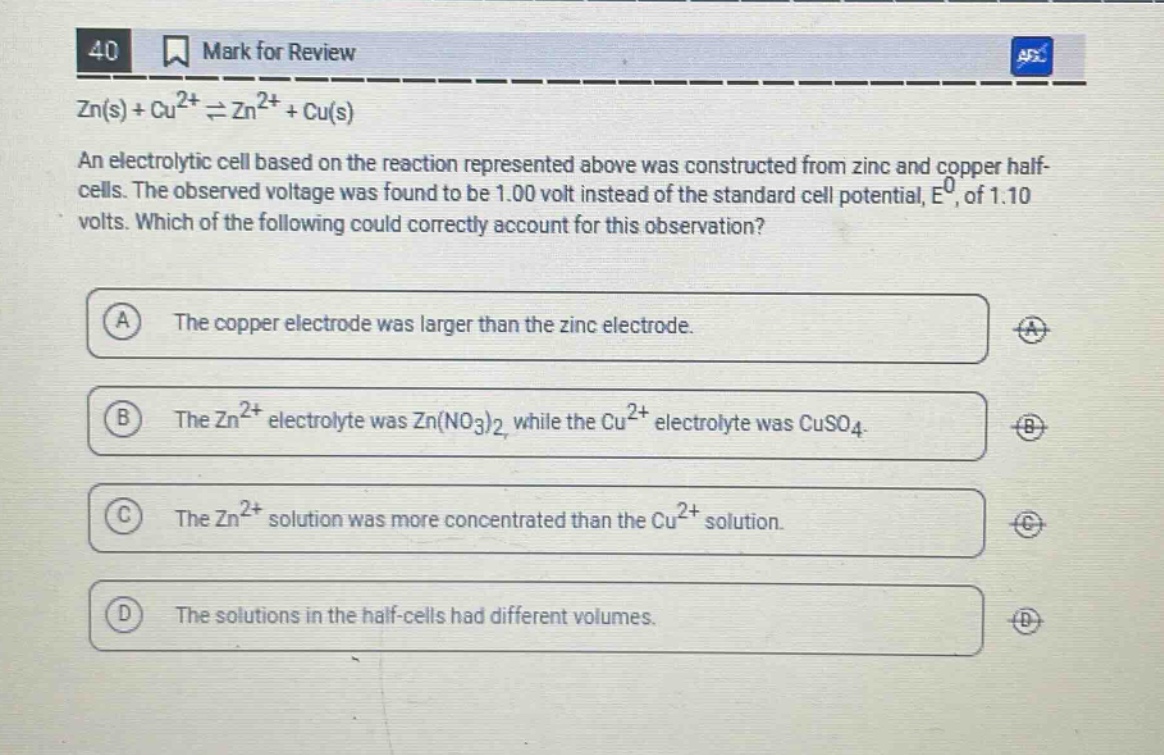
40 mark for review zn(s) + cu²⁺ ⇌ zn²⁺ + cu(s) an electrolytic cell based on the reaction represented above was constructed from zinc and copper half - cells. the observed voltage was found to be 1.00 volt instead of the standard cell potential, e⁰, of 1.10 volts. which of the following could correctly account for this observation? a the copper electrode was larger than the zinc electrode. b the zn²⁺ electrolyte was zn(no₃)₂ while the cu²⁺ electrolyte was cuso₄. c the zn²⁺ solution was more concentrated than the cu²⁺ solution. d the solutions in the half - cells had different volumes.
Answer
Explanation:
Step1: Recall Nernst equation
The Nernst equation for a cell reaction is $E = E^0-\frac{RT}{nF}\ln Q$, where $E$ is the cell - potential, $E^0$ is the standard cell - potential, $Q$ is the reaction quotient. For the reaction $Zn(s)+Cu^{2 + }\rightleftharpoons Zn^{2 + }+Cu(s)$, $Q=\frac{[Zn^{2 + }]}{[Cu^{2 + }]}$.
Step2: Analyze the effect of concentration on cell - potential
When $[Zn^{2 + }]>[Cu^{2 + }]$, $\ln Q>0$. Then $E = E^0-\frac{RT}{nF}\ln Q$. Since $\frac{RT}{nF}\ln Q>0$, $E < E^0$.
Step3: Analyze each option
- Option A: The size of the electrodes does not affect the cell - potential.
- Option B: The identity of the anions in the electrolytes ($NO_3^-$ and $SO_4^{2 - }$) does not affect the cell - potential as long as they do not participate in the redox reaction.
- Option C: If the $Zn^{2 + }$ solution is more concentrated than the $Cu^{2 + }$ solution, $Q=\frac{[Zn^{2 + }]}{[Cu^{2 + }]}>1$, and according to the Nernst equation, $E < E^0$, which can account for the observed lower cell - potential.
- Option D: The volume of the solutions in the half - cells does not affect the cell - potential as long as the concentrations remain the same.
Answer:
C. The $Zn^{2+}$ solution was more concentrated than the $Cu^{2+}$ solution.