51. explain the difference between a temporary dipole and a permanent dipole.\n52. why are dispersion forces…
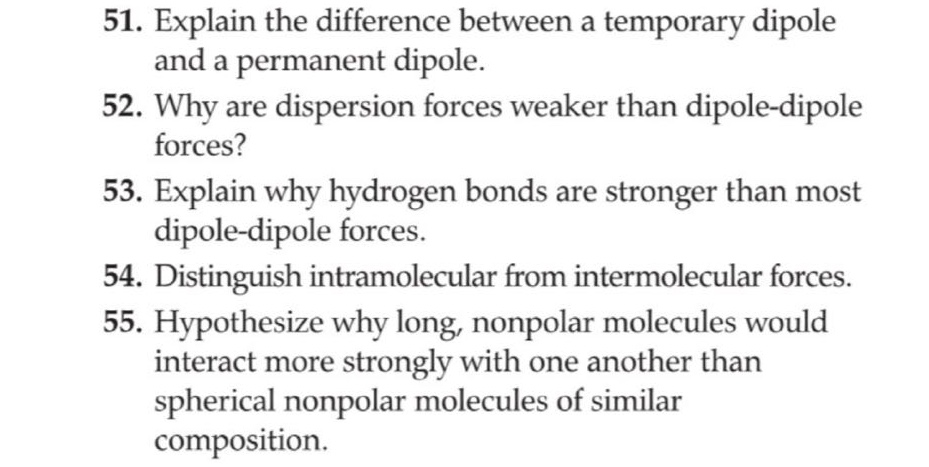
51. explain the difference between a temporary dipole and a permanent dipole.\n52. why are dispersion forces weaker than dipole - dipole forces?\n53. explain why hydrogen bonds are stronger than most dipole - dipole forces.\n54. distinguish intramolecular from intermolecular forces.\n55. hypothesize why long, nonpolar molecules would interact more strongly with one another than spherical nonpolar molecules of similar composition.
Answer
Brief Explanations:
51.
A temporary dipole occurs due to momentary electron - cloud distortion in non - polar molecules. A permanent dipole exists in polar molecules because of unequal electronegativity between atoms, creating a permanent charge separation.
52.
Dispersion forces are due to temporary dipoles. Dipole - dipole forces are between permanent dipoles. Permanent dipoles have a more stable and stronger charge separation, making dipole - dipole forces stronger.
53.
Hydrogen bonds involve a highly electronegative atom (N, O, F) bonded to hydrogen. The large electronegativity difference creates a very strong dipole. Also, the small size of hydrogen allows for closer approach, enhancing the force strength compared to most dipole - dipole forces.
54.
Intramolecular forces are the strong bonds (covalent, ionic) that hold atoms together within a molecule. Intermolecular forces are the weaker attractions between different molecules.
55.
Long non - polar molecules have a larger surface area for contact between molecules. More surface area means more opportunities for temporary dipoles to interact, resulting in stronger dispersion forces compared to spherical non - polar molecules of similar composition which have less surface area for interaction.
Answer:
- Temporary dipole: due to momentary electron - cloud distortion in non - polar molecules; Permanent dipole: exists in polar molecules from unequal electronegativity.
- Dispersion from temporary dipoles, dipole - dipole from permanent dipoles; permanent dipoles have stronger charge separation.
- Large electronegativity difference and small hydrogen size in hydrogen bonds create stronger dipoles and closer approach.
- Intramolecular: bonds within a molecule; Intermolecular: attractions between molecules.
- Long non - polar molecules have larger surface area for more temporary dipole interactions.