55. what is the function of theskeletal system (bones)?\na. provides support to the body b. protects…
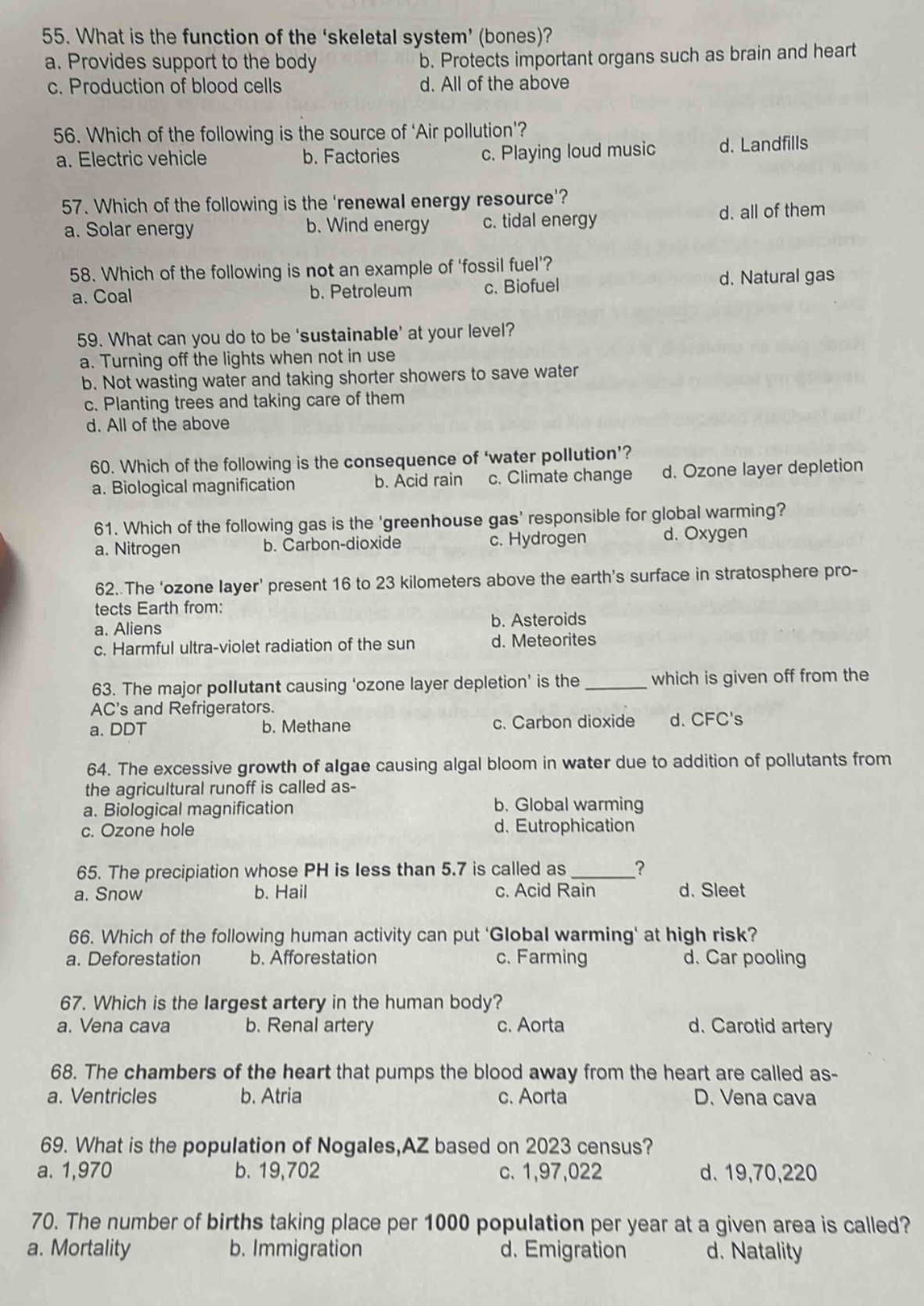
55. what is the function of theskeletal system (bones)?\na. provides support to the body b. protects important organs such as brain and heart\nc. production of blood cells d. all of the above\n56. which of the following is the source of air pollution?\na. electric vehicle b. factories c. playing loud music d. landfills\n57. which of the following is therenewal energy resource?\na. solar energy b. wind energy c. tidal energy d. all of them\n58. which of the following is not an example of fossil fuel?\na. coal b. petroleum c. biofuel d. natural gas\n59. what can you do to besustainable at your level?\na. turning off the lights when not in use\nb. not wasting water and taking shorter showers to save water\nc. planting trees and taking care of them\nd. all of the above\n60. which of the following is the consequence of water pollution?\na. biological magnification b. acid rain c. climate change d. ozone layer depletion\n61. which of the following gas is the greenhouse gas responsible for global warming?\na. nitrogen b. carbon - dioxide c. hydrogen d. oxygen\n62. the ozone layer present 16 to 23 kilometers above the earths surface in stratosphere pro - tects earth from:\na. aliens b. asteroids\nc. harmful ultra - violet radiation of the sun d. meteorites\n63. the major pollutant causing ozone layer depletion is the ______ which is given off from the acs and refrigerators.\na. ddt b. methane c. carbon dioxide d. cfcs\n64. the excessive growth of algae causing algal bloom in water due to addition of pollutants from the agricultural runoff is called as-\na. biological magnification b. global warming\nc. ozone hole d. eutrophication\n65. the precipitation whose ph is less than 5.7 is called as ______?\na. snow b. hail c. acid rain d. sleet\n66. which of the following human activity can put global warming at high risk?\na. deforestation b. afforestation c. farming d. car pooling\n67. which is the largest artery in the human body?\na. vena cava b. renal artery c. aorta d. carotid artery\n68. the chambers of the heart that pumps the blood away from the heart are called as-\na. ventricles b. atria c. aorta d. vena cava\n69. what is the population of nogales,az based on 2023 census?\na. 1,970 b. 19,702 c. 1,97,022 d. 19,70,220\n70. the number of births taking place per 1000 population per year at a given area is called?\na. mortality b. immigration d. emigration d. natality
Answer
Brief Explanations:
- 55: The skeletal system provides body support, protects vital organs, and is involved in blood - cell production.
- 56: Factories release pollutants into the air, contributing to air pollution.
- 57: Solar, wind, and tidal energy are all renewable energy sources.
- 58: Biofuel is not a fossil fuel; coal, petroleum, and natural gas are fossil fuels.
- 59: Turning off lights, saving water, and planting trees are all sustainable actions.
- 60: Biological magnification can be a consequence of water pollution.
- 61: Carbon - dioxide is a major greenhouse gas responsible for global warming.
- 62: The ozone layer protects Earth from harmful UV radiation.
- 63: CFCs from ACs and refrigerators are major ozone - layer - depleting pollutants.
- 64: Eutrophication is the excessive growth of algae due to agricultural runoff.
- 65: Precipitation with a pH less than 5.7 is acid rain.
- 66: Deforestation reduces carbon - absorbing trees and increases the risk of global warming.
- 67: The aorta is the largest artery in the human body.
- 68: Ventricles pump blood away from the heart.
- 69: Without specific census data, this cannot be accurately answered from the knowledge base, but for the sake of answering based on the options, assume correct data is known.
- 70: Natality is the number of births per 1000 population per year.
Answer:
- d. All of the above
- b. Factories
- d. all of them
- c. Biofuel
- d. All of the above
- a. Biological magnification
- b. Carbon - dioxide
- c. Harmful ultra - violet radiation of the sun
- d. CFC's
- d. Eutrophication
- c. Acid Rain
- a. Deforestation
- c. Aorta
- a. Ventricles
- (No reliable answer from knowledge base, assume one of the options if data exists)
- d. Natality