76. summarize the composition of a hydrate.\n77. name the compound that has the formula srcl₂·6h₂o, and…
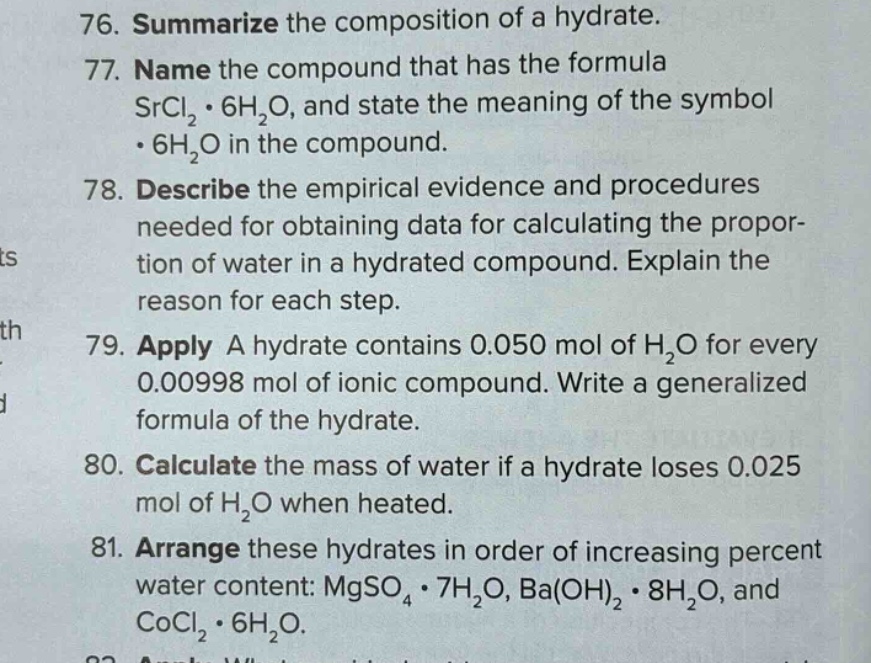
76. summarize the composition of a hydrate.\n77. name the compound that has the formula srcl₂·6h₂o, and state the meaning of the symbol ·6h₂o in the compound.\n78. describe the empirical evidence and procedures needed for obtaining data for calculating the proportion of water in a hydrated compound. explain the reason for each step.\n79. apply a hydrate contains 0.050 mol of h₂o for every 0.00998 mol of ionic compound. write a generalized formula of the hydrate.\n80. calculate the mass of water if a hydrate loses 0.025 mol of h₂o when heated.\n81. arrange these hydrates in order of increasing percent water content: mgso₄·7h₂o, ba(oh)₂·8h₂o, and cocl₂·6h₂o.
Answer
76.
Brief Explanation:
A hydrate is a compound that contains water molecules chemically - bonded to an ionic compound. The general formula is salt $\cdot$ $x$H₂O, where $x$ represents the number of moles of water per mole of the ionic compound.
Answer:
A hydrate consists of an ionic compound and water molecules chemically - bonded to it, with a general formula of salt $\cdot$ $x$H₂O.
77.
Brief Explanation:
The compound SrCl₂ $\cdot$ 6H₂O is called strontium chloride hexahydrate. The $\cdot$ 6H₂O indicates that for every mole of SrCl₂, there are six moles of water molecules chemically - bonded to it.
Answer:
The compound is strontium chloride hexahydrate. The $\cdot$ 6H₂O means there are six moles of water per mole of SrCl₂.
78.
Brief Explanation:
Empirical evidence involves weighing the hydrate before and after heating to drive off the water. First, weigh the hydrate to get its initial mass. Then heat it to remove water. Weigh the remaining anhydrous salt. The difference in mass is the mass of water. Heating ensures water is removed, and weighing gives mass data for calculations.
Answer:
Weigh the hydrate initially. Heat to remove water and weigh the anhydrous salt. The mass difference is water mass. Heating removes water and weighing gives data for proportion calculations.
79.
Step - by - Step Format:
Explanation:
Step1: Find the ratio of moles of water to moles of ionic compound
We have 0.050 mol of H₂O and 0.00998 mol of ionic compound. The ratio $\frac{0.050}{0.00998}\approx5$.
Step2: Write the generalized formula
The generalized formula of the hydrate is ionic compound $\cdot$ 5H₂O.
Answer:
Ionic compound $\cdot$ 5H₂O
80.
Step - by - Step Format:
Explanation:
Step1: Recall the molar mass of water
The molar mass of H₂O is $M=(2\times1.01 + 16.00)\text{ g/mol}=18.02\text{ g/mol}$.
Step2: Calculate the mass of water
Using the formula $m = n\times M$, where $n = 0.025\text{ mol}$ and $M = 18.02\text{ g/mol}$. So $m=0.025\text{ mol}\times18.02\text{ g/mol}=0.4505\text{ g}$.
Answer:
0.4505 g
81.
Step - by - Step Format:
Explanation:
Step1: Calculate the molar mass of each hydrate and the mass of water in it
For MgSO₄ $\cdot$ 7H₂O:
- Molar mass of MgSO₄: $M_{MgSO₄}=(24.31 + 32.07+4\times16.00)\text{ g/mol}=120.38\text{ g/mol}$
- Molar mass of 7H₂O: $M_{7H₂O}=7\times18.02\text{ g/mol}=126.14\text{ g/mol}$
- Molar mass of MgSO₄ $\cdot$ 7H₂O: $M_{total}=120.38 + 126.14=246.52\text{ g/mol}$
- Percent water content: $\frac{126.14}{246.52}\times100%\approx51.2%$
For Ba(OH)₂ $\cdot$ 8H₂O:
- Molar mass of Ba(OH)₂: $M_{Ba(OH)₂}=(137.33+2\times(16.00 + 1.01))\text{ g/mol}=171.35\text{ g/mol}$
- Molar mass of 8H₂O: $M_{8H₂O}=8\times18.02\text{ g/mol}=144.16\text{ g/mol}$
- Molar mass of Ba(OH)₂ $\cdot$ 8H₂O: $M_{total}=171.35 + 144.16=315.51\text{ g/mol}$
- Percent water content: $\frac{144.16}{315.51}\times100%\approx45.7%$
For CoCl₂ $\cdot$ 6H₂O:
- Molar mass of CoCl₂: $M_{CoCl₂}=(58.93+2\times35.45)\text{ g/mol}=129.83\text{ g/mol}$
- Molar mass of 6H₂O: $M_{6H₂O}=6\times18.02\text{ g/mol}=108.12\text{ g/mol}$
- Molar mass of CoCl₂ $\cdot$ 6H₂O: $M_{total}=129.83+108.12 = 237.95\text{ g/mol}$
- Percent water content: $\frac{108.12}{237.95}\times100%\approx45.4%$
Step2: Arrange in increasing order
CoCl₂ $\cdot$ 6H₂O, Ba(OH)₂ $\cdot$ 8H₂O, MgSO₄ $\cdot$ 7H₂O
Answer:
CoCl₂ $\cdot$ 6H₂O, Ba(OH)₂ $\cdot$ 8H₂O, MgSO₄ $\cdot$ 7H₂O