which is the most accurate statement about the heating curve and energy?\na moving from a to c the…
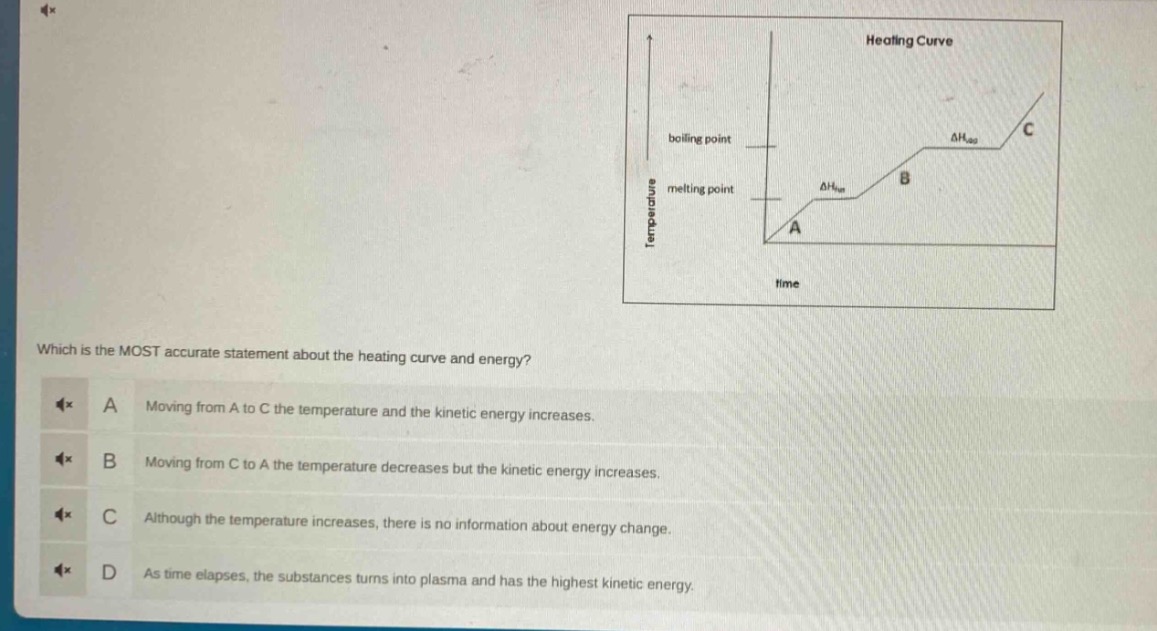
which is the most accurate statement about the heating curve and energy?\na moving from a to c the temperature and the kinetic energy increases.\nb moving from c to a the temperature decreases but the kinetic energy increases.\nc although the temperature increases, there is no information about energy change.\nd as time elapses, the substances turns into plasma and has the highest kinetic energy.
Answer
Brief Explanations:
- Option A:
- Temperature is a measure of the average kinetic energy of particles.
- As we move from (A) to (C) on the heating curve, the temperature is increasing (except for the phase - change plateaus, but overall trend). So, the average kinetic energy of the particles also increases.
- Option B:
- When moving from (C) to (A) (cooling), the temperature decreases. Since temperature is related to average kinetic energy ((KE_{avg}=\frac{3}{2}kT), where (k) is the Boltzmann constant and (T) is temperature), the kinetic energy decreases, not increases.
- Option C:
- A heating curve shows the relationship between temperature (related to kinetic energy) and heat (energy) input. As heat is added (time elapses), there is energy change.
- Option D:
- The heating curve shown does not indicate a phase - change to plasma. It shows melting ((\Delta H_{fus})) and boiling ((\Delta H_{vap})) phase - changes.
Answer:
A. Moving from A to C the temperature and the kinetic energy increases.