9) an acid commonly used in the automotive industry is shown to be 31.6% phosphorous, 3.1% hydrogen, and…
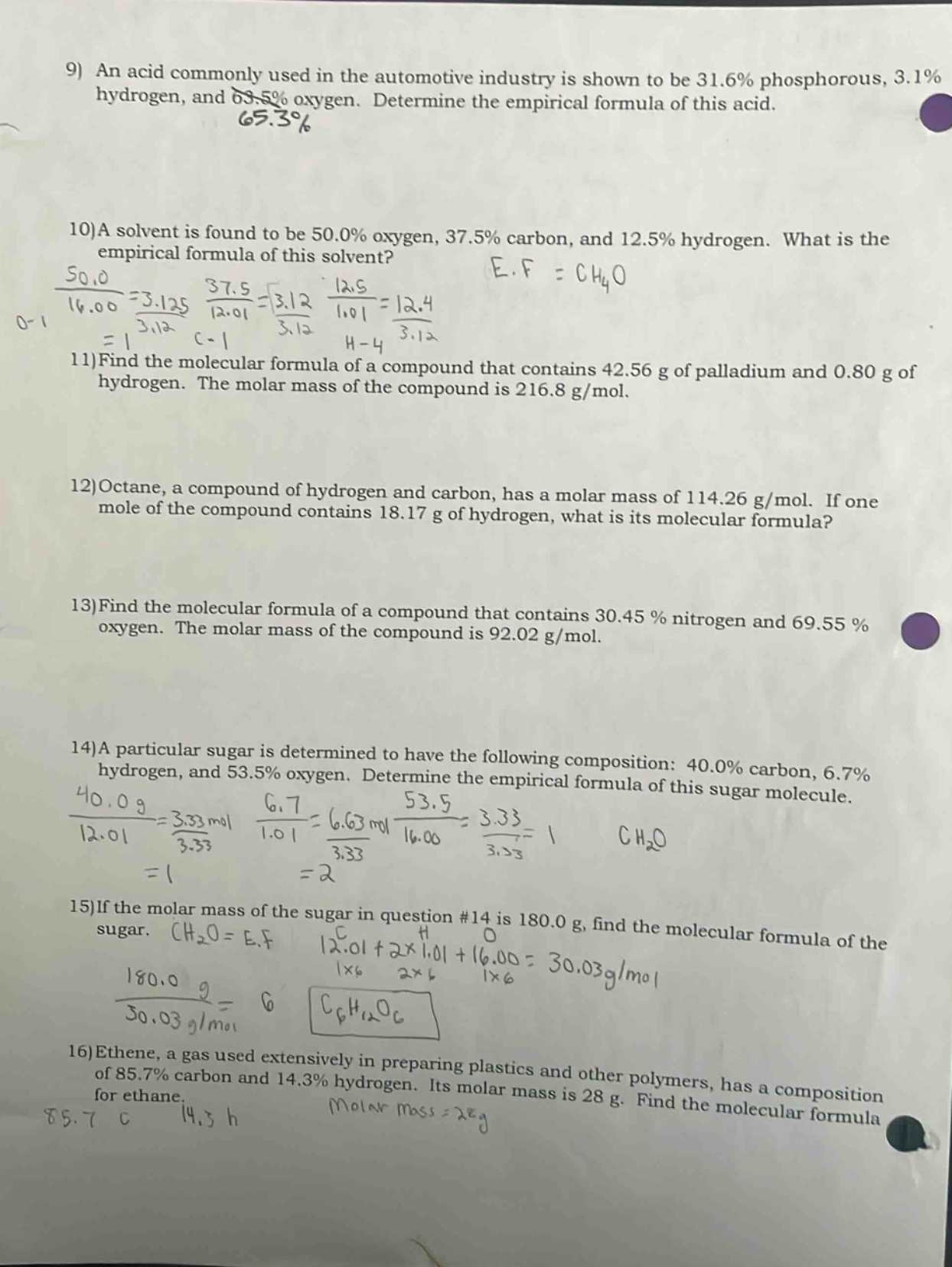
9) an acid commonly used in the automotive industry is shown to be 31.6% phosphorous, 3.1% hydrogen, and 65.3% oxygen. determine the empirical formula of this acid.\n10)a solvent is found to be 50.0% oxygen, 37.5% carbon, and 12.5% hydrogen. what is the empirical formula of this solvent?\n11)find the molecular formula of a compound that contains 42.56 g of palladium and 0.80 g of hydrogen. the molar mass of the compound is 216.8 g/mol.\n12)octane, a compound of hydrogen and carbon, has a molar mass of 114.26 g/mol. if one mole of the compound contains 18.17 g of hydrogen, what is its molecular formula?\n13)find the molecular formula of a compound that contains 30.45% nitrogen and 69.55% oxygen. the molar mass of the compound is 92.02 g/mol.\n14)a particular sugar is determined to have the following composition: 40.0% carbon, 6.7% hydrogen, and 53.5% oxygen. determine the empirical formula of this sugar molecule.\n15)if the molar mass of the sugar in question #14 is 180.0 g, find the molecular formula of the sugar.\n16)ethene, a gas used extensively in preparing plastics and other polymers, has a composition of 85.7% carbon and 14.3% hydrogen. its molar mass is 28 g. find the molecular formula for ethane.
Answer
Explanation:
Step1: Assume 100g of the compound
Assume we have 100g of the acid. Then, we have 31.6g of phosphorus ((P)), 3.1g of hydrogen ((H)), and (100 - 31.6-3.1=65.3)g of oxygen ((O)).
Step2: Calculate the number of moles of each element
- Moles of (P): (n_{P}=\frac{31.6\mathrm{g}}{30.97\mathrm{g/mol}}\approx1.02\mathrm{mol})
- Moles of (H): (n_{H}=\frac{3.1\mathrm{g}}{1.01\mathrm{g/mol}}\approx3.07\mathrm{mol})
- Moles of (O): (n_{O}=\frac{65.3\mathrm{g}}{16.00\mathrm{g/mol}}\approx4.08\mathrm{mol})
Step3: Divide by the smallest number of moles
The smallest number of moles is approximately (1.02).
- For (P): (\frac{1.02}{1.02} = 1)
- For (H): (\frac{3.07}{1.02}\approx3)
- For (O): (\frac{4.08}{1.02} = 4)
Answer:
The empirical formula is (H_{3}PO_{4})