an acid (x) reacts with a base (y) to produce mg₃(po₄)₂. what are x and y?\no x = h₃po₃; y = mg(oh)₂\no x =…
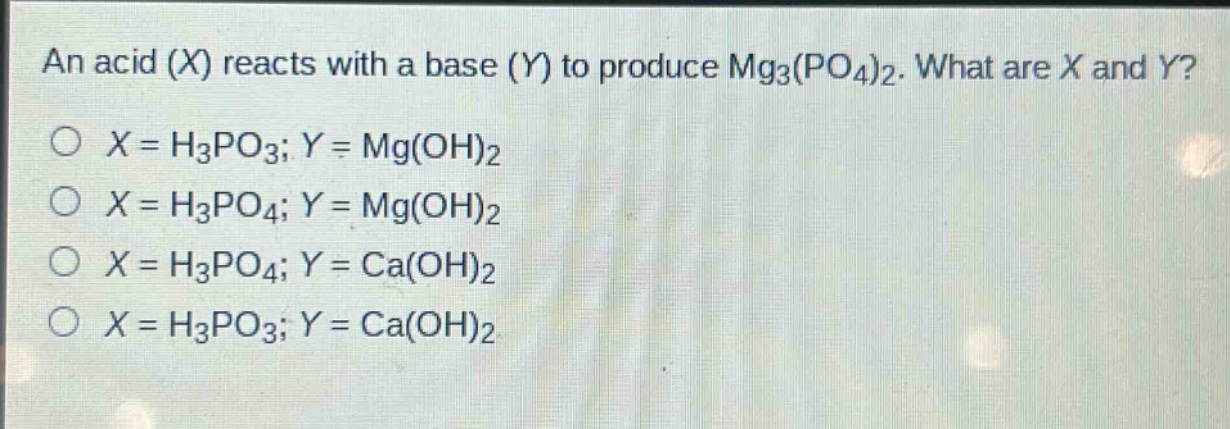
an acid (x) reacts with a base (y) to produce mg₃(po₄)₂. what are x and y?\no x = h₃po₃; y = mg(oh)₂\no x = h₃po₄; y = mg(oh)₂\no x = h₃po₄; y = ca(oh)₂\no x = h₃po₃; y = ca(oh)₂
Answer
Explanation:
Step1: Analyze product composition
The product is $\ce{Mg3(PO4)2}$, which contains magnesium ($\ce{Mg^{2+}}$) and phosphate ($\ce{PO4^{3-}}$) ions.
Step2: Determine acid and base
The acid should provide the phosphate - containing anion and the base should provide the magnesium cation. Phosphoric acid $\ce{H3PO4}$ can provide $\ce{PO4^{3-}}$ and magnesium hydroxide $\ce{Mg(OH)2}$ can provide $\ce{Mg^{2+}}$.
Answer:
B. $X = \ce{H3PO4}; Y=\ce{Mg(OH)2}$