analysis questions: part 1\n1. what is the function of the salt bridge?\n2. what do electrons flow…
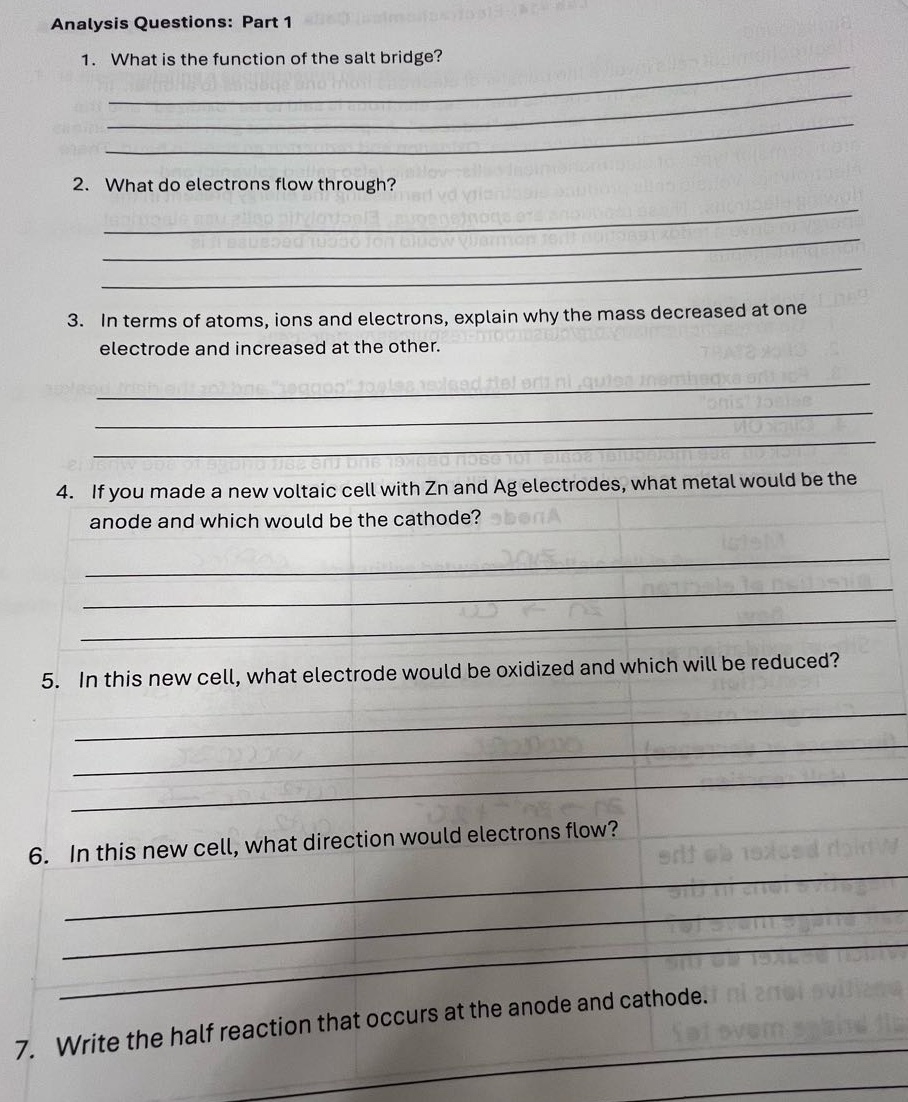
analysis questions: part 1\n1. what is the function of the salt bridge?\n2. what do electrons flow through?\n3. in terms of atoms, ions and electrons, explain why the mass decreased at one electrode and increased at the other.\n4. if you made a new voltaic cell with zn and ag electrodes, what metal would be the anode and which would be the cathode?\n5. in this new cell, what electrode would be oxidized and which will be reduced?\n6. in this new cell, what direction would electrons flow?\n7. write the half - reaction that occurs at the anode and cathode.
Answer
Brief Explanations:
- The salt - bridge maintains electrical neutrality in the half - cells by allowing the flow of ions. It completes the electrical circuit.
- Electrons flow through the external circuit (e.g., a wire connecting the two electrodes).
- At the anode, atoms lose electrons and become ions, dissolving into the solution, so the mass decreases. At the cathode, ions gain electrons and deposit as atoms, increasing the mass.
- Zinc (Zn) has a lower reduction potential than silver (Ag), so Zn is the anode and Ag is the cathode.
- The anode (Zn) is oxidized as it loses electrons, and the cathode (Ag) is reduced as it gains electrons.
- Electrons flow from the anode (Zn) to the cathode (Ag) through the external circuit.
- Anode half - reaction: $Zn(s)\rightarrow Zn^{2 + }(aq)+2e^{-}$; Cathode half - reaction: $Ag^{+}(aq)+e^{-}\rightarrow Ag(s)$
Answer:
- Maintains electrical neutrality and completes the circuit.
- External circuit (wire).
- Anode: atoms become ions and dissolve; Cathode: ions become atoms and deposit.
- Anode: Zn; Cathode: Ag.
- Oxidized: Zn; Reduced: Ag.
- From Zn (anode) to Ag (cathode).
- Anode: $Zn(s)\rightarrow Zn^{2 + }(aq)+2e^{-}$; Cathode: $Ag^{+}(aq)+e^{-}\rightarrow Ag(s)$