which answer below correctly identifies the type of change and the explanation when potassium iodide and…
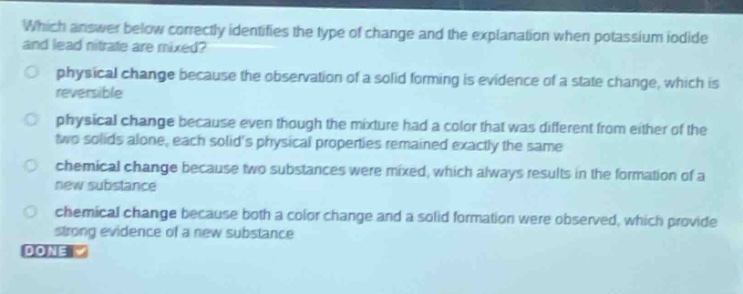
which answer below correctly identifies the type of change and the explanation when potassium iodide and lead nitrate are mixed?\nphysical change because the observation of a solid forming is evidence of a state change, which is reversible\nphysical change because even though the mixture had a color that was different from either of the two solids alone, each solids physical properties remained exactly the same\nchemical change because two substances were mixed, which always results in the formation of a new substance\nchemical change because both a color change and a solid formation were observed, which provide strong evidence of a new substance\ndone
Answer
Brief Explanations:
A chemical change occurs when new substances are formed. Color - change and solid - formation (precipitation) are strong indicators of a chemical reaction. When potassium iodide and lead nitrate are mixed, lead iodide (a yellow - solid precipitate) is formed along with potassium nitrate, indicating a chemical change.
Answer:
chemical change because both a color change and a solid formation were observed, which provide strong evidence of a new substance