when applied to a dish, soap makes grease soluble in water. which explanation correctly supports the role of…
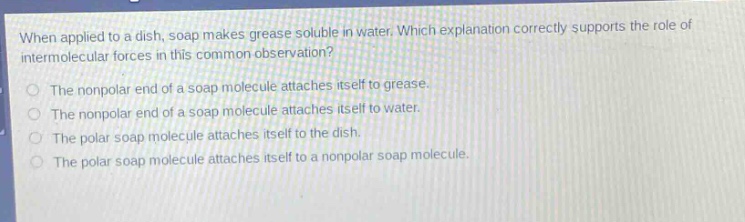
when applied to a dish, soap makes grease soluble in water. which explanation correctly supports the role of intermolecular forces in this common observation?\nthe nonpolar end of a soap molecule attaches itself to grease.\nthe nonpolar end of a soap molecule attaches itself to water.\nthe polar soap molecule attaches itself to the dish.\nthe polar soap molecule attaches itself to a nonpolar soap molecule.
Answer
Brief Explanations:
Soap molecules have a non - polar end (hydrophobic) and a polar end (hydrophilic). Grease is non - polar. According to the principle of "like dissolves like", the non - polar end of the soap molecule (which is hydrophobic) will attach to the non - polar grease. Water is polar, and the polar end of the soap molecule (hydrophilic) will attach to water.
- For the second option: Water is polar, and the non - polar end of the soap molecule does not attach to water.
- For the third option: The statement about the polar soap molecule attaching to the dish is not relevant to the solubility of grease in water.
- For the fourth option: The attachment of a polar soap molecule to a non - polar soap molecule does not explain the solubility of grease in water.
Answer:
The nonpolar end of a soap molecule attaches itself to grease.