approximate rates of speech and information conveyed for five languages\nlanguage rate of speech (syllables…
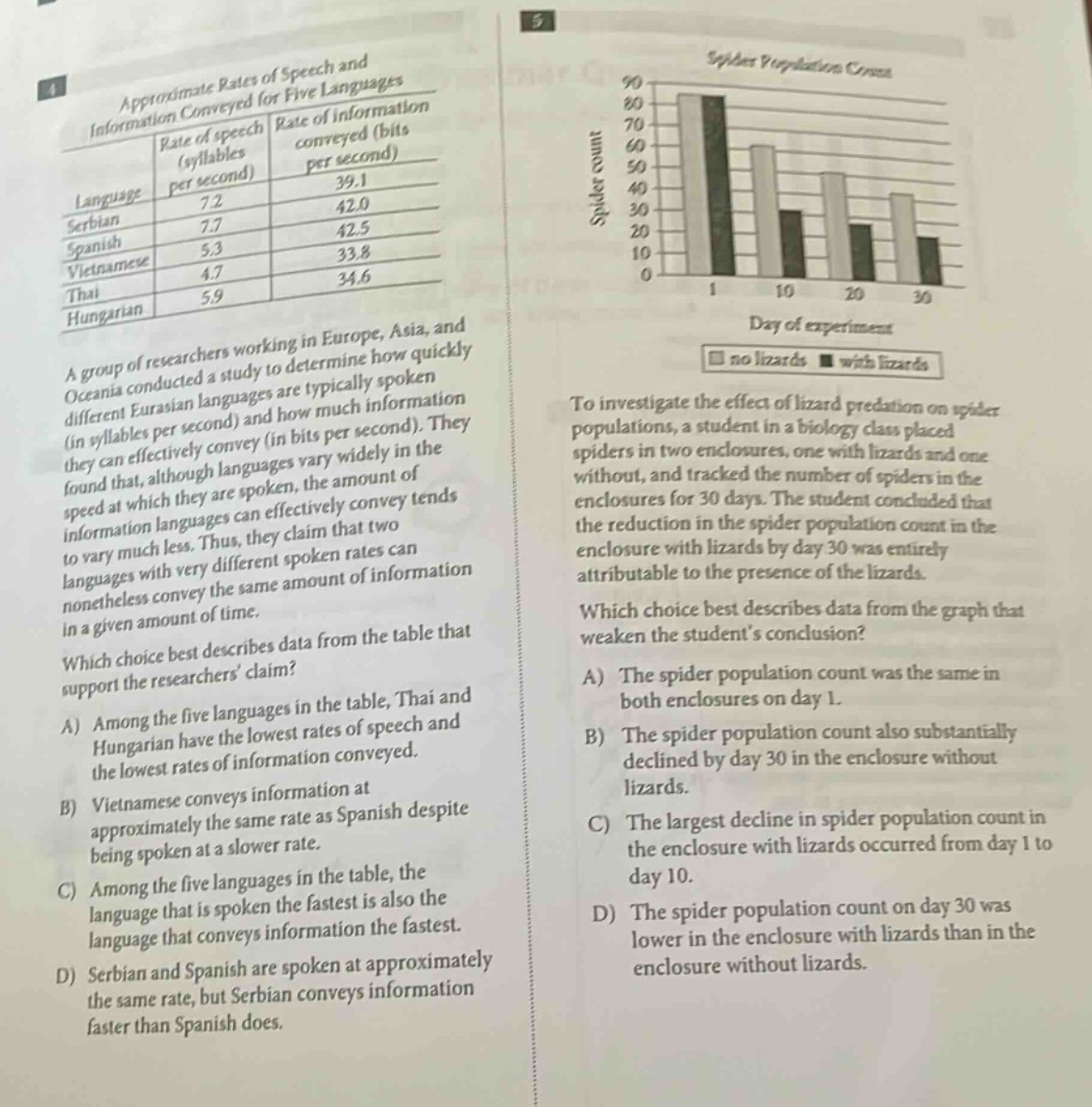
approximate rates of speech and information conveyed for five languages\nlanguage rate of speech (syllables per second) rate of information conveyed (bits per second)\nserbian 7.2 39.1\nspanish 7.7 42.0\nvietnamese 5.3 42.5\nthai 4.7 33.8\nhungarian 5.9 34.6\na group of researchers working in europe, asia, and oceania conducted a study to determine how quickly different eurasian languages are typically spoken (in syllables per second) and how much information they can effectively convey (in bits per second). they found that, although languages vary widely in the speed at which they are spoken, the amount of information languages can effectively convey tends to vary much less. thus, they claim that two languages with very different spoken rates can nonetheless convey the same amount of information in a given amount of time.\nwhich choice best describes data from the table that support the researchers claim?\na) among the five languages in the table, thai and hungarian have the lowest rates of speech and the lowest rates of information conveyed.\nb) vietnamese conveys information at approximately the same rate as spanish despite being spoken at a slower rate.\nc) among the five languages in the table, the language that is spoken the fastest is also the language that conveys information the fastest.\nd) serbian and spanish are spoken at approximately the same rate, but serbian conveys information faster than spanish does.\nspider population counts\nday of experiment\nto investigate the effect of lizard predation on spider populations, a student in a biology class placed spiders in two enclosures, one with lizards and one without, and tracked the number of spiders in the enclosures for 30 days. the student concluded that the reduction in the spider population count in the enclosure with lizards by day 30 was entirely attributable to the presence of the lizards.\nwhich choice best describes data from the graph that weaken the students conclusion?\na) the spider population count was the same in both enclosures on day 1.\nb) the spider population count also substantially declined by day 30 in the enclosure without lizards.\nc) the largest decline in spider population count in the enclosure with lizards occurred from day 1 to day 10.\nd) the spider population count on day 30 was lower in the enclosure with lizards than in the enclosure without lizards.
Answer
4.
Brief Explanations:
The researchers claim that different - spoken - rate languages can convey the same amount of information. Option B shows that Vietnamese (spoken slower) conveys information at approximately the same rate as Spanish, which supports this claim.
Answer:
B. Vietnamese conveys information at approximately the same rate as Spanish despite being spoken at a slower rate.
5.
Brief Explanations:
The student concludes that the reduction in spider population in the lizard - enclosure is due to lizards. Option B shows that the spider population also declined in the non - lizard enclosure, weakening the claim that the decline in the lizard enclosure is solely due to lizards.
Answer:
B. The spider population count also substantially declined by day 30 in the enclosure without lizards.