an atom that has 84 protons and 86 neutrons undergoes a reaction. at the end of the reaction, it has 82…
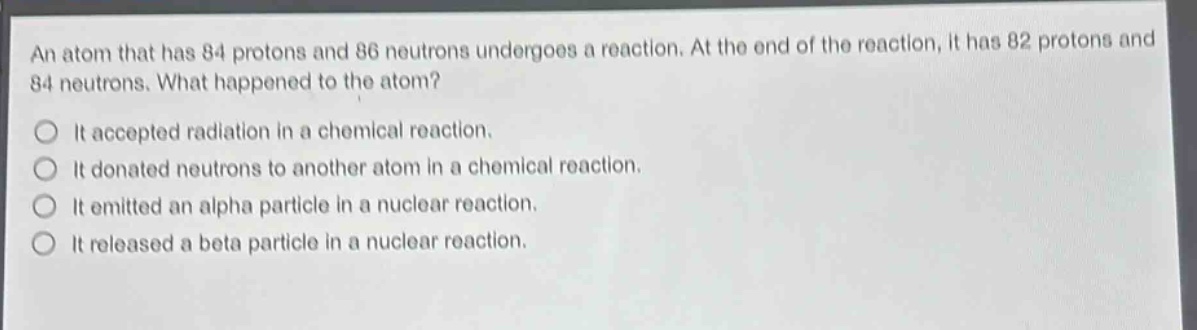
an atom that has 84 protons and 86 neutrons undergoes a reaction. at the end of the reaction, it has 82 protons and 84 neutrons. what happened to the atom?\nit accepted radiation in a chemical reaction.\nit donated neutrons to another atom in a chemical reaction.\nit emitted an alpha particle in a nuclear reaction.\nit released a beta particle in a nuclear reaction.
Answer
Brief Explanations:
An alpha - particle is a helium nucleus with 2 protons and 2 neutrons. Initially, the atom has 84 protons and 86 neutrons. After the reaction, it has 82 protons and 84 neutrons. The loss of 2 protons and 2 neutrons indicates emission of an alpha - particle in a nuclear reaction. Chemical reactions don't change the number of protons and neutrons in the nucleus. Releasing a beta - particle changes a neutron to a proton (or vice - versa) but doesn't result in loss of 2 protons and 2 neutrons simultaneously.
Answer:
It emitted an alpha particle in a nuclear reaction.