when an atom that has no charge loses two electrons, it becomes a\npositive ion.\nnegative ion.\npositive…
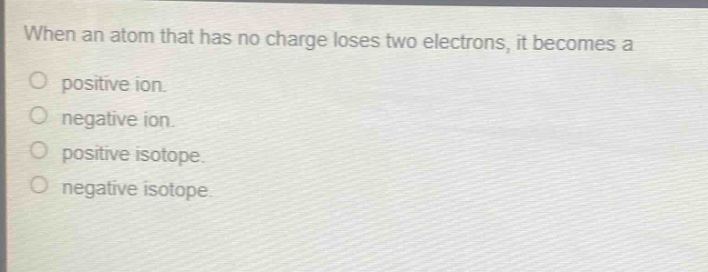
when an atom that has no charge loses two electrons, it becomes a\npositive ion.\nnegative ion.\npositive isotope.\nnegative isotope.
Answer
Brief Explanations:
Electrons are negatively - charged particles. When a neutral atom loses electrons, the number of protons (positively - charged) exceeds the number of electrons. So, it becomes a positively - charged ion. Isotopes are atoms of the same element with different numbers of neutrons, not related to electron loss.
Answer:
A. positive ion