which atom is most likely to accept electrons to form an ionic bond?\no a mercury ion with a negative 2…
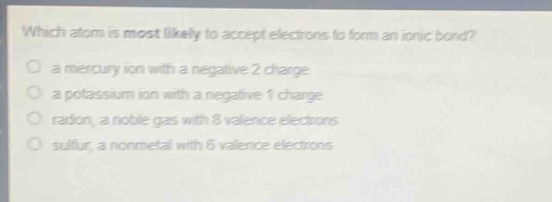
which atom is most likely to accept electrons to form an ionic bond?\no a mercury ion with a negative 2 charge\no a potassium ion with a negative 1 charge\no radon, a noble gas with 8 valence electrons\no sulfur, a nonmetal with 6 valence electrons
Answer
Answer:
D. sulfur, a nonmetal with 6 valence electrons
Explanation:
Step1: Analyze mercury ion
A mercury ion with a - 2 charge already has an excess of electrons and is not likely to accept more.
Step2: Analyze potassium ion
A potassium ion with a - 1 charge is not typical (potassium usually forms + 1 ions) and having a negative charge means it is not likely to accept more electrons.
Step3: Analyze radon
Radon is a noble gas with a full - outer shell (8 valence electrons). Noble gases are very stable and do not readily accept or lose electrons to form bonds.
Step4: Analyze sulfur
Sulfur is a non - metal with 6 valence electrons. It needs 2 more electrons to achieve a stable octet configuration (like noble gases). So it is most likely to accept electrons to form an ionic bond.