which atom is most likely to accept electrons to form an ionic bond? a mercury ion with a negative 2 charge…
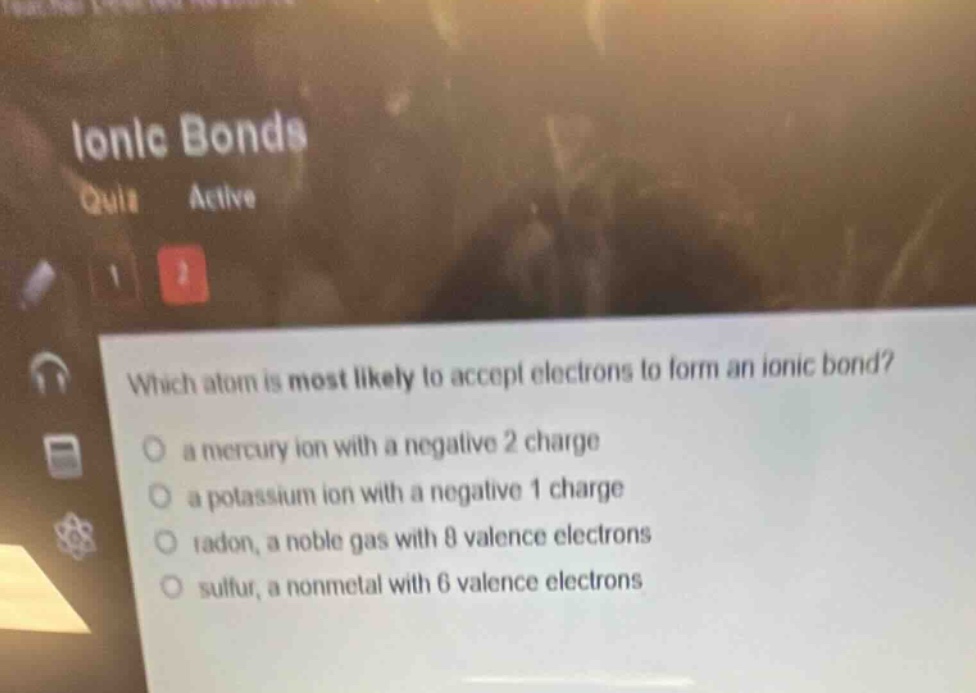
which atom is most likely to accept electrons to form an ionic bond? a mercury ion with a negative 2 charge a potassium ion with a negative 1 charge radon, a noble gas with 8 valence electrons sulfur, a nonmetal with 6 valence electrons
Answer
Explanation:
Step1: Understand ionic - bond formation
Atoms form ionic bonds by gaining or losing electrons to achieve a stable electron - configuration (usually a noble - gas configuration). Nonmetals tend to gain electrons and metals tend to lose electrons.
Step2: Analyze each option
- A mercury ion with a negative 2 charge already has an excess of electrons and is not likely to accept more.
- A potassium ion with a negative 1 charge is an unusual species. Potassium is a metal and typically forms positive ions by losing electrons, not negative ions. And a negatively - charged potassium ion is not likely to accept more electrons.
- Radon is a noble gas with 8 valence electrons. Noble gases have a stable electron configuration and are very reluctant to gain or lose electrons.
- Sulfur is a nonmetal with 6 valence electrons. It needs 2 more electrons to achieve a stable noble - gas configuration (8 valence electrons like argon). So, it is likely to accept electrons to form an ionic bond.
Answer:
sulfur, a nonmetal with 6 valence electrons