the atomic symbol $_{19}^{40}k$ represents potassium - 40 (k - 40), a radioactive isotope that has 19…
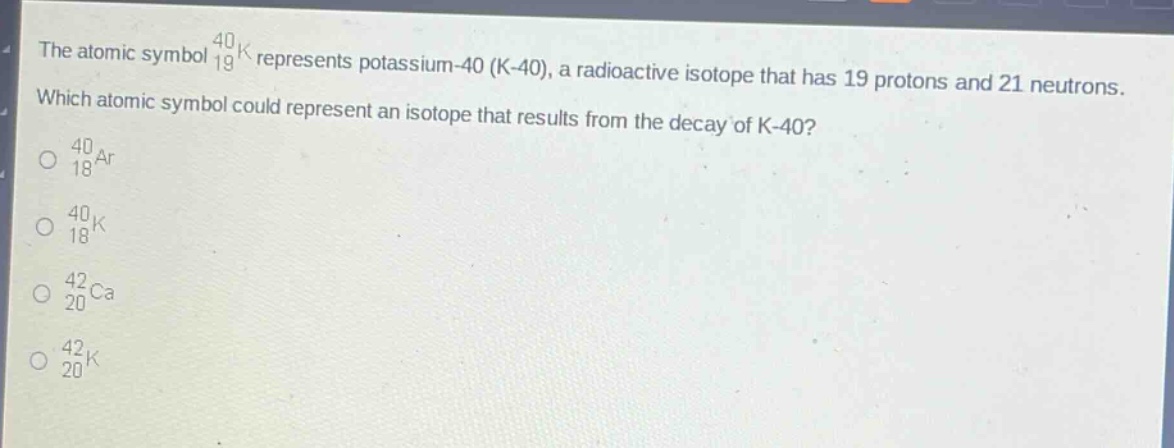
the atomic symbol $_{19}^{40}k$ represents potassium - 40 (k - 40), a radioactive isotope that has 19 protons and 21 neutrons. which atomic symbol could represent an isotope that results from the decay of k - 40?\n$_{18}^{40}ar$\n$_{18}^{40}k$\n$_{20}^{42}ca$\n$_{20}^{42}k$
Answer
Explanation:
Step1: Understand beta - decay of K - 40
Potassium - 40 ($^{40}_{19}K$) undergoes beta - decay. In beta - decay, a neutron in the nucleus is converted into a proton, an electron, and an antineutrino.
Step2: Analyze the change in atomic and mass numbers
The mass number (A) remains the same in beta - decay because a neutron is converted into a proton, and the sum of protons and neutrons (A) is unchanged. The atomic number (Z) increases by 1 since a neutron turns into a proton. For $^{40}_{19}K$, after beta - decay, the atomic number becomes 19 + 1=20, and the mass number remains 40.
Step3: Identify the element
The element with atomic number 20 is calcium (Ca). So the resulting isotope is $^{40}{20}Ca$. But this is not in the options. Another common decay of K - 40 is electron capture. In electron capture, a proton in the nucleus combines with an inner - shell electron to form a neutron and a neutrino. The mass number remains the same and the atomic number decreases by 1. So the new atomic number is 19 - 1 = 18, and the mass number is 40. The element with atomic number 18 is argon (Ar), and the isotope is $^{40}{18}Ar$.
Answer:
$^{40}_{18}Ar$